Body Shape Guide
Apple Body Shape
Bust and hips close in size, but the waist doesn't taper much between them — fullness sits through the midsection. Roughly 14% of women measure this way. Here's the exact formula, what it means for health, and how to dress for it.
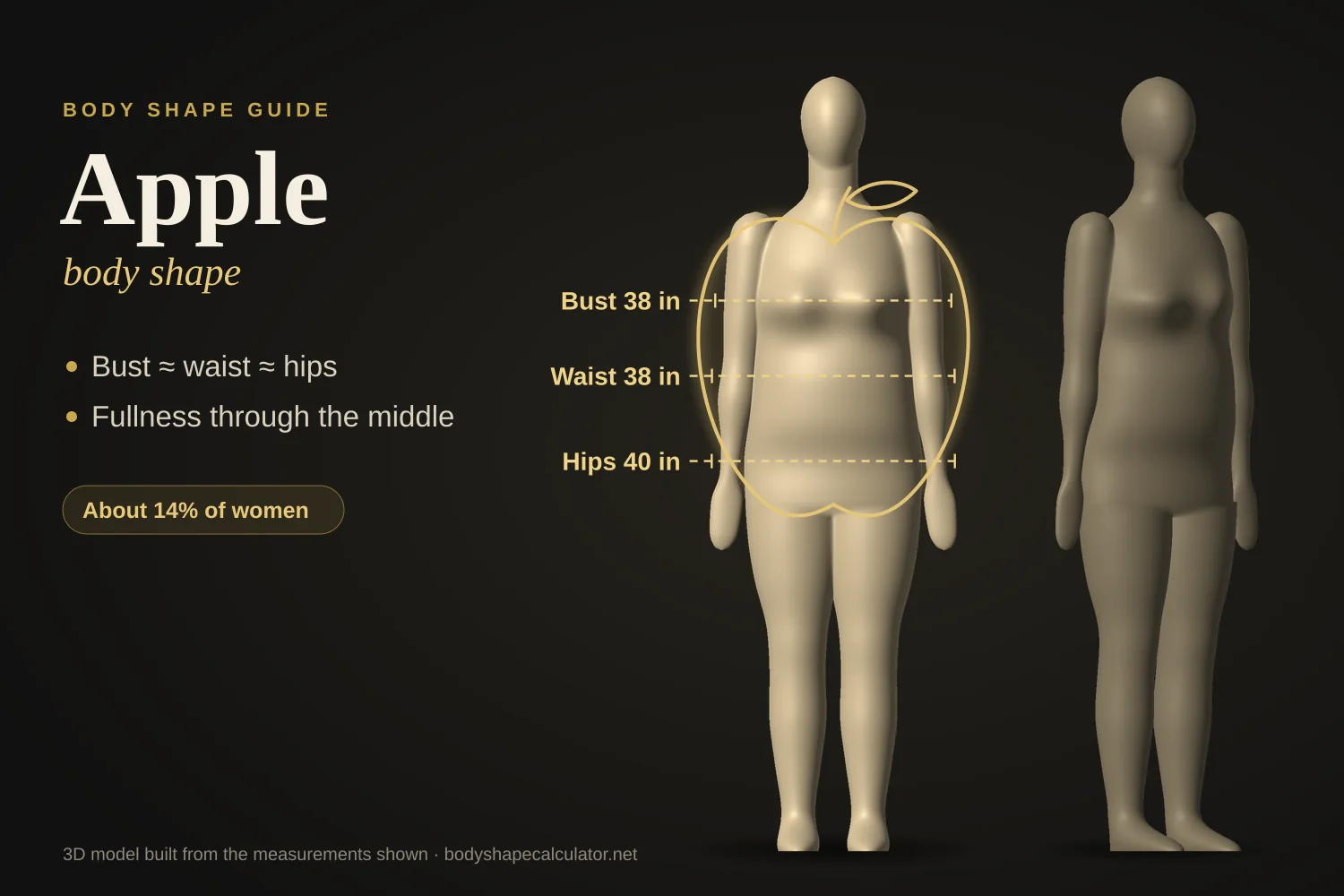
What Is an Apple Body Shape?
An apple body shape has a bust and hips that are roughly the same width, with a waist that stays close to those measurements rather than tapering inward. The fullness that would normally sit at the hips or bust in other shapes shows up around the midsection instead — belly, ribs and sometimes the upper back. Haven't measured yet? Our full body type calculator will confirm which of the seven shapes actually fits your numbers.
The formula: bust and hips need to be within 3.6 inches of each other, and your waist needs to sit within 2 inches of — or larger than — either the bust or the hips. That second part is what separates apple from rectangle. Both shapes have balanced bust and hips; the difference is entirely in how much waist definition is left.
Quick check: bust and hips within 3.6 inches of each other, waist within 2 inches of (or bigger than) both of them. If your waist is clearly smaller than either one — by more than 2 inches, just not by a dramatic amount — you're more likely a rectangle.
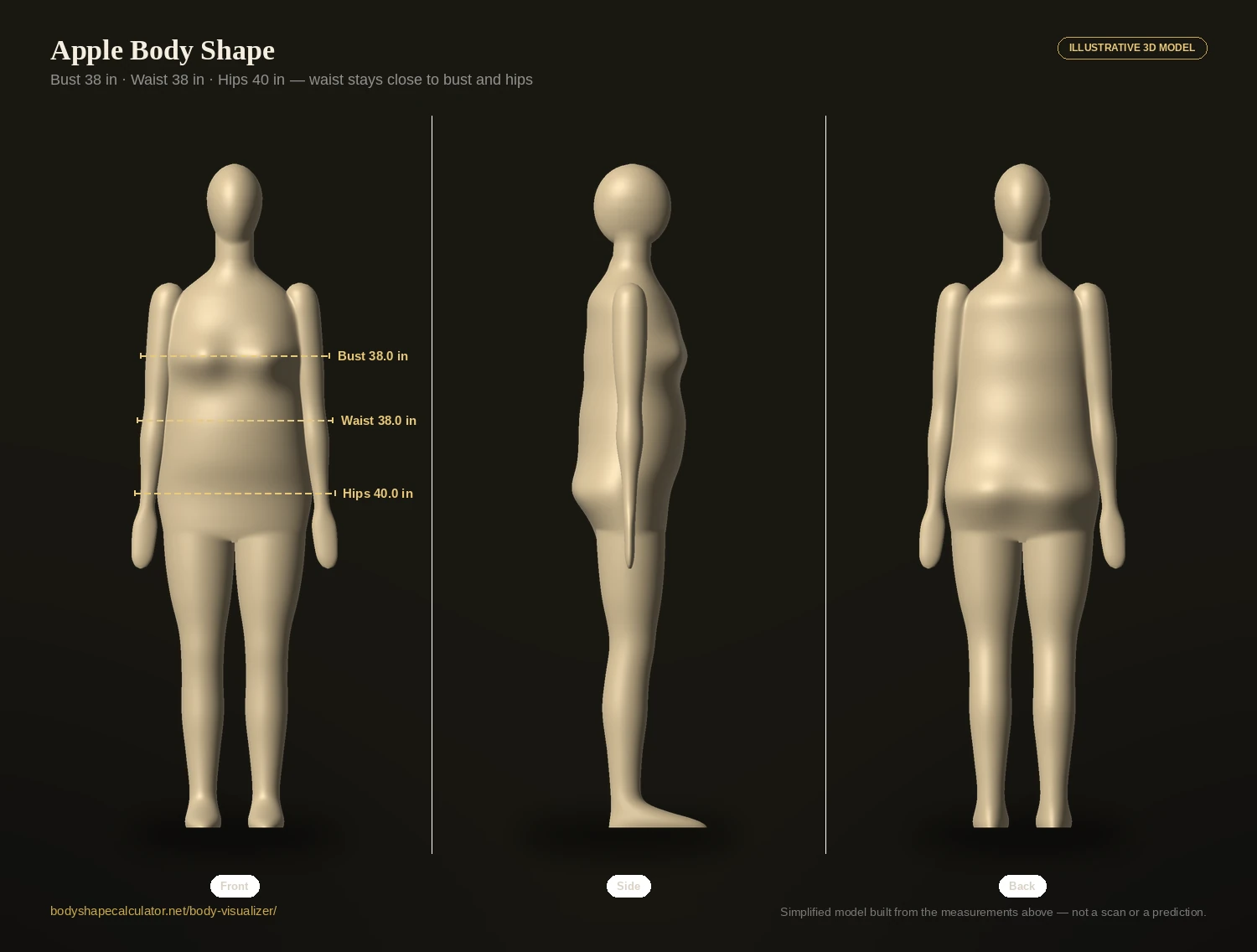
Want to see the shape interactively? Open the body visualizer, choose the female model and tap the Apple chip under Try a shape to rotate an apple silhouette from the front, side and back.
How Common Is the Apple Shape?
The most widely cited figures, from a 2006 NC State analysis of over 6,000 women, put the apple shape at roughly 14% — less common than rectangle (~46%) and pear (~20%), but noticeably more common than the hourglass family (~8% combined). Those specific numbers come from a press release rather than a peer-reviewed table, and later re-analyses have found different splits, so treat them as commonly cited rather than exact. Apple is also one of the shapes most misunderstood in casual conversation, often conflated with body size rather than proportion.
Apple shape is not a weight category. It describes where your frame carries fullness relative to your own bust and hip measurements — a slim person can be apple-shaped, and a larger person can be a rectangle or hourglass. Two people at very different sizes can both be genuine apples if their waist-to-bust-to-hip relationship matches the formula.
Apple vs Rectangle — What's the Real Difference?
These two get mixed up constantly, because both have a balanced bust and hip measurement. The waist is the entire distinction.
| Trait | Apple | Rectangle |
|---|---|---|
| Bust vs. hips | Within 3.6 in of each other | Within 3.6 in of each other |
| Waist | Within 2 in of, or larger than, bust/hips | More than 2 in smaller, but under 9–10 in |
| Visual read | Fullness sits through the middle | Straight, uniform column top to bottom |
| Styling focus | Elongate the torso, imply a waistline | Add curves and definition the frame doesn't naturally have |
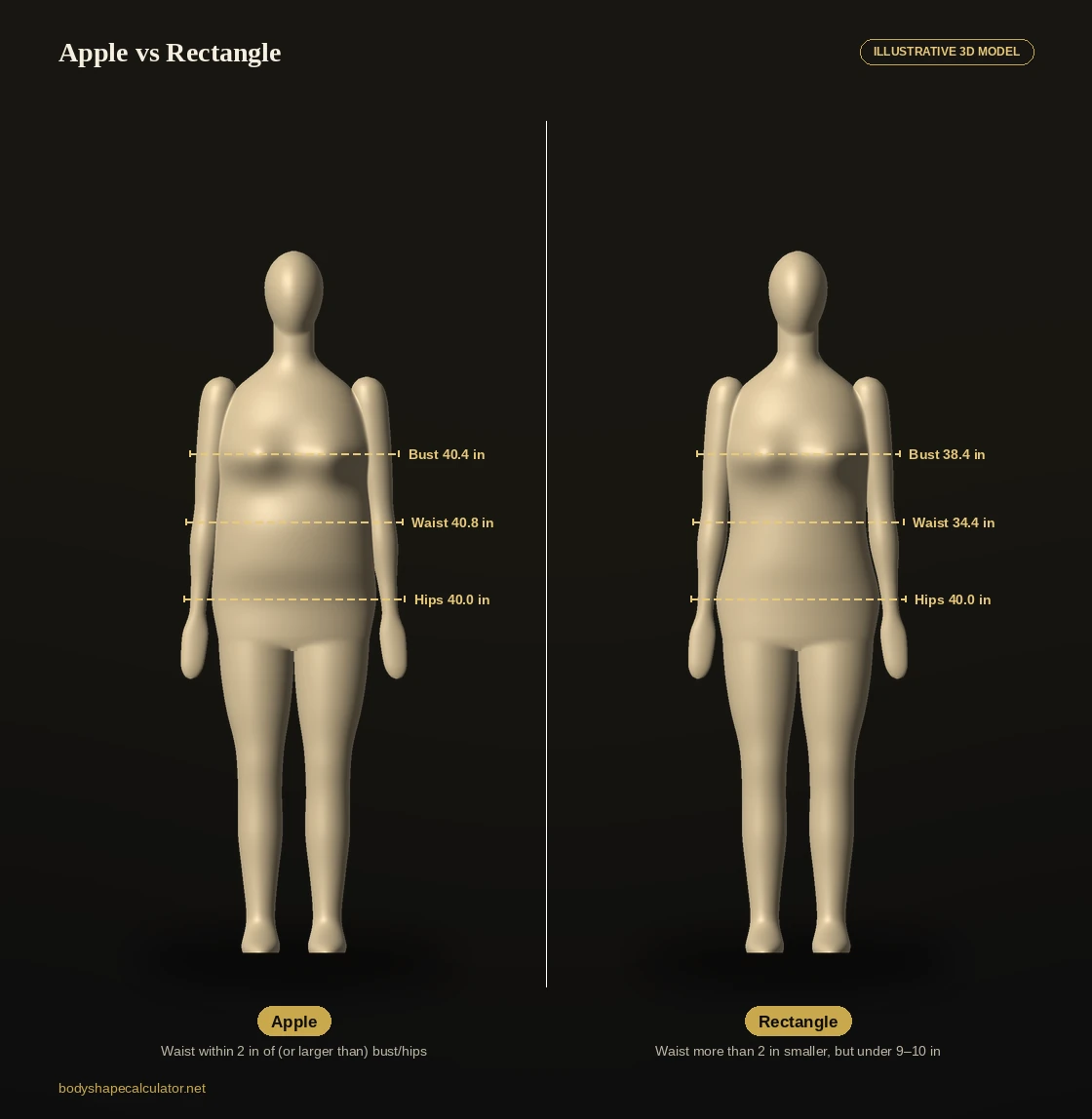
If style advice written for "straight" or "athletic" body types has never quite worked for you, this is often why — rectangle tips assume there's a waist to belt or cinch, and an apple shape doesn't have the same room to work with in that specific spot.
What Does an Apple Shape Mean for Waist-to-Hip and Waist-to-Height Ratio?
Because the waist sits close to (or larger than) the bust and hips, apple shapes tend to run on the higher side of waist-to-hip ratio (WHR) — often somewhere around 0.85 and up for women, at or above the WHO's threshold for elevated cardiovascular and metabolic risk. This is the shape most directly linked to that particular health conversation, because abdominal fat behaves differently, metabolically, from the fat carried in the hips and thighs of a pear shape.
Waist-to-height ratio (WHtR) is worth checking alongside WHR here specifically, since it doesn't depend on your hip measurement at all — just waist and height. A ratio under 0.5 is the widely cited healthy target. Run both numbers on our waist to hip ratio calculator and waist to height ratio calculator rather than assuming from shape category alone. The body proportions calculator shows both ratios together with your bust-to-hip ratio.
None of this is a diagnosis. WHR and WHtR are population-level risk indicators, not individual verdicts — genetics, activity level, diet quality, sleep and stress all matter more than any single ratio. If a number concerns you, the right next step is a conversation with a doctor, not a plan built from a calculator result.
How to Dress for an Apple Body Shape
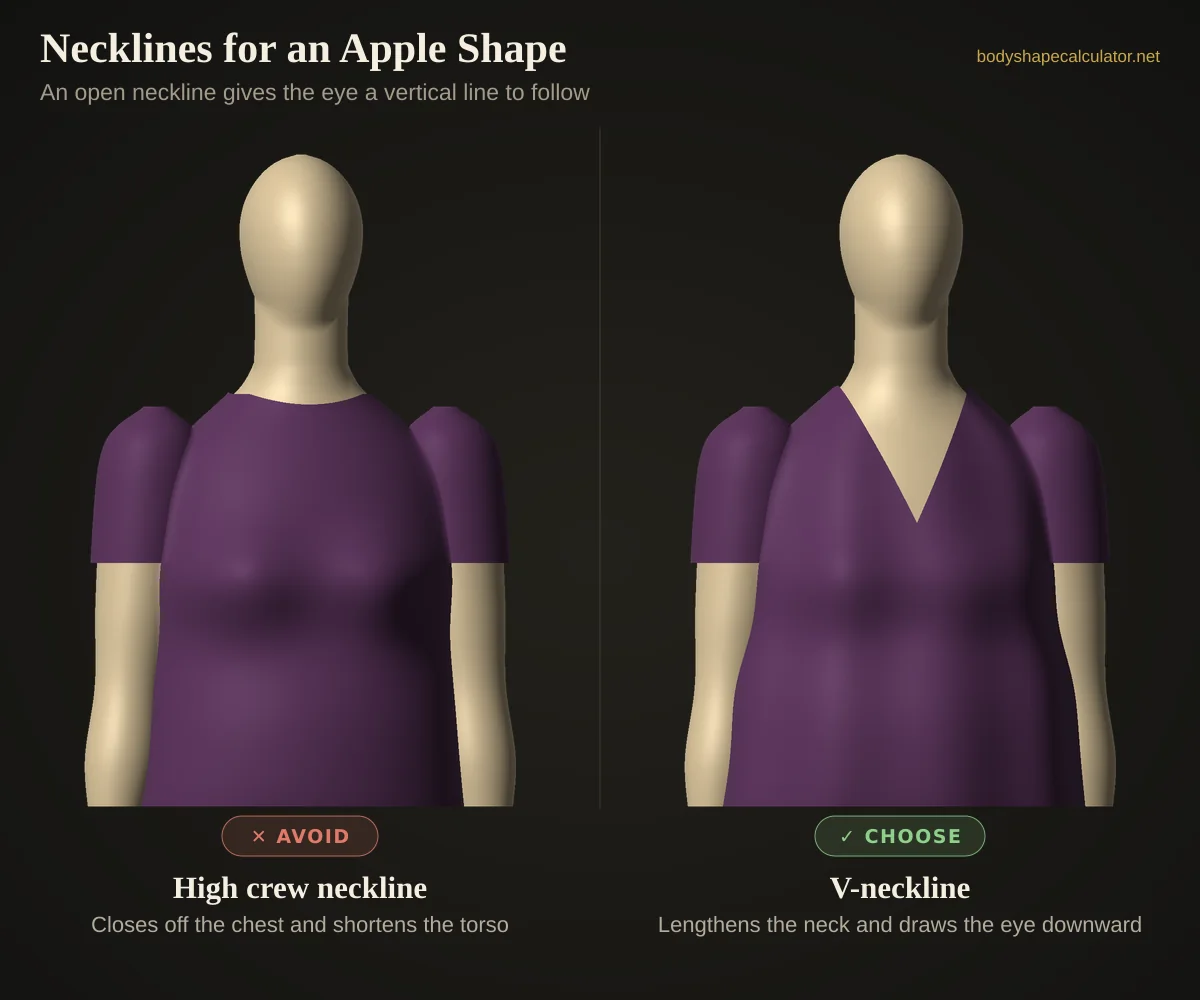
The core rule for this shape is about direction, not concealment: clothing that creates a long, unbroken vertical line — and skims rather than clings through the midsection — works with you, not against you. The sections below work through each category piece by piece, shown on a 3D apple-shaped figure (38–38–40 in) in two versions — one that breaks the vertical line, one that builds it.
Necklines
A neckline that opens up vertically does more for this shape than almost anything else in the wardrobe, because it lengthens the distance the eye travels before it reaches your midsection. A V-neckline, the deeper the better within reason, is the most reliable choice — it draws a clean line downward and makes the whole torso read as longer. A scoop neck does a softer version of the same thing. High, crew, or boat necklines are worth limiting: they sit close to the collarbone and can make the distance between chin and bust look shorter, which puts more visual weight on the midsection rather than less.
Sleeves
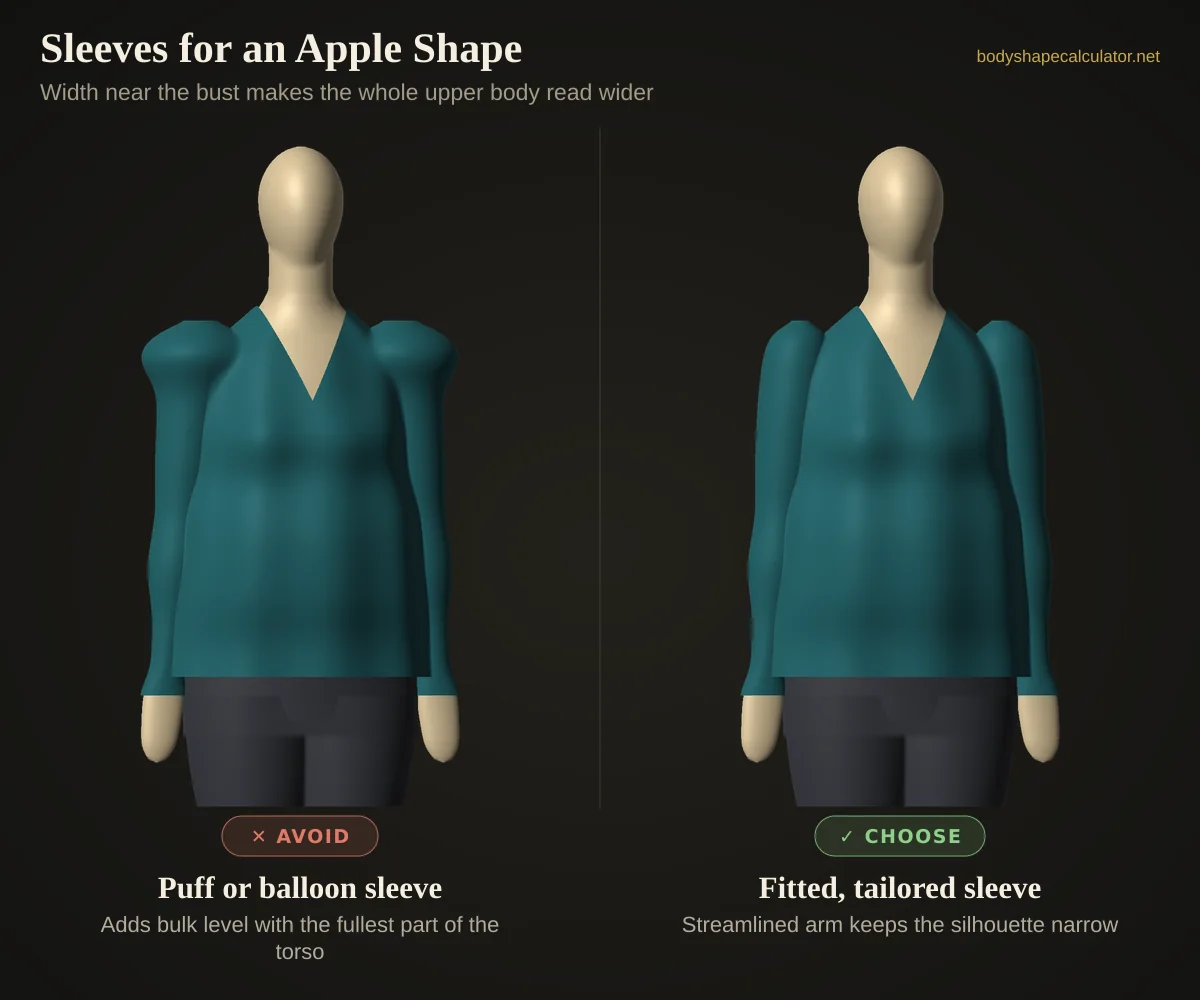
Sleeves matter here mainly because of where they add width — the goal is to keep the shoulder and upper-arm line fairly streamlined so nothing competes with the vertical lines you’re building elsewhere. A fitted or tailored sleeve that follows the arm does this without effort. A three-quarter length is a particularly good option, since it shows a slim part of the arm and adds a natural break in the eye line. Puff, dolman, and heavily gathered sleeves are the ones to be selective with — they add volume right at the widest part of the upper body, which pulls attention back up to an area you’re usually trying to soften.
Shirts, T-Shirts & Tops
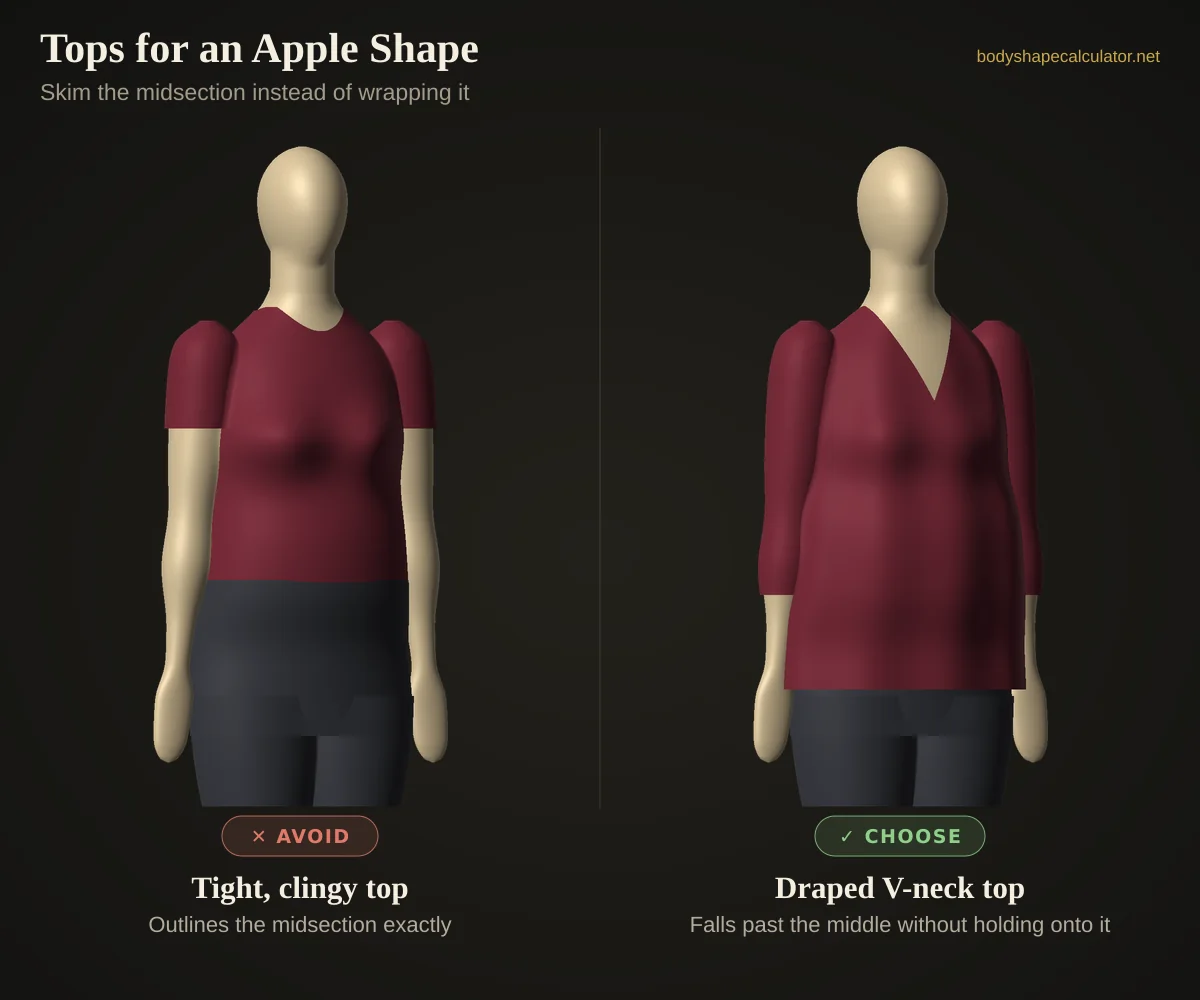
The most useful word for tops on this shape is skim, not fit and not hide — fabric that follows the body loosely enough to move past the midsection without clinging to it. A wrap top does this cleanly: the tie creates definition at a point you choose, while the rest of the fabric drapes rather than pulls. A relaxed tunic in a fabric with some drape works the same way over trousers or leggings. Tight, fitted-through-the-body tops are the trickiest choice here, since clingy fabric follows every contour of the midsection rather than skimming past it.
Knitwear
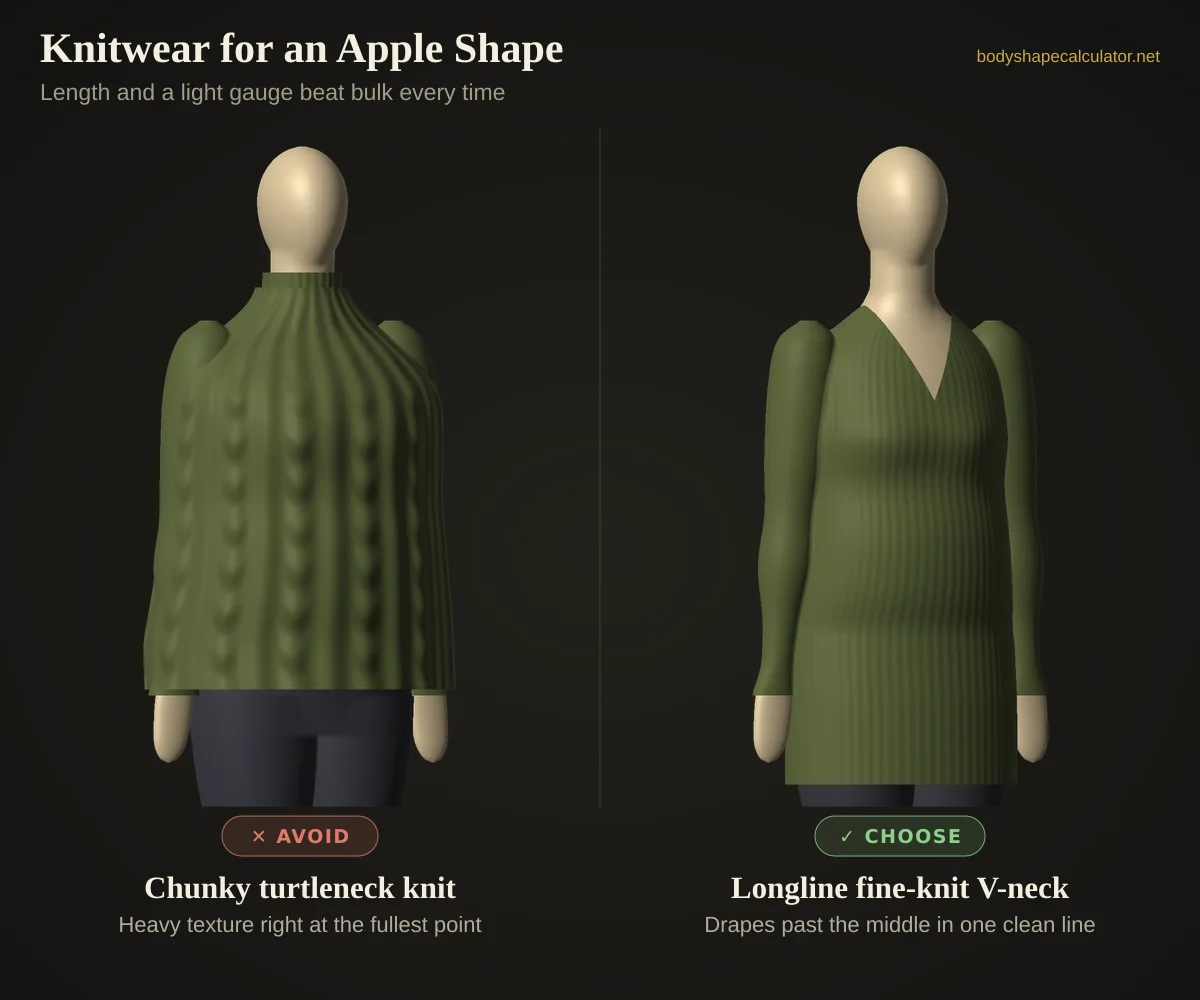
Knitwear can be one of the more forgiving categories here, as long as the fabric has enough drape to move past the body rather than hug it. A longline, lightweight sweater that falls past the hip elongates the whole torso and skims over the midsection on its way down. A fine-gauge cardigan left open, worn over a V-neck layer, does something similar by creating a long vertical line down the front. Thick, chunky, or cropped knits are worth being selective with — heavier yarn adds bulk exactly where you’re usually trying to minimise it, and a cropped length stops right at the widest point instead of moving past it.
Jackets
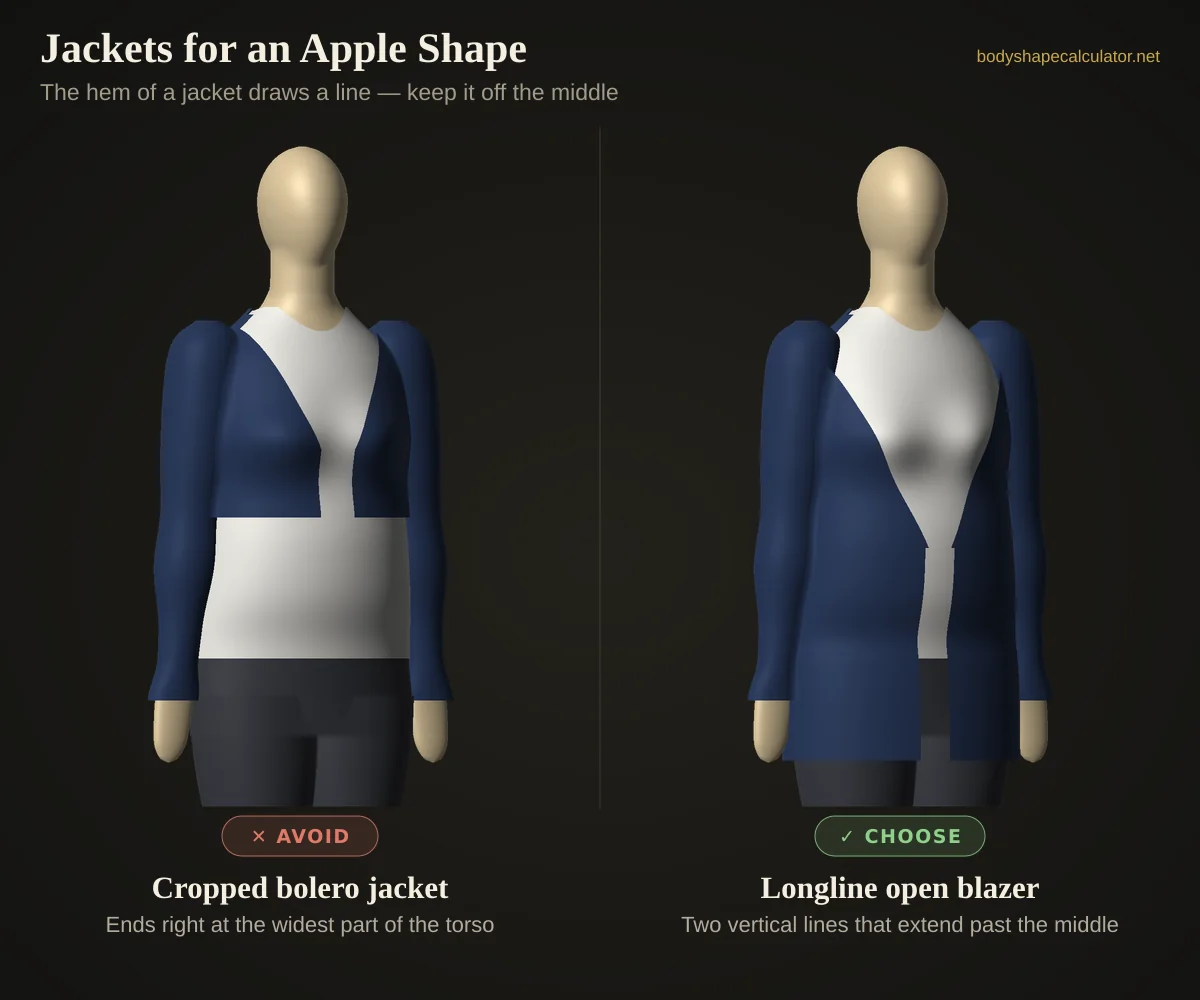
Jacket length is doing most of the work in this category. A longline blazer or duster coat, left open rather than buttoned, creates a continuous vertical line from shoulder to thigh that carries the eye straight past the midsection. An open, unstructured cardigan-style jacket works the same way for something more casual. Cropped jackets and boleros are the length to watch — anything that ends right at or just above the natural waist draws a horizontal line exactly at the point you’re usually trying to soften, which has the opposite effect of a longer style worn open.
Coats
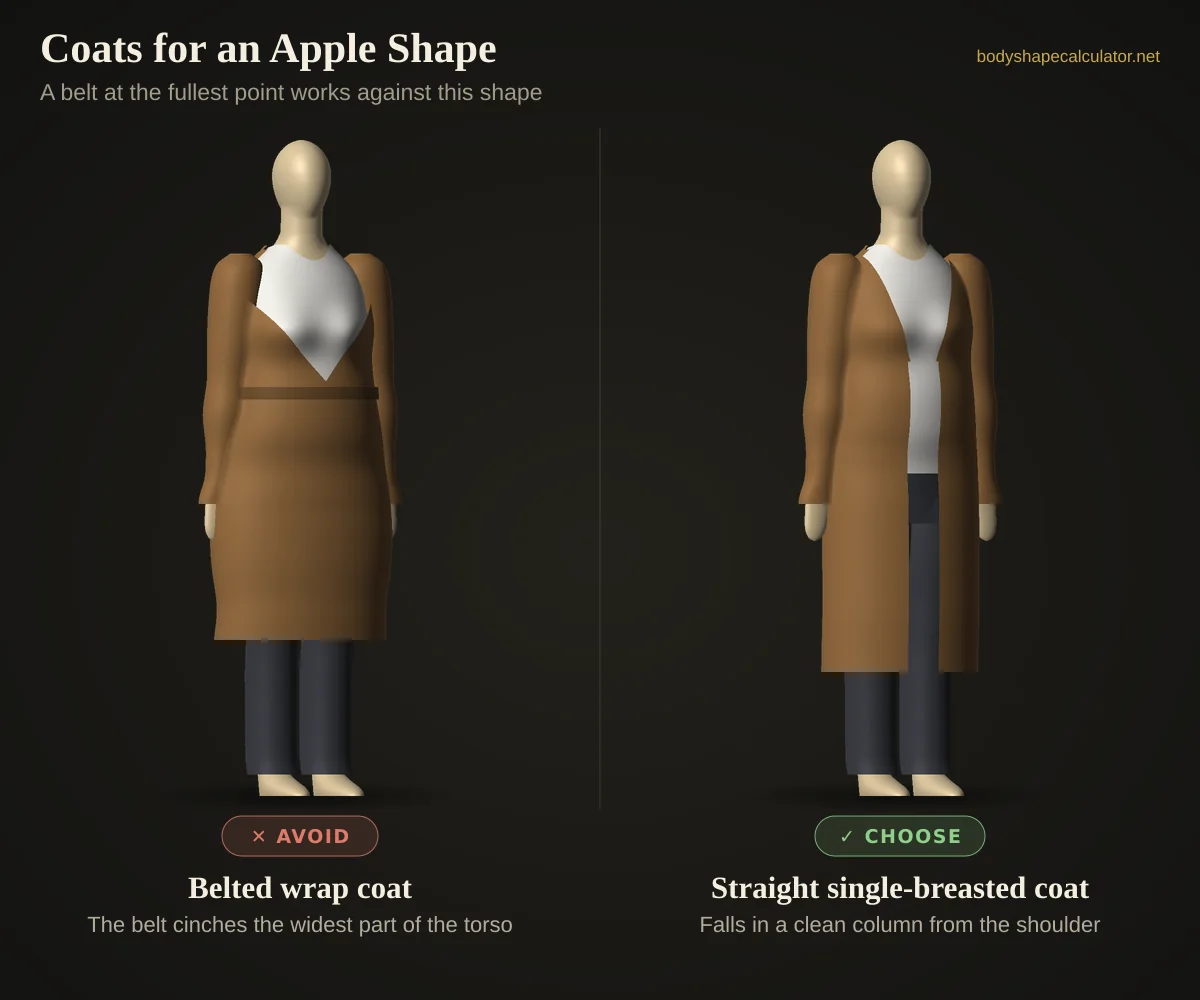
Leave the belt off your outerwear. A wrap coat tied at the waist cinches the fullest part of the torso, which is the reverse of what this shape needs. A straight, single-breasted coat worn open — or a longline duster — falls in a clean column from the shoulder and draws two long vertical lines down the front of the body. Aim for a hem at the knee or below and a fabric with some weight (wool, heavy crepe, a lined trench cotton) so it hangs from the shoulders instead of following the midsection.
Trousers
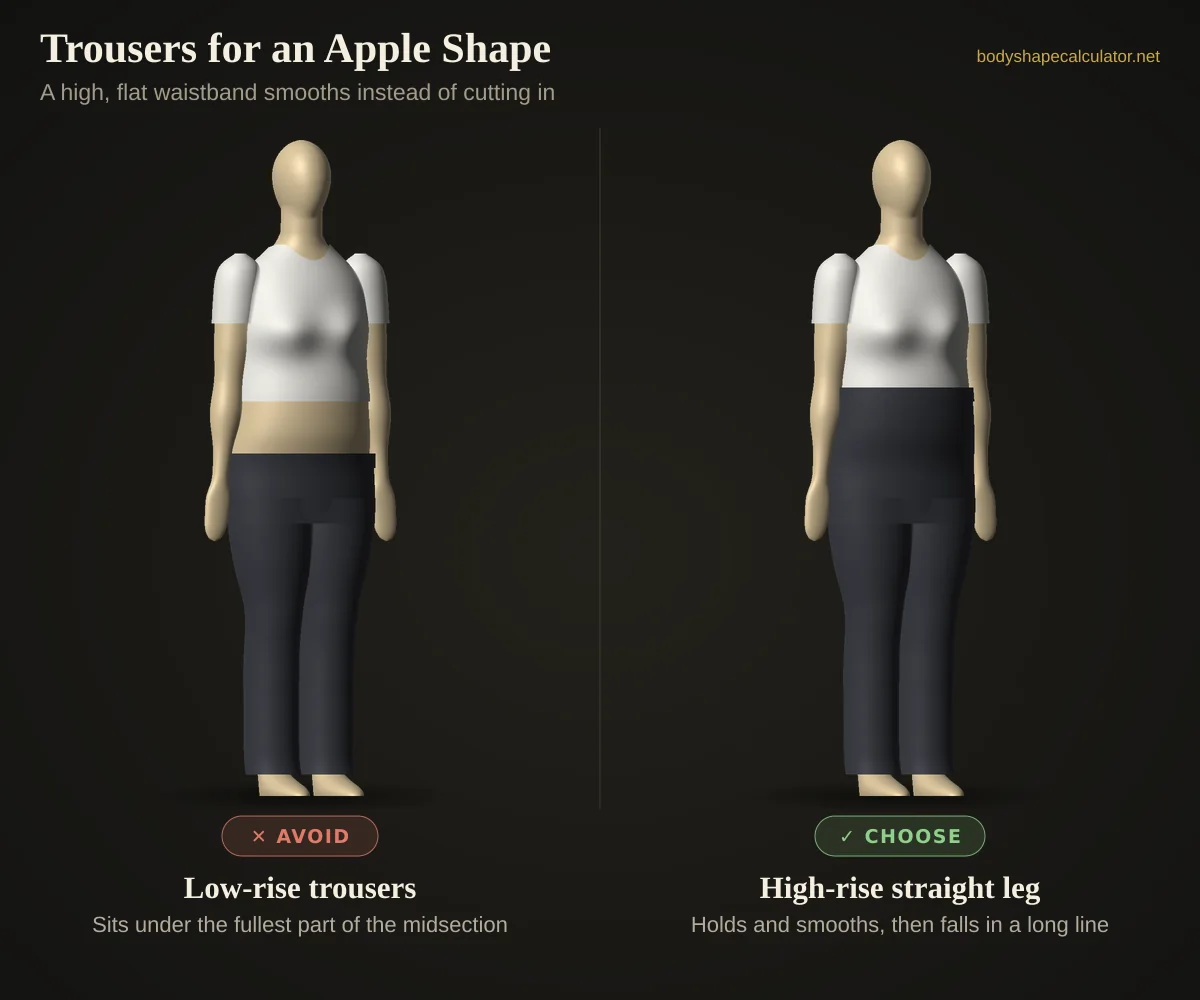
A high-rise waistband is one of the most useful single choices available to this shape, since it holds the midsection in gently and extends the visual line of the torso upward before the leg even begins. Straight-leg or slightly wide-leg trousers in a structured fabric keep the rest of the silhouette clean and balanced underneath. Low-rise cuts are the ones to reconsider — a waistband that sits below the natural midsection point means fabric and seams collect right at the fullest part of the torso, which draws attention there rather than smoothing past it.
Jeans
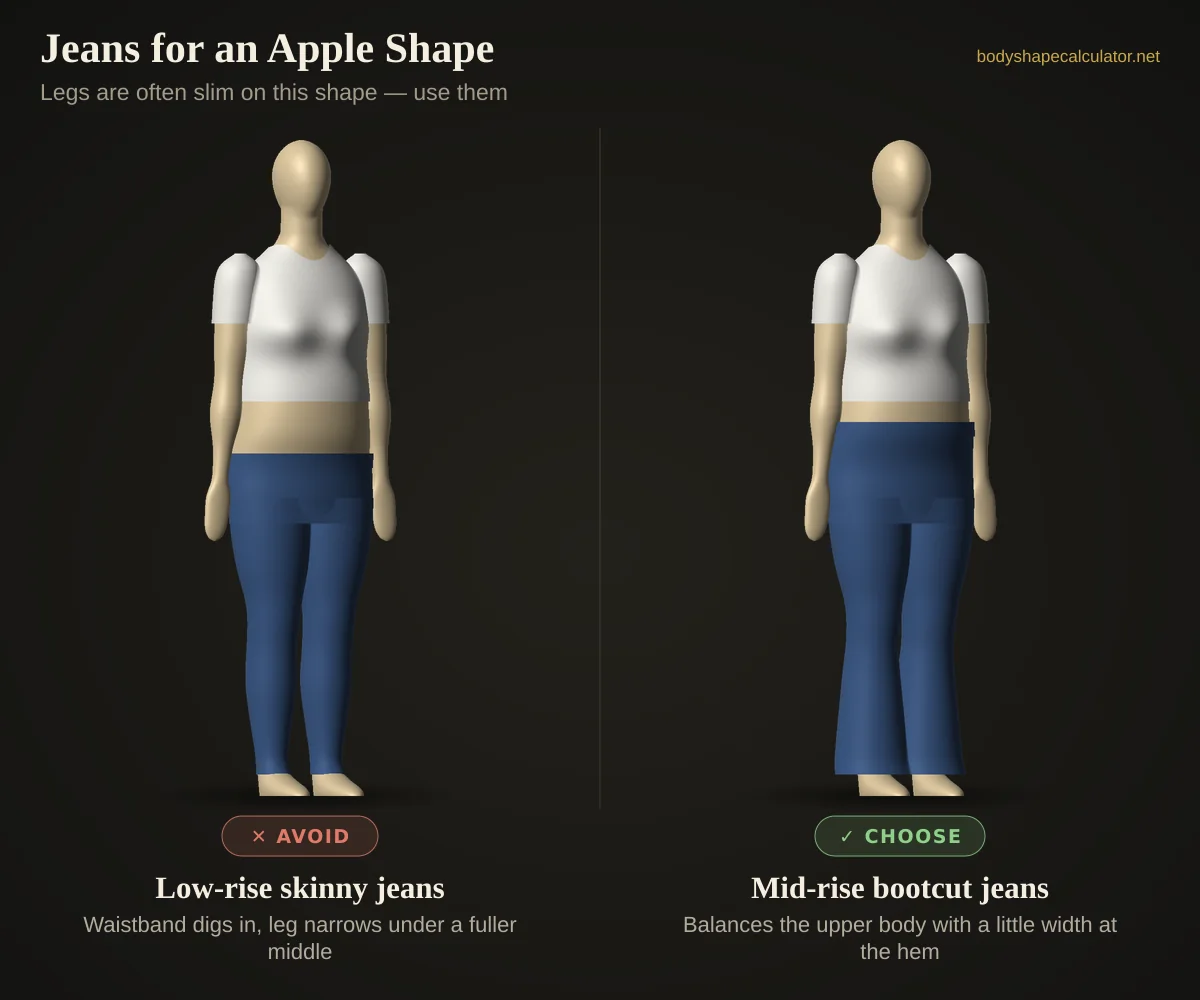
Apple shapes often have slimmer legs than the upper body suggests, and jeans are the easiest place to use that. A mid-rise bootcut or straight leg sits flat below the midsection and adds a little width at the hem to balance the top half. Look for a contoured or wider waistband and a little stretch, so the band lies flat rather than digging in. Low-rise skinny jeans combine both problems at once: the waistband cuts in under the fullest point and the leg narrows away beneath it, which makes the torso read heavier than it is.
Skirts
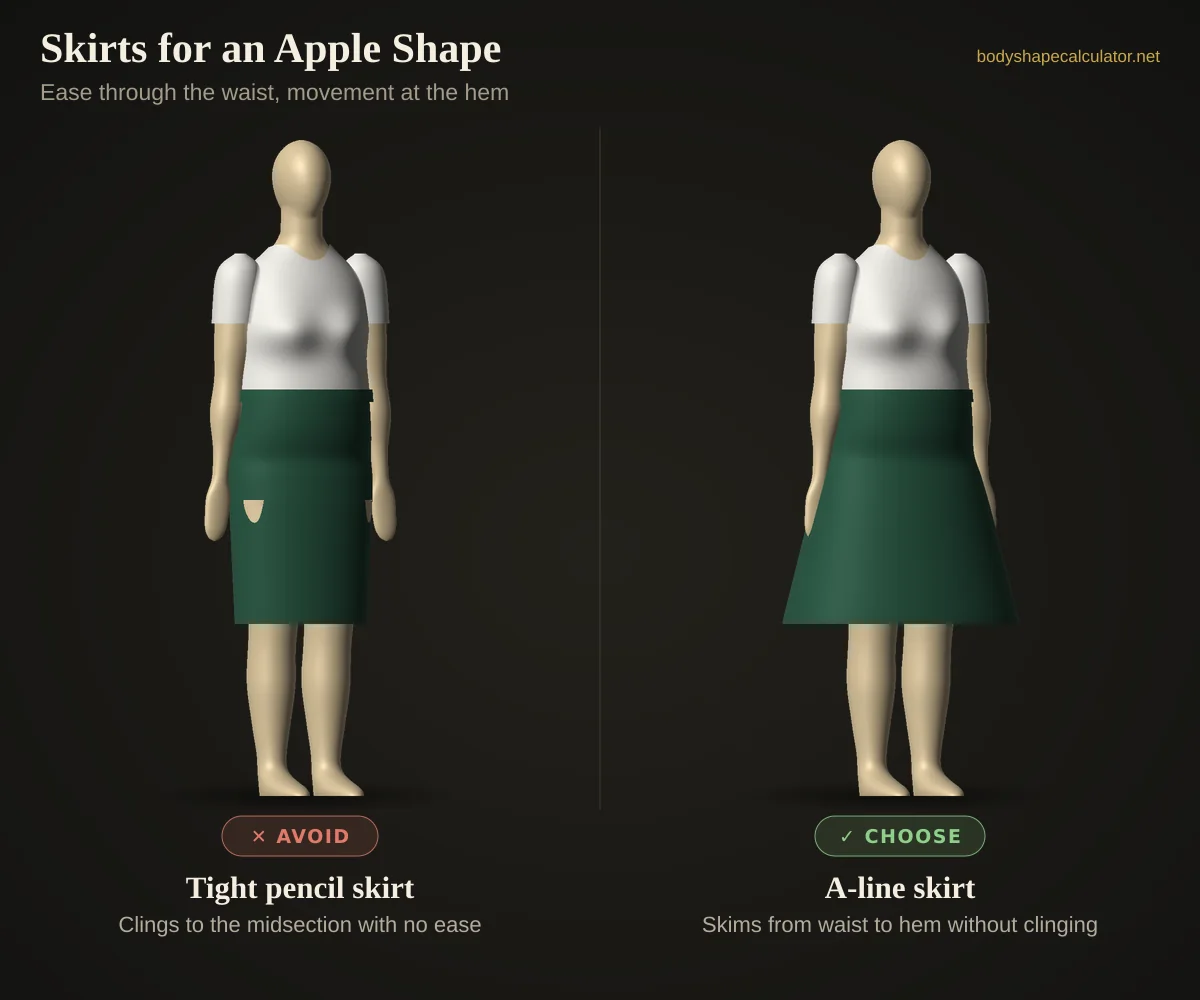
An A-line skirt, sitting at or just above the natural waist, is close to a universal recommendation for this shape because it skims outward from the body instead of clinging to it at any point. Paired with a top that has some vertical detail — a placket, a seam, an open cardigan — it builds one long line from shoulder to hem. A tight pencil skirt is the more difficult choice here, purely because the fitted fabric has nowhere to go but follow the body’s exact shape through the midsection, with none of the ease an A-line naturally builds in.
Dresses
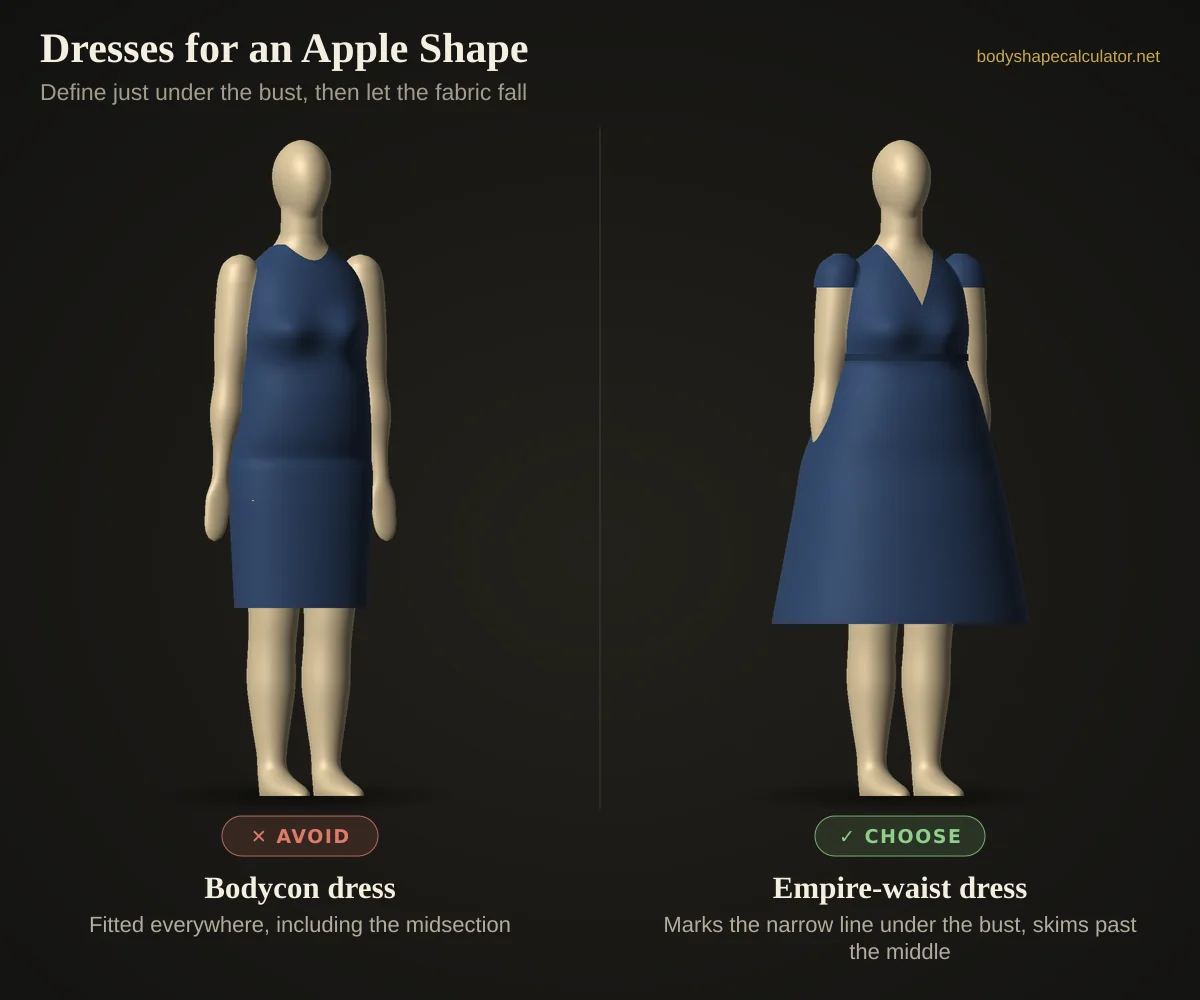
An empire-waist dress is one of the most reliably flattering silhouettes for this shape, because the seam sits just under the bust — above the midsection entirely — and everything below it falls loosely to the hem. That single design choice does most of the work: there’s a defined point on the body, and it isn’t the one you’re usually trying to minimise. A wrap dress in a fabric with good drape is a close second. Bodycon and other clingy, fitted-throughout dresses are the hardest category here, simply because there’s no point in the garment that isn’t following the body closely.
Shorts
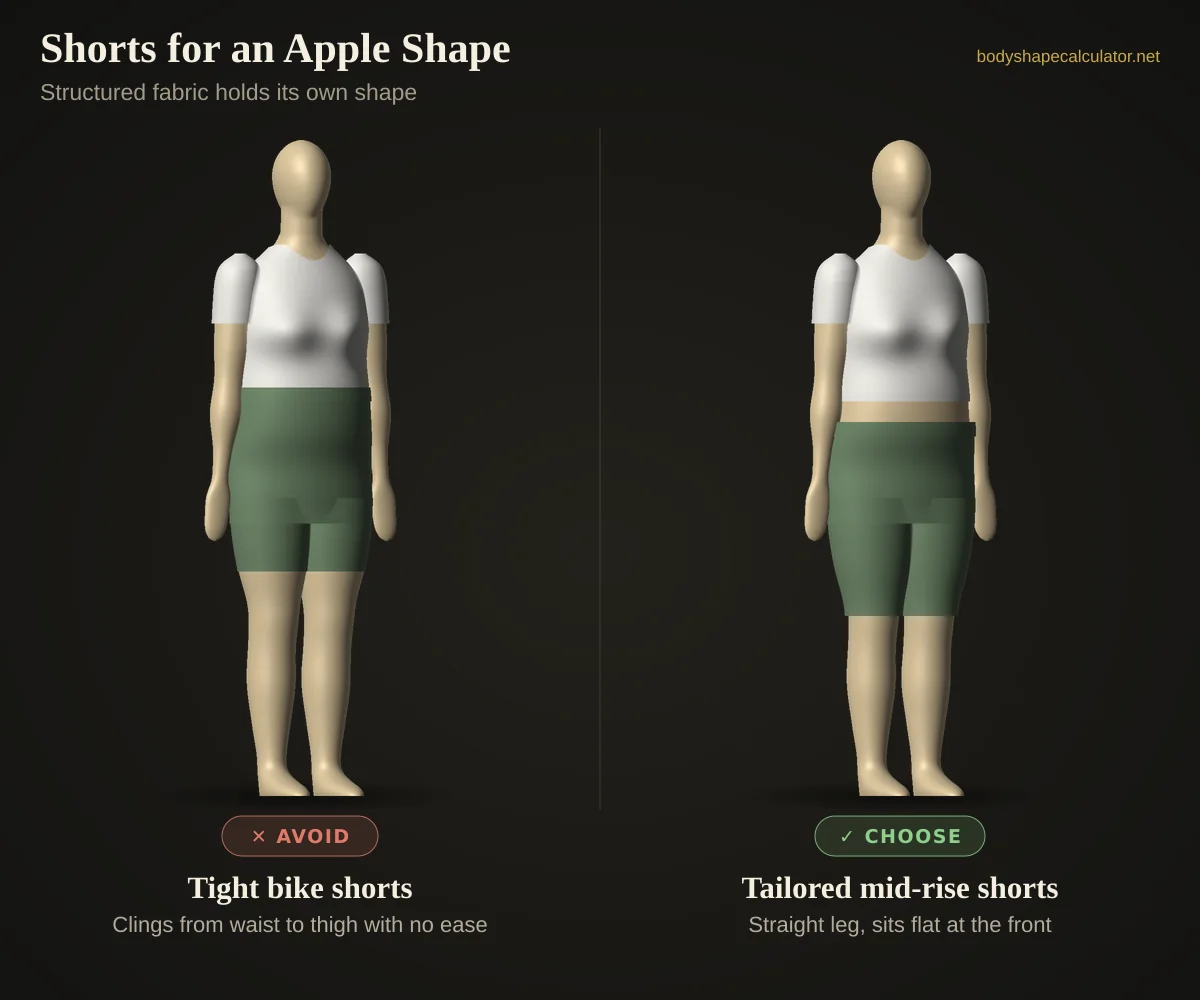
Structured fabric does more here than cut alone — a pair of tailored shorts in a fabric with a little body (cotton twill, a light linen blend) holds its own shape rather than collapsing onto the midsection the way soft, clingy fabric does. A mid-rise waistband, neither cutting across the fullest point nor sitting so high it emphasises it, is usually the most comfortable balance. Tight bike shorts or anything in a very stretchy, thin jersey are the ones to be selective with, since that fabric follows the body’s exact shape from waistband to hem with essentially no ease built in.
Jumpsuits & Playsuits
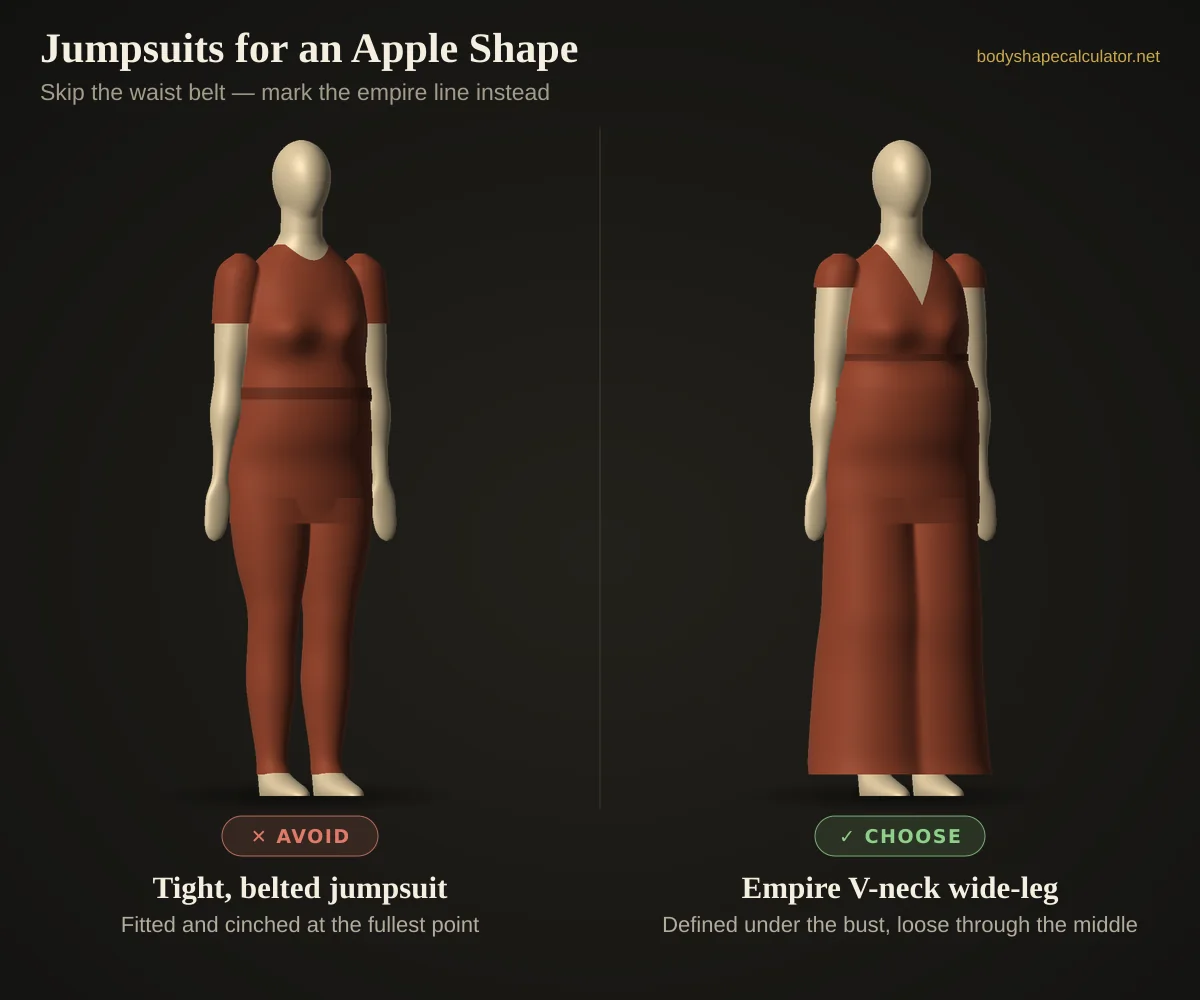
Define the empire line, not the waist. A jumpsuit with a V-neck and a seam just under the bust, falling loose to a wide leg, gives you a defined point at your narrowest spot and room through the middle. Soft, drapey fabric matters more here than in any other category — crepe and viscose move past the midsection, stiff cotton stands away from it. A tight jumpsuit with a belt at the natural waist is the combination to avoid: it outlines the midsection and then draws a line across it.
Common Apple Shape Measurements by Size
The pattern holds at every size — bust and hips close together, waist close behind or level with them:
| Frame | Bust | Waist | Hips |
|---|---|---|---|
| Petite | 34 in | 34 in | 36 in |
| Average | 38 in | 38 in | 40 in |
| Plus-size | 46 in | 46 in | 48 in |
In every row, the waist is within an inch or two of the bust — there's no 9-inch taper anywhere in sight. That's the entire signature of this shape, regardless of overall size.
Try the average row in the Body Visualizer: switch to inches, enter a 38 in bust, 38 in waist and 40 in hips, and the live analysis confirms the shape while you rotate the model.
A Five-Point Check Before You Buy
You don't need to memorise every category above. Hold any piece up in the fitting room and run through these five questions — if it passes four, it will almost certainly work.
- Does it make a vertical line? V-necks, open jackets, long cardigans and front seams all do; horizontal stripes and wide belts at the middle don't.
- Does it skim or cling at the midsection? Hold the fabric an inch away from your stomach — if it falls back without grabbing, it skims.
- Where is the defined point? Under the bust or at the hip is fine; right at the natural waist usually isn't.
- Where does the hem land? Past the hip (tops, jackets) or at the knee (skirts, coats) — never at the fullest part of the torso.
- Are the legs doing any work? A straight, bootcut or slim leg, or a knee-length hem, shows off the part of the body that is usually slimmest.
Frequently Asked Questions
What is the exact formula for an apple body shape?
Bust and hips within 3.6 inches of each other, and a waist within 2 inches of — or equal to or larger than — both the bust and the hips. Both parts matter: the first rules out pear and inverted triangle, and the second is what separates apple from rectangle, which has the same balanced bust and hips but a bit more waist definition.
Is an apple body shape unhealthy?
Shape itself isn't a diagnosis. What the research does show is that abdominal fat — the kind associated with an apple shape — is more metabolically active than fat stored in the hips and thighs, and is linked to higher cardiovascular and metabolic risk at a population level. Waist-to-hip ratio and waist-to-height ratio are the specific numbers worth tracking if this is a concern, not the shape label on its own.
What's the difference between apple and rectangle?
Both have a bust and hip measurement that are close together. The waist is the difference: a rectangle's waist is more than 2 inches smaller than the bust and hips (just not dramatically so), while an apple's waist sits within 2 inches of them, or even matches or exceeds them.
Does an apple shape mean I'm overweight?
No. Apple describes a proportion — the relationship between your bust, waist and hip measurements — not a weight category. A slim person can be apple-shaped just as easily as a larger person can be a rectangle or hourglass. It's about where your particular frame carries its fullness, not how much of it there is.
Can pregnancy or menopause cause an apple shape?
Yes, both are common triggers for a shift toward this shape. Pregnancy changes waist measurements, sometimes permanently. Menopause-related hormonal shifts often move fat storage from the hips toward the abdomen, which is why someone who measured as a pear or hourglass earlier in life may measure as an apple later on. Re-measuring every six months, or after a major life change, keeps your result current.
What kind of exercise suits an apple shape?
There's no exercise that changes your underlying frame or converts one shape into another, but general strength training and regular movement support a healthier waist-to-hip and waist-to-height ratio over time, alongside diet and sleep. If you're starting a new programme, a trainer or doctor familiar with your specific situation is a better source of a plan than a shape calculator.
The apple label carries more baggage than any of the other six shapes, mostly because it gets tangled up with conversations about weight that have nothing to do with proportion. Once you separate the two — a formula about bust, waist and hip relationships on one side, and body size on the other — the shape itself is just one more way a frame can be built, with its own specific things that fit well.
This guide is for educational and styling purposes only. It does not diagnose any medical condition and isn't a substitute for advice from a qualified healthcare professional.