Quick answer: FFMI = lean mass (kg) ÷ height (m)². For men, 17–20 is average, 20–22 trained and 22–25 very muscular; about 25 is the natural limit. For women, 14.5–17 is average.
What Is FFMI?
The fat-free mass index is a height-adjusted measure of how much lean mass you carry: muscle, bone, organs and water. Because it leaves out fat, it shows muscularity in a way BMI cannot. Two men can both have a BMI of 27; one may have an FFMI of 19 and 25% body fat, the other an FFMI of 23 and 12% body fat.
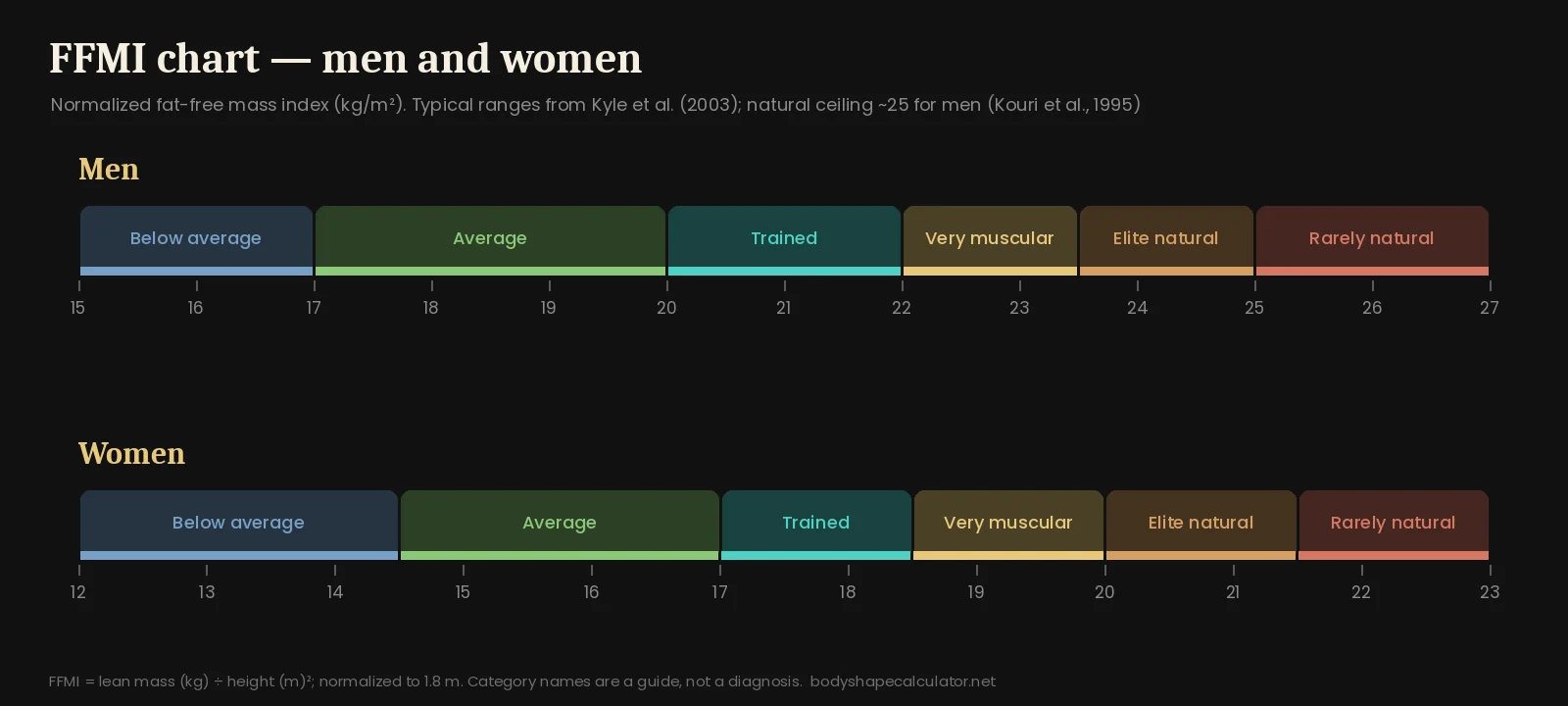
FFMI Chart for Men and Women
| Category | Men | Women |
|---|---|---|
| Below average | under 17 | under 14.5 |
| Average | 17–20 | 14.5–17 |
| Trained | 20–22 | 17–18.5 |
| Very muscular | 22–23.5 | 18.5–20 |
| Elite natural | 23.5–25 | 20–21.5 |
| Rarely reached naturally | over 25 | over 21.5 |
Average ranges come from Kyle and colleagues’ study of almost 5,700 healthy adults; the upper bands reflect what trained lifters reach. Category names are a practical guide, not medical labels.
FFMI Formula
Lean mass = weight × (1 − body fat %)
FFMI = lean mass (kg) ÷ height (m)²
Normalized FFMI = FFMI + 6.1 × (1.8 − height in m)
- Weigh yourself. Weigh yourself in the morning, before eating, in light clothing.
- Estimate body fat. Use a DEXA scan, calipers, a smart scale or the U.S. Navy tape method. The calculator can estimate it from your neck and waist.
- Find lean mass. Multiply your weight by (1 minus your body fat as a decimal). At 80 kg and 15% body fat, lean mass is 80 × 0.85 = 68 kg.
- Divide by height squared. Divide lean mass in kg by height in meters squared. 68 ÷ (1.78 × 1.78) = 21.5.
- Normalize for height. Add 6.1 × (1.8 − height in meters). For 1.78 m, add 0.12, giving a normalized FFMI of 21.6.
The Natural FFMI Limit
In 1995, Kouri and colleagues measured 157 male athletes, 83 drug-free and 74 who had used anabolic steroids. The drug-free men topped out around a normalized FFMI of 25, while many users went beyond it. Later work has found a few drug-free athletes slightly above 25, so it is a rough ceiling rather than a test.
| Height | FFMI 20 | FFMI 22 | FFMI 25 |
|---|---|---|---|
| 5 ft 6 in | 136 lb | 150 lb | 171 lb |
| 5 ft 10 in | 157 lb | 173 lb | 197 lb |
| 6 ft 2 in | 181 lb | 199 lb | 226 lb |
Most men who train hard for years land between 22 and 24. Reaching the upper end usually takes a large frame as well as time; see average wrist size and the frame size calculator.
FFMI Depends on Your Body Fat Estimate
FFMI is only as accurate as the body fat number behind it. A 3-point error in body fat moves FFMI by about 0.6 to 0.8. DEXA is the most accurate common method; tape measures and smart scales are rougher. Track change over time with the same method, and use the body fat percentage chart to sanity-check your number against pictures.
How to Raise Your FFMI
FFMI rises only when lean mass rises. That means progressive resistance training for all major muscle groups, enough protein (about 1.6 g per kg of body weight per day is a common evidence-based target), a small calorie surplus or maintenance, and sleep. Beginners can gain several kilograms of lean mass in the first year; gains slow to a fraction of that after a few years.
See how your build compares in other ways with the average bicep size, shoulder-to-waist ratio and the 3D body visualizer.
FFMI FAQ
What is FFMI?
FFMI, or fat-free mass index, is your lean body mass in kilograms divided by your height in meters squared. It works like BMI but leaves out body fat, so it measures how much muscle and other lean tissue you carry for your height.
How do you calculate FFMI?
First find lean mass: weight × (1 − body fat percentage). Then divide lean mass in kg by height in meters squared. Normalized FFMI adds 6.1 × (1.8 − height in meters) to adjust for height.
What is a good FFMI?
For men, an FFMI of about 17 to 20 is average, 20 to 22 shows clear training, and 22 to 25 is very muscular. For women, about 14.5 to 17 is average and 17 to 20 is well trained.
What is the natural FFMI limit?
In a 1995 study of 157 male athletes by Kouri and colleagues, drug-free lifters rarely exceeded a normalized FFMI of about 25, while many steroid users did. An FFMI above 25 is not proof of drug use, but it is uncommon without it. For women, about 21 to 22 is often given as a practical ceiling.
What is the average FFMI?
In a study of almost 3,000 healthy Swiss men and 2,650 women, FFMI for people with a normal BMI ranged from about 16.7 to 19.8 for men and 14.6 to 16.8 for women.
What is the difference between FFMI and normalized FFMI?
Raw FFMI tends to be slightly higher in tall people. Normalized FFMI adjusts every result to a height of 1.8 m so that tall and short people can be compared fairly.
Is FFMI better than BMI?
For muscular people, yes. BMI cannot tell muscle from fat, so a lean, muscular person can be labeled overweight. FFMI separates the two, but it depends on an accurate body fat estimate.
Sources
- Kouri EM, Pope HG, Katz DL, Oliva P. Fat-free mass index in users and nonusers of anabolic-androgenic steroids. Clinical Journal of Sport Medicine. 1995;5(4):223–228.
- Kyle UG, Schutz Y, Dupertuis YM, Pichard C. Body composition interpretation: contributions of the fat-free mass index and the body fat mass index. Nutrition. 2003;19(7–8):597–604.
- Morton RW, et al. A systematic review, meta-analysis and meta-regression of the effect of protein supplementation on resistance training-induced gains in muscle mass and strength. British Journal of Sports Medicine. 2018;52:376–384.
FFMI depends on your body fat estimate. Categories are a guide, not a diagnosis. For general information only.