Quick answer: the average waist size for men in the U.S. is 40.6 inches (103 cm), measured at the top of the hip bone (NHANES 2021–2023, men 20+). For health, keep it under 40 in (102 cm), ideally under 37 in, and under half your height.
Average Waist Size for Men in the U.S.
The average American man aged 20 or older has a 40.6 inch (103 cm) waist, according to the most recent National Health and Nutrition Examination Survey (NHANES, August 2021–August 2023). The median is about 40 inches, so half of U.S. men measure more and half less. The same survey puts the average man at 5 ft 9 in (68.9 in) and 199 lb.
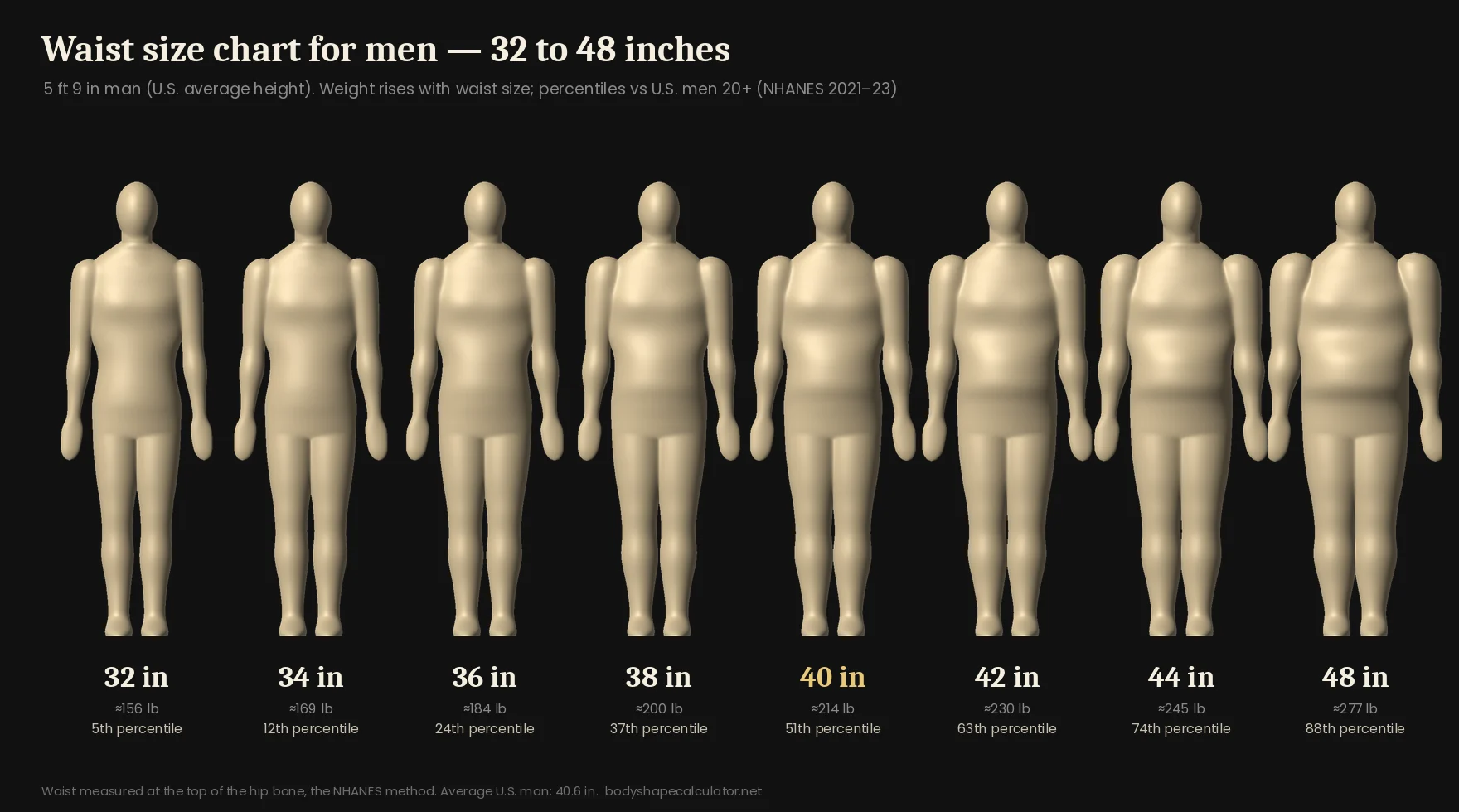
| Waist (tape) | Percentile, U.S. men 20+ | Health risk band |
|---|---|---|
| 30 in (76 cm) | 2nd | Low |
| 32 in (81 cm) | 5th | Low |
| 34 in (86 cm) | 12th | Low |
| 36 in (91 cm) | 24th | Low |
| 38 in (97 cm) | 37th | Increased |
| 40 in (102 cm) | 51st | Increased |
| 42 in (107 cm) | 63rd | High |
| 44 in (112 cm) | 74th | High |
| 46 in (117 cm) | 82nd | High |
| 48 in (122 cm) | 88th | High |
The average has grown over time. U.S. men averaged about 39 inches at the turn of the century; today a waist that would have been typical then is below the median. “Average” is therefore not the same as “healthy”: the average man is now right at the 40 inch line that health guidelines use for high risk.
Average Waist Size for Men by Age
Men’s waists grow steadily from the 20s to the 50s, then level off. The table shows the median (middle) waist and the range covering the middle half of men in each age group.
| Age | Median waist | Middle half | 5th / 95th percentile |
|---|---|---|---|
| 20-29 | 36.8 in (93.4 cm) | 32.5–41.8 in | 28.1 / 49.0 in |
| 30-39 | 38.8 in (98.6 cm) | 35.4–43.3 in | 31.6 / 51.4 in |
| 40-49 | 40.0 in (101.5 cm) | 36.3–44.9 in | 33.0 / 55.0 in |
| 50-59 | 41.1 in (104.3 cm) | 37.1–45.2 in | 32.8 / 53.9 in |
| 60-69 | 41.1 in (104.5 cm) | 37.6–44.5 in | 33.1 / 52.0 in |
| 70-79 | 42.0 in (106.6 cm) | 38.3–46.1 in | 33.3 / 51.7 in |
| 80+ | 40.4 in (102.6 cm) | 37.5–43.9 in | 33.3 / 49.6 in |
The jump between the 20s and 30s, about 2 inches at the median, is the largest. That is when many men become less active and gain weight without noticing, because the change is slow and pants often sit below the belly.
Ideal Waist Size for Men by Height
Because a tall man naturally has a bigger frame, the most useful target scales with height. Research by Ashwell and others supports a simple rule: keep your waist to less than half your height. A waist-to-height ratio of 0.5 or more is linked with higher cardiometabolic risk across ages and ethnic groups.
| Height | Keep waist under (0.5) | Lean to healthy (0.45–0.5) | High risk (0.6+) |
|---|---|---|---|
| 5 ft 4 in | 32.0 in | 28.8–32.0 in | 38.4 in |
| 5 ft 6 in | 33.0 in | 29.7–33.0 in | 39.6 in |
| 5 ft 8 in | 34.0 in | 30.6–34.0 in | 40.8 in |
| 5 ft 10 in | 35.0 in | 31.5–35.0 in | 42.0 in |
| 6 ft 0 in | 36.0 in | 32.4–36.0 in | 43.2 in |
| 6 ft 2 in | 37.0 in | 33.3–37.0 in | 44.4 in |
| 6 ft 4 in | 38.0 in | 34.2–38.0 in | 45.6 in |
Try your own numbers in the waist-to-height ratio calculator, which also explains the 0.4 and 0.6 lines.
What Waist Size Is Healthy for a Man?
Waist size is one of the simplest ways to spot belly fat, the visceral fat around the organs that drives insulin resistance, high blood pressure and heart disease. The WHO and the U.S. National Institutes of Health use these cut-offs for men of European descent:
- Under 37 in (94 cm): low risk from waist size.
- 37–40 in (94–102 cm): increased risk.
- Over 40 in (102 cm): substantially increased risk.
The International Diabetes Federation uses a lower cut-off of 35.5 in (90 cm) for South Asian, Chinese and Japanese men, who tend to carry more visceral fat at a given waist size. Waist size matters even at a normal BMI: a man with a normal weight but a large belly has a higher risk than his BMI suggests. To see how much of your weight is fat, use the body fat percentage chart; your waist is the main input there too.
Waist Size vs. Pants Size
The number on your jeans is usually not your waist. Men’s pants sit lower than the navel and many brands cut them larger than labeled, a practice often called vanity sizing. Tape-measure checks by journalists and tailors have found the true waist of “32” pants anywhere from 33 to 36 inches.
As a rough guide, add 1 to 3 inches to your pants size to estimate your waist at the navel; the calculator adds 2 inches when you choose Pants size. For health, always use a tape measure. For buying clothes, measure the waistband of pants that fit you well and compare that with the brand’s size chart.
How to Measure a Man’s Waist
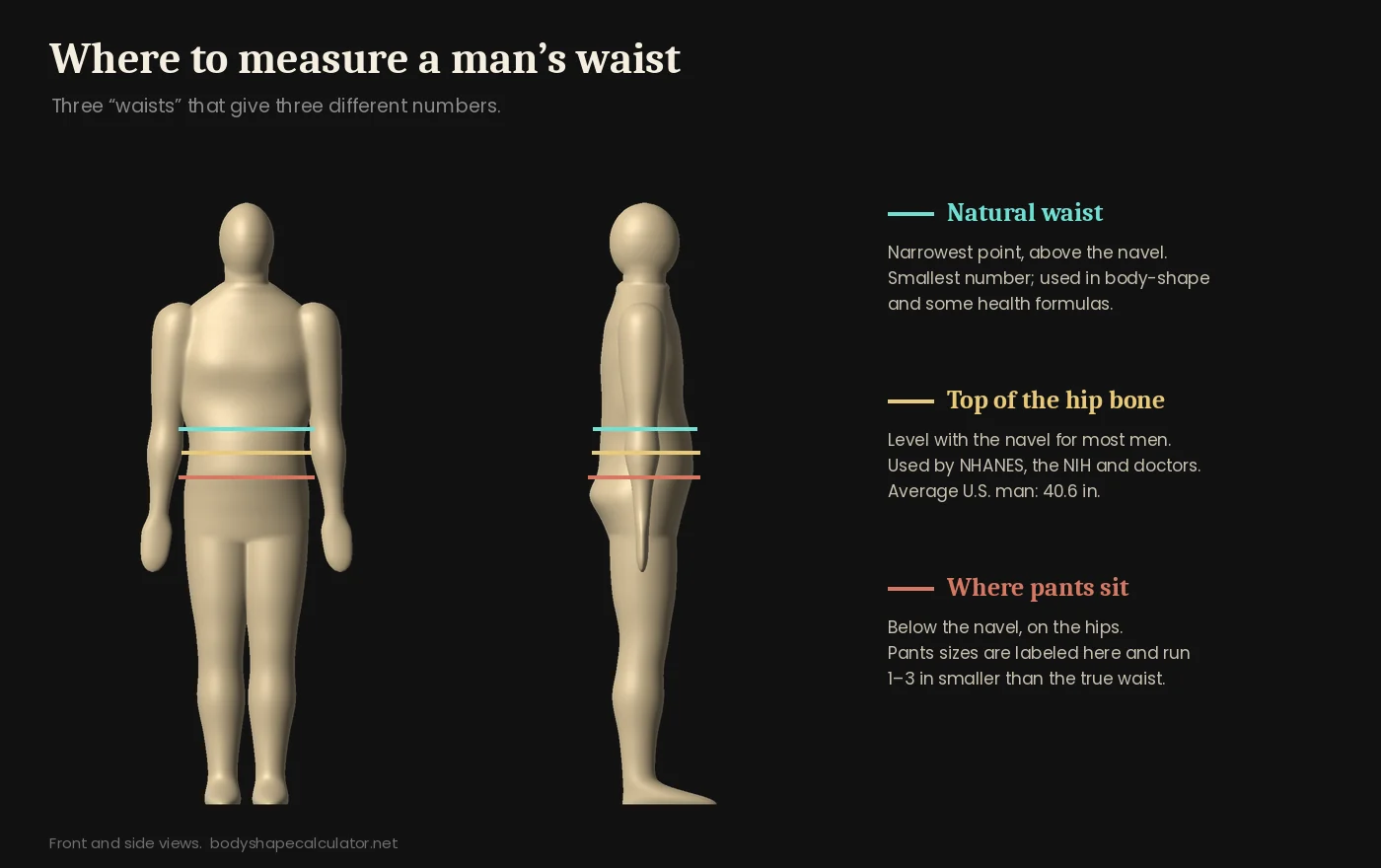
- Find the top of the hip bone. Stand up straight and feel for the top of your hip bone (iliac crest) on the side of your body. For most men it is level with the navel.
- Wrap the tape. Wrap a soft tape measure around your body at that level, keeping it parallel to the floor all the way around. Use a mirror to check the back.
- Breathe out normally. Relax, breathe out normally and read the tape at the end of the breath. Do not suck in your stomach or pull the tape tight.
- Record and repeat. Take two readings and use the average. Measure at the same time of day each time you check, ideally in the morning.
Measuring at the narrowest point instead gives a smaller number, which is what body-shape tools such as our male body type calculator ask for. Stick to one method when tracking progress. Our body measurements guide shows every tape position in 3D.
How Men Compare With Women
The average U.S. woman has a 38.5 inch (98 cm) waist, about 2 inches less than the average man, even though she is about 5 inches shorter. Health cut-offs for women are lower: 31.5 in (80 cm) for increased risk and 35 in (88 cm) for high risk. For a ratio that works for both sexes and every height, see the waist-to-hip ratio calculator.
How to Reduce Your Waist Size
Spot-reducing does not work: crunches build the muscles under the fat but do not burn the fat on top. What shrinks the waist is losing body fat overall, and belly fat is often among the first to go in men.
The basics that work: a modest calorie deficit, enough protein to keep muscle, resistance training two to four times a week, regular walking, and enough sleep. Many men lose roughly an inch of waist for every 8 to 10 pounds of fat lost. Use the 3D body visualizer to see what a smaller waist would look like on your frame.
Men’s Waist Size FAQ
What is the average waist size for men?
The average waist size for men in the United States is 40.6 inches (103 cm), measured at the top of the hip bone, according to NHANES August 2021–August 2023 data for men aged 20 and over. The median is about 40 inches.
Is a 32 inch waist small for a man?
Yes, by today’s U.S. standards a true 32 inch waist is small: only about 5% of men aged 20 and over measure less. Many men who wear 32 inch jeans actually measure 33 to 35 inches with a tape, because pants sizes run small.
Is a 34 inch waist good for a man?
A 34 inch waist is smaller than about 88% of U.S. men and well under the 37 inch (94 cm) level where health risk starts to rise. For most men of average height it is a healthy, lean-to-fit waist.
Is a 36 inch waist big for a man?
No. A 36 inch waist is below the U.S. average (about the 24th percentile) and below the 37 inch (94 cm) risk threshold. Whether it is ideal depends on height: for a 6 foot man it gives a waist-to-height ratio of exactly 0.5.
What waist size is unhealthy for a man?
Health guidelines from the WHO and NIH use 40 inches (102 cm) as the point where the risk of type 2 diabetes and heart disease is substantially increased for men, with risk starting to rise from about 37 inches (94 cm). Some groups, including South and East Asian men, use a lower cut-off of 35.5 inches (90 cm).
What is the ideal waist size for a man by height?
A simple rule is to keep your waist under half your height (a waist-to-height ratio under 0.5). That means under 34 inches at 5 ft 8 in, under 35 inches at 5 ft 10 in, and under 36 inches at 6 ft.
Is my pants size the same as my waist size?
Usually not. Men’s pants are labeled by a waist size that is often 1 to 3 inches smaller than a tape measure reading at the navel, and pants sit lower, on the hips. Measure with a tape for health checks and use the brand’s size chart for clothes.
Does waist size increase with age?
Yes. The median man’s waist grows from about 36.8 inches in his 20s to about 41 to 42 inches in his 50s through 70s, as body fat increases and shifts toward the abdomen.
Sources
- Fryar CD, et al. Anthropometric Reference Data for Children and Adults: United States, August 2021–August 2023. National Center for Health Statistics, 2025. doi:10.15620/cdc/174595
- CDC National Center for Health Statistics. FastStats: Body Measurements.
- World Health Organization. Waist Circumference and Waist–Hip Ratio: Report of a WHO Expert Consultation. Geneva, 2008.
- International Diabetes Federation. The IDF consensus worldwide definition of the metabolic syndrome. 2006.
- Ashwell M, Gunn P, Gibson S. Waist-to-height ratio is a better screening tool than waist circumference and BMI for adult cardiometabolic risk factors. Obesity Reviews. 2012;13(3):275–286.
Percentiles between published points are interpolated; the all-ages figures are weighted from the age-group tables. For general information only, not medical advice.