Quick answer: the average thigh size is about 24 inches (61–62 cm) at the upper thigh for both women and men, and about 21 inches (53 cm) at mid-thigh (women 20.8 in, men 21.2 in).
Average Thigh Size for Men and Women
Thigh size depends heavily on where you put the tape. At the upper thigh, just below the buttock, the average is about 24.3 inches (61.6 cm) for women and 24.6 inches (62.5 cm) for men (U.S. Army survey, ANSUR II). At mid-thigh, halfway to the knee, U.S. adults average 20.8 inches for women and 21.2 inches for men (NHANES).
| 5th | 25th | 50th | 75th | 95th | |
|---|---|---|---|---|---|
| Women | 20.6 in (52.4) | 22.8 in (57.8) | 24.3 in (61.6) | 25.7 in (65.4) | 27.9 in (70.8) |
| Men | 20.9 in (53.0) | 23.1 in (58.6) | 24.6 in (62.5) | 26.1 in (66.4) | 28.4 in (72.0) |
Unlike most body measurements, thigh size is almost the same for men and women. Men have more muscle in the thigh, women more fat, and the two balance out on the tape measure.
Thigh Size Chart for Women
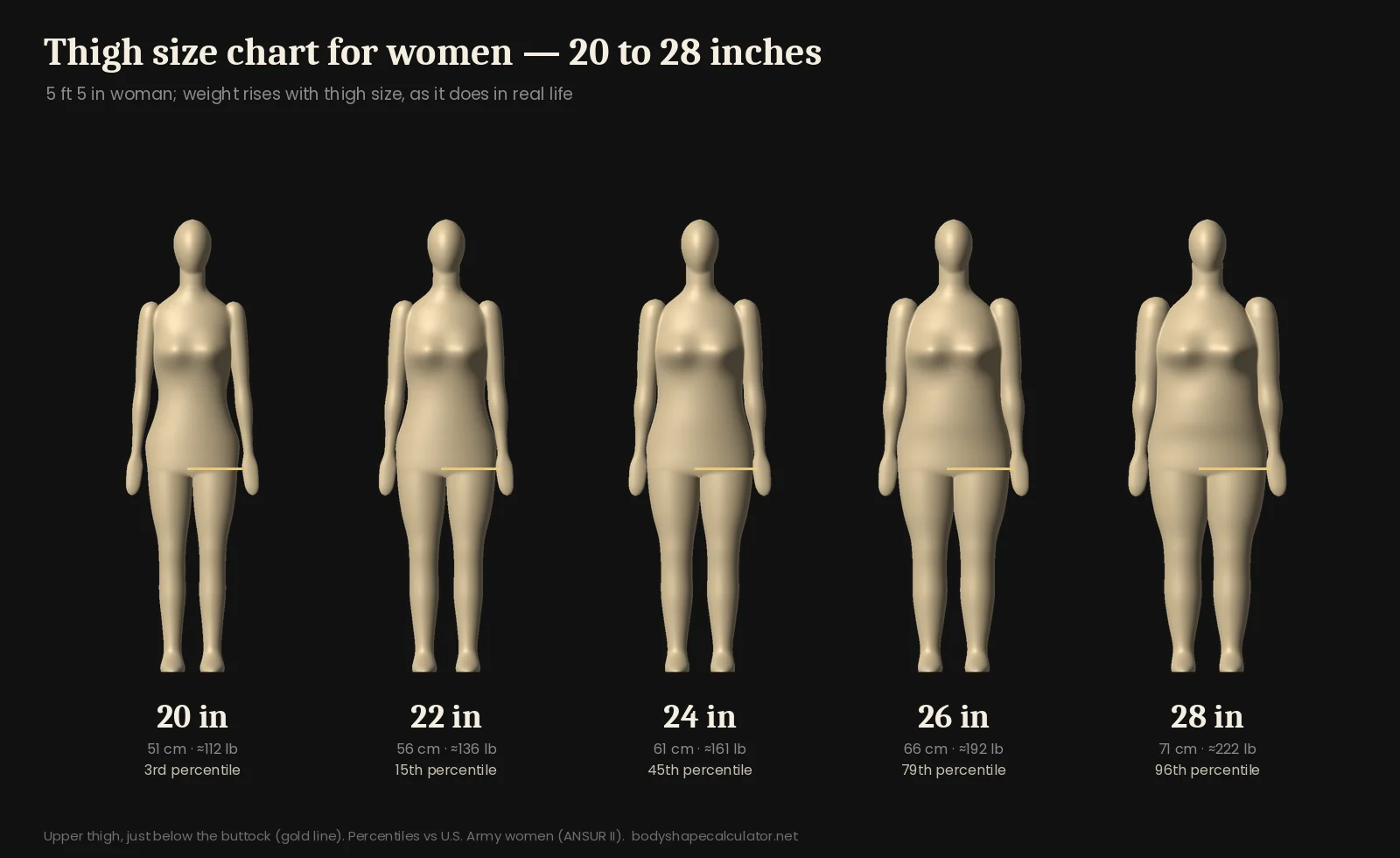
For women, thigh size tracks hip size very closely; in the Army data, hip circumference explains almost 90% of the variation in thigh size. If your thighs are large compared with your bust and waist, you may have a pear body shape, the most common shape in women.
| Height | Average | Middle 90% |
|---|---|---|
| Under 5 ft 2 in | 23.3 in (59.3 cm) | 20.1–26.9 in |
| 5 ft 2–4 in | 24.1 in (61.1 cm) | 20.7–27.5 in |
| 5 ft 5–7 in | 24.8 in (63.0 cm) | 21.4–28.3 in |
| 5 ft 8 in and over | 25.8 in (65.4 cm) | 22.5–28.8 in |
Thigh Size Chart for Men
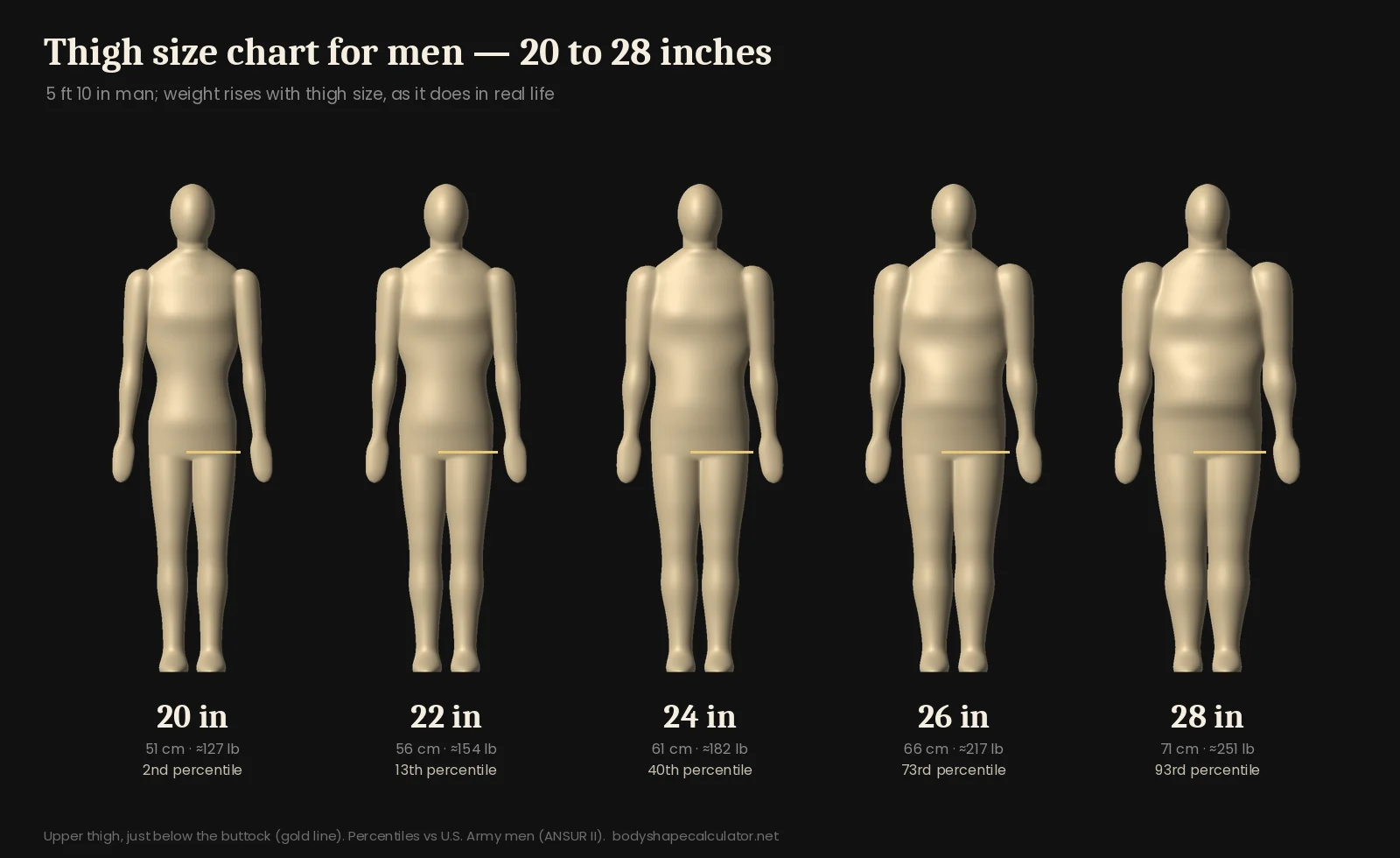
For men, bigger thighs usually mean more muscle, especially in the quadriceps. Recreational lifters often measure 24–26 inches at the upper thigh, while competitive powerlifters and bodybuilders can exceed 28 inches.
Is Your Thigh Size Big? Common Sizes Explained
| Upper thigh | Women | Men |
|---|---|---|
| 20 in (51 cm) | 3rd | 2nd |
| 21 in (53 cm) | 7th | 6th |
| 22 in (56 cm) | 15th | 13th |
| 23 in (58 cm) | 29th | 24th |
| 24 in (61 cm) | 45th | 40th |
| 25 in (64 cm) | 63rd | 57th |
| 26 in (66 cm) | 79th | 73rd |
| 27 in (69 cm) | 89th | 85th |
| 28 in (71 cm) | 96th | 93rd |
| 30 in (76 cm) | 99th | 99th |
These ranks are for the upper thigh. The same reading taken at mid-thigh ranks much higher, because mid-thigh is several inches smaller on the same leg. Always check which site a chart uses.
Average Thigh Size by Age
Thigh size stays fairly steady through the 20s to 40s, then shrinks as people lose muscle in later life. This mid-thigh data comes from the NHANES 2003–2006 survey, the most recent national survey to measure the thigh.
| Age | Men | Women |
|---|---|---|
| 20–29 | 21.7 in (55.1 cm) | 20.8 in (52.9 cm) |
| 30–39 | 21.7 in (55.1 cm) | 21.3 in (54.2 cm) |
| 40–49 | 21.7 in (55.0 cm) | 21.4 in (54.4 cm) |
| 50–59 | 20.9 in (53.2 cm) | 20.9 in (53.2 cm) |
| 60–69 | 20.4 in (51.9 cm) | 20.6 in (52.2 cm) |
| 70–79 | 19.7 in (50.0 cm) | 19.5 in (49.6 cm) |
| 80+ | 18.3 in (46.6 cm) | 18.7 in (47.5 cm) |
The drop after 60, about 3 to 4 inches by the 80s, mostly reflects muscle loss (sarcopenia). Leg strength training is one of the most effective ways to slow it.
How to Measure Your Thigh
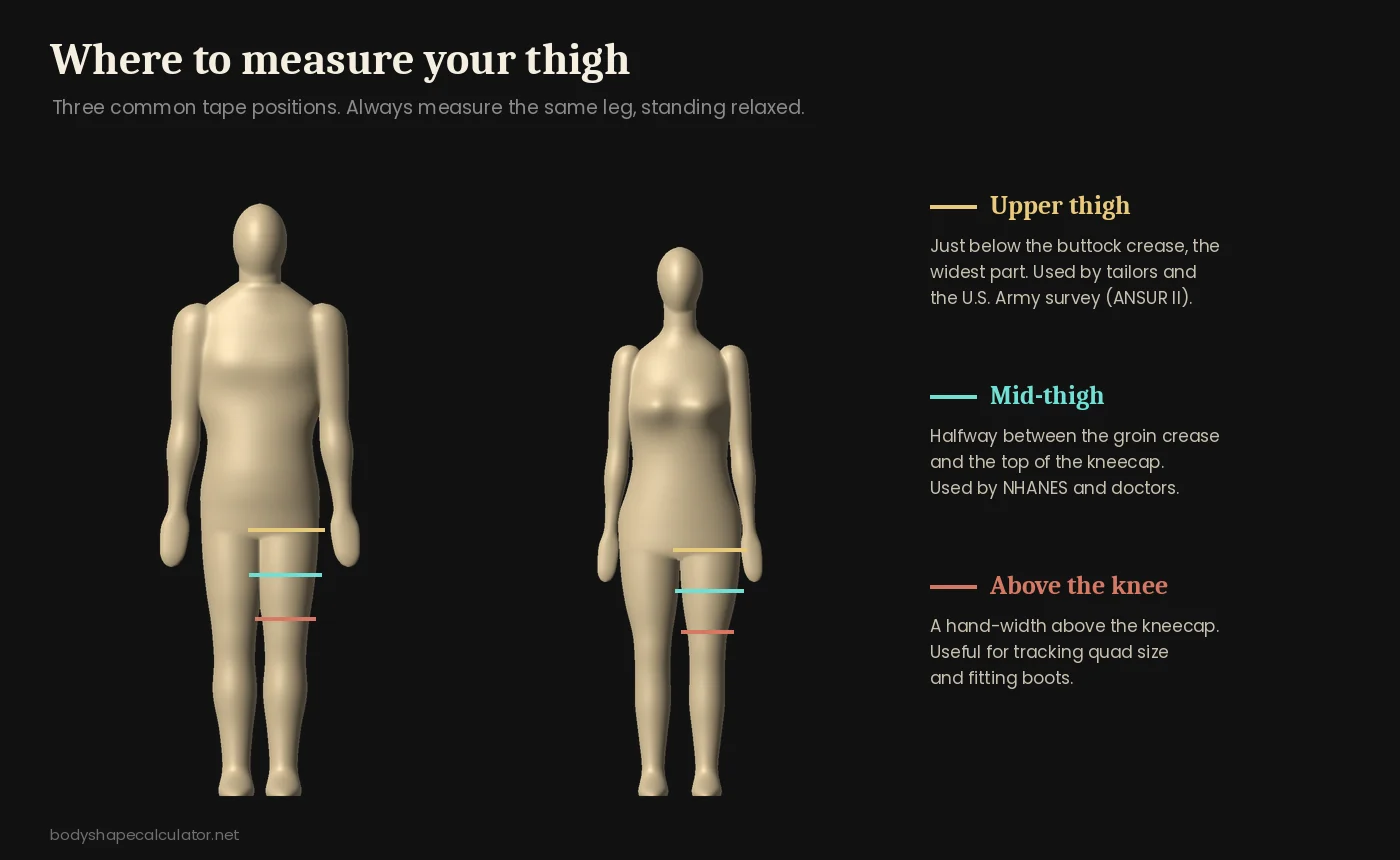
- Stand relaxed. Stand with feet about hip-width apart and your weight spread evenly on both legs. Keep the leg muscles relaxed.
- Find the spot. For the upper thigh, find the widest point just below the buttock crease. For mid-thigh, mark halfway between the groin crease and the top of the kneecap.
- Wrap the tape. Wrap a soft tape around the thigh at that point, keeping it level all the way around. It should sit flat on the skin without pressing in.
- Read and repeat. Read the tape, take a second reading and use the average. Note which leg you measured so you can compare like with like later.
See all the other tape positions in our body measurements guide.
Thigh Size and Health
Thigh size says something about muscle. A Danish study of about 2,800 adults followed for over 12 years found that people with a thigh circumference below about 60 cm (23.6 in, measured just below the buttock) had a higher risk of heart disease and early death, even after accounting for body fat. Small thighs often signal low muscle mass.
Large thighs are not a problem in themselves. Fat stored on the hips and thighs is less harmful than fat around the waist, which is why waist-to-hip ratio gives a better picture of risk than thigh size alone. For overall fatness, check the body fat percentage chart.
Can You Change Your Thigh Size?
Smaller thighs: losing body fat overall is the only way to slim the thighs; exercises that target the inner or outer thigh build muscle but do not burn the fat over it. Many women lose thigh fat later than belly fat because hormones favor fat storage there.
Bigger thighs: squats, lunges, Romanian deadlifts, leg presses and hip thrusts build the quads, hamstrings and glutes. Train legs at least twice a week and add weight over time. Want to see the effect first? Change the thigh measurement in the 3D body visualizer.
Thigh Size FAQ
What is the average thigh size for a woman?
Measured at mid-thigh, the average U.S. woman’s thigh is about 20.8 inches (52.9 cm), from NHANES data for women aged 20 and over. Measured at the upper thigh just below the buttock, U.S. Army women average 24.3 inches (61.6 cm).
What is the average thigh size for a man?
At mid-thigh, the average U.S. man’s thigh is about 21.2 inches (53.8 cm) according to NHANES. At the upper thigh, U.S. Army men average 24.6 inches (62.5 cm).
Is a 22 inch thigh big?
At the upper thigh, 22 inches is below average for both sexes (about the 15th percentile for women and the 13th for men). At mid-thigh, 22 inches is above average, larger than about 69% of U.S. women.
Is a 24 inch thigh big?
At the upper thigh, 24 inches is close to average: about the 45th percentile for women and the 40th for men. At mid-thigh it is large, bigger than about 86% of U.S. women.
Why are women’s thighs similar in size to men’s?
Women carry more fat on the hips and thighs, while men carry more muscle there. The two roughly cancel out, so average thigh circumference is nearly the same for both sexes even though men are taller and heavier.
Where should I measure my thigh?
For clothing and most size charts, measure the upper thigh at its widest point, just below the buttock crease. For comparing with health surveys, measure at mid-thigh, halfway between the groin crease and the top of the kneecap. Always measure the same leg while standing relaxed.
Are bigger thighs healthier?
Thigh size from muscle is linked with better health. Several studies have found that people with very small thighs have a higher risk of heart disease and diabetes, likely because small thighs reflect low muscle mass. Large thighs from fat do not carry the same benefit, so waist size and body fat still matter.
How can I make my thighs smaller or bigger?
You cannot spot-reduce fat from the thighs; losing overall body fat is what shrinks them. To build bigger thighs, train the quads, hamstrings and glutes with squats, lunges, leg presses and deadlifts, progressing the load over time and eating enough protein.
Sources
- Gordon CC, et al. 2012 Anthropometric Survey of U.S. Army Personnel: Methods and Summary Statistics (ANSUR II). NATICK/TR-15/007, 2014.
- McDowell MA, Fryar CD, Ogden CL, Flegal KM. Anthropometric Reference Data for Children and Adults: United States, 2003–2006. National Health Statistics Reports No. 10, 2008.
- Heitmann BL, Frederiksen P. Thigh circumference and risk of heart disease and premature death: prospective cohort study. BMJ. 2009;339:b3292.
Upper-thigh percentiles assume a normal distribution fitted to the ANSUR II mean and spread; women’s mid-thigh percentiles are interpolated from NHANES; men’s mid-thigh percentiles are estimates. For general information only.