Quick answer: a balanced starting point is 1.6–2.2 g of protein per kg of body weight, 25–35% of calories from fat, and the rest from carbohydrate. Calories come from your maintenance needs, minus 15–20% to lose fat or plus about 10% to gain muscle.
How the Macro Calculator Works
First it estimates your basal metabolic rate with the Mifflin-St Jeor equation, the most accurate common formula for adults, and multiplies it by your activity level to get maintenance calories (TDEE). It then adjusts for your goal, sets protein by body weight, fat as a share of calories, and fills the rest with carbohydrate.
BMR (men) = 10 × kg + 6.25 × cm − 5 × age + 5
BMR (women) = 10 × kg + 6.25 × cm − 5 × age − 161
What Are Macros?
| Macro | Calories per gram | Main roles |
|---|---|---|
| Protein | 4 | Builds and repairs muscle, keeps you full |
| Carbohydrate | 4 | Main fuel for intense exercise and the brain |
| Fat | 9 | Hormones, vitamin absorption, long-lasting energy |
Macro Ratios by Goal
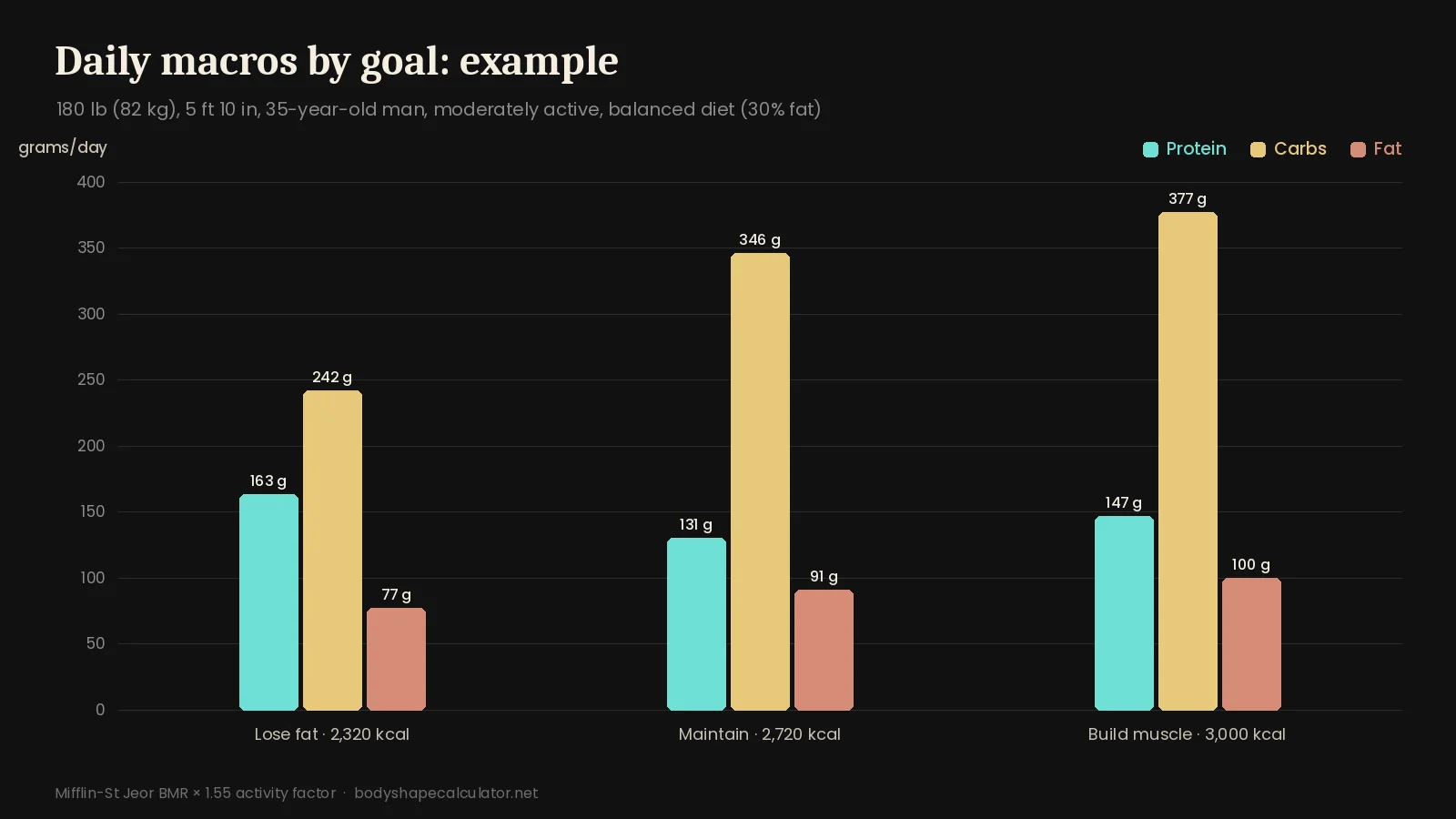
| Goal | Calories | Protein | Fat |
|---|---|---|---|
| Fat loss | TDEE − 15–20% | 1.8–2.4 g/kg | 25–35% |
| Maintenance | TDEE | 1.4–1.8 g/kg | 25–35% |
| Muscle gain | TDEE + 5–10% | 1.6–2.2 g/kg | 20–30% |
For protein alone, use the protein calculator. To see your lean mass and muscle level, try the FFMI calculator.
How to Hit Your Macros
Track for a week or two with a food app to learn portion sizes, then switch to rough tracking if you prefer. Build each meal around a protein source, add vegetables and fruit for fiber (see the fiber calculator), and fill the rest with carbs and fats to taste. Weigh yourself a few times a week and adjust calories by 100–200 if the trend is not moving after 2–3 weeks.
Macro Calculator FAQ
How do I calculate my macros?
Estimate your maintenance calories, adjust for your goal, then set protein (about 1.6–2.2 g per kg), fat (25–35% of calories) and give the remaining calories to carbs.
What is the best macro ratio for weight loss?
There is no single best ratio. High protein (about 2 g per kg) helps keep muscle and control hunger; the carb-to-fat split matters much less than total calories.
How accurate is the Mifflin-St Jeor equation?
It predicts resting metabolism within about 10% for most adults. Treat the result as a starting point and adjust based on your weight trend.
Should I count macros or calories?
Counting calories controls weight; counting protein as well helps body composition. Full macro counting is optional for most people.
How many carbs should I eat?
Usually whatever is left after protein and fat: commonly 40–50% of calories, more for endurance athletes and less on low-carb or keto diets.
Sources
- Mifflin MD, St Jeor ST, et al. A new predictive equation for resting energy expenditure in healthy individuals. American Journal of Clinical Nutrition. 1990;51(2):241–247.
- Jäger R, et al. International Society of Sports Nutrition Position Stand: protein and exercise. JISSN. 2017;14:20.
- U.S. Department of Agriculture and HHS. Dietary Guidelines for Americans, 2020–2025.
Estimates for healthy adults. Talk to a doctor or registered dietitian if you are pregnant, have a medical condition or a history of disordered eating.