Body Shape Guide
Hourglass Body Shape
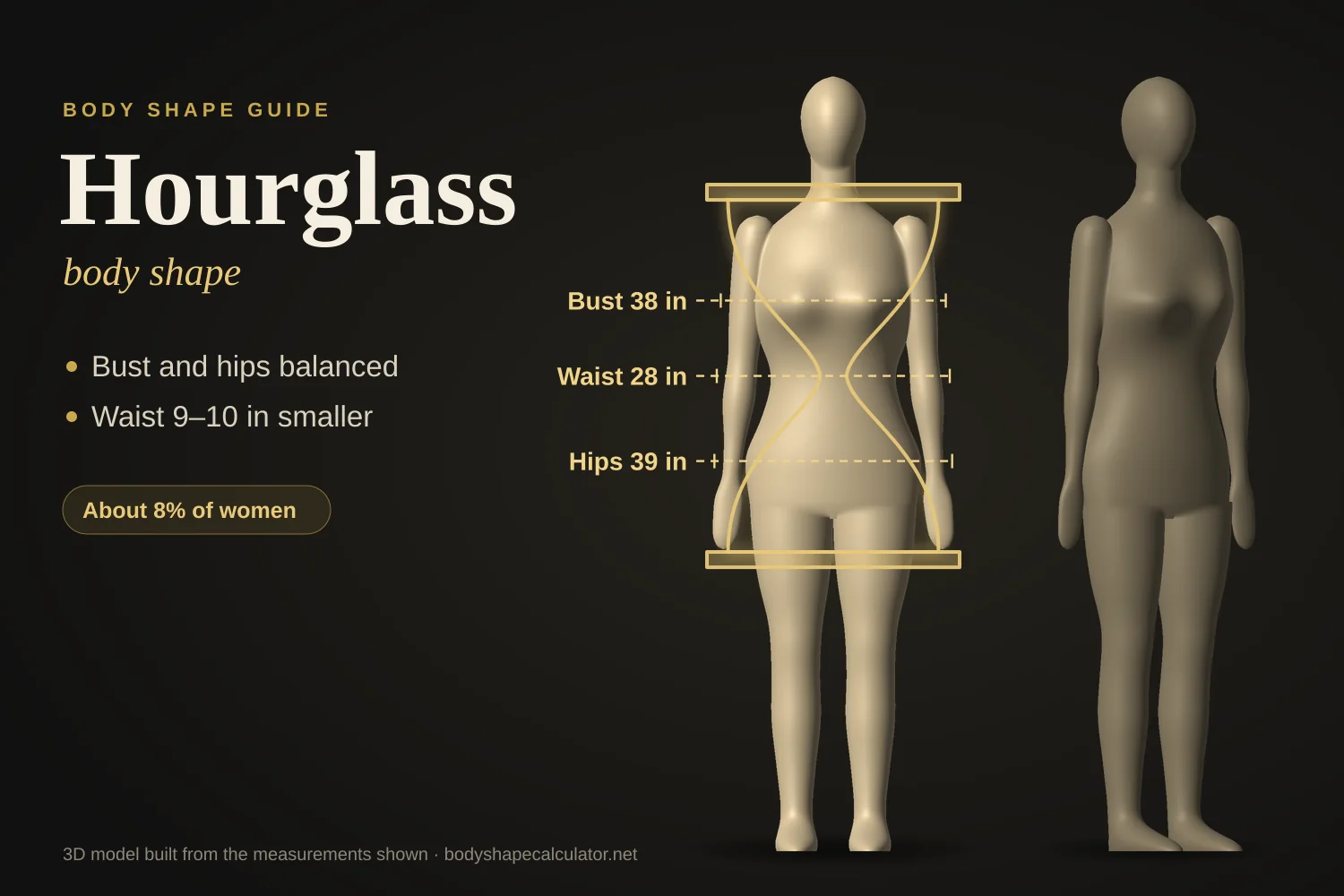
Balanced bust and hips, a clearly defined waist — the rarest of the seven female body shapes, at roughly 8% of women. Here's exactly what defines it, how it differs from its close cousins, and how to dress for it.
What Is an Hourglass Body Shape?
An hourglass body shape has a bust and hips that are close to equal in width, with a waist that is clearly, visibly narrower than both. It's the shape most people picture when they hear "curvy" — but the definition is stricter than that word suggests. Not to know your exact shape yet? Run your numbers through our full body type calculator first; the rest of this guide will make more sense once you have your own figures in front of you.
In measurement terms, the difference between your bust and hips has to be under 3.6 inches, and your waist has to sit at least 9 inches smaller than your bust or at least 10 inches smaller than your hips. Both conditions matter — a body with balanced bust and hips but a soft, undefined waist is a rectangle, not an hourglass. The waist is what earns the name.
Quick check: bust no more than 1 inch bigger than hips, hips no more than 3.6 inches bigger than bust, waist 9+ inches smaller than the bust. If that's you, you're a true hourglass — not top hourglass, not bottom hourglass, the classic version.
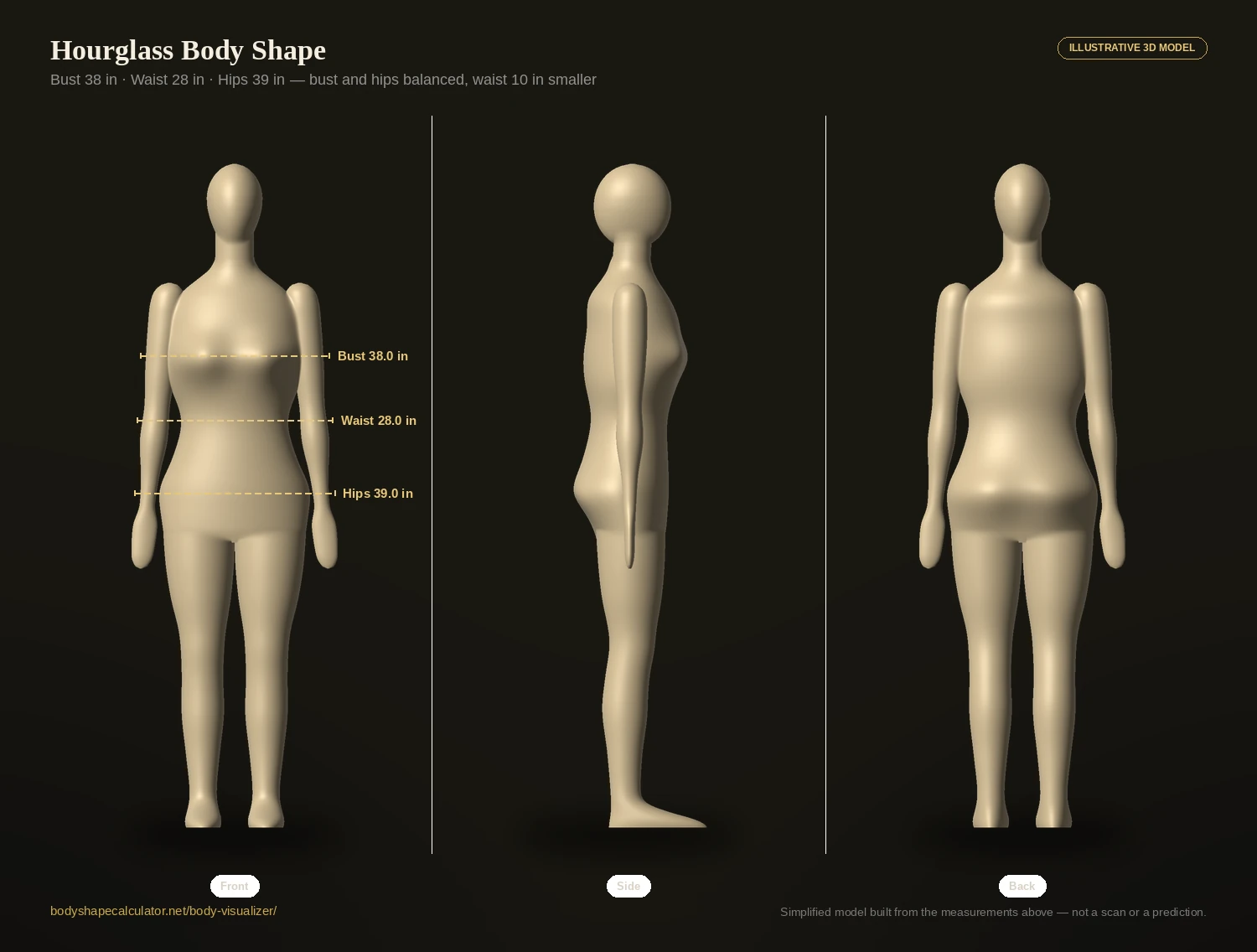
Prefer to see it interactively? The 3D body visualizer has an Hourglass preset: pick the female model, tap the chip and rotate the figure to see how the bust, waist and hip balance looks from every angle. The Top hourglass and Bottom hourglass presets sit right beside it for comparison.
How Rare Is the Hourglass Shape, Really?
The most-cited figure comes from a 2006 North Carolina State University analysis of more than 6,300 women, led by Dr. Cindy Istook, which found that only about 8% measured as a true hourglass — Rectangle came out far more common at roughly 46%, followed by pear at around 20% and apple at around 14%. That specific breakdown traces to a press release rather than a published table, and a 2021 re-analysis of the same formulas on 3D body scans found a notably higher hourglass share (26–34%) — so treat these as the most commonly repeated figures, not an exact census. The classification formula itself is separately documented in peer-reviewed clothing-science literature.
That 8% figure surprises most people, because "hourglass" gets used loosely in everyday conversation to describe anyone with visible curves. The strict version — where bust and hips are within an inch of each other and the waist is dramatically smaller than both — is the rarest of the seven shapes, not the default "curvy" category.
Hourglass vs Top Hourglass vs Bottom Hourglass
These three get confused constantly because they share the same defined waist. The difference is which half is slightly larger — and it changes what actually flatters you.
| Trait | Hourglass | Top Hourglass | Bottom Hourglass |
|---|---|---|---|
| Bust vs. hips | Within 1 in of each other | Bust 1–10 in larger | Hips 3.6–10 in larger |
| Waist | ≥9 in smaller than bust | ≥9 in smaller than bust | ≥9 in smaller than hips |
| Visual balance | Symmetrical | Fuller on top | Fuller below |
| Styling focus | Show the waist, either half works | Necklines and tops carry the look | Bottoms and hemlines carry the look |
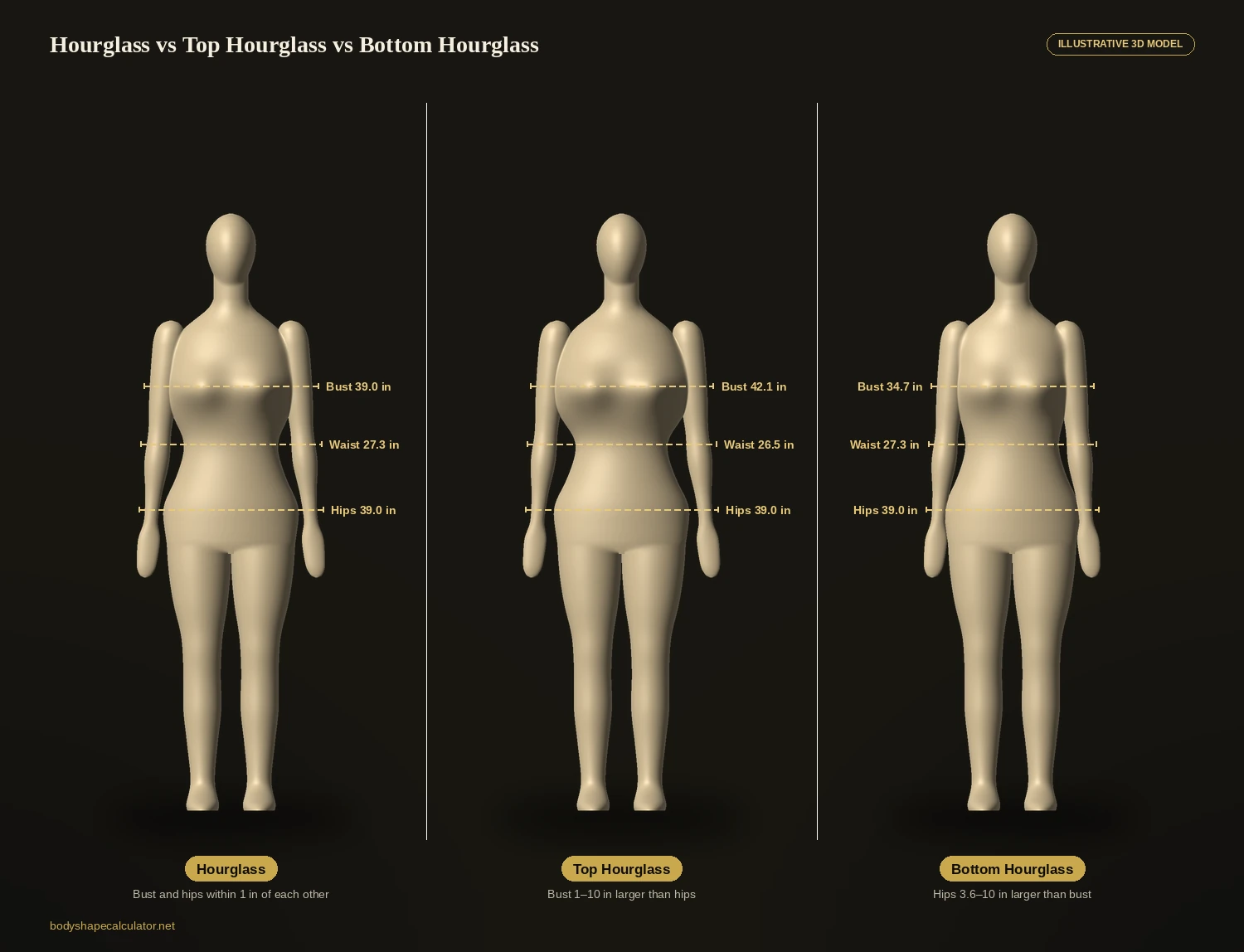
If you've tried classic hourglass styling advice and it hasn't quite landed, this table is usually why — you're likely a top or bottom hourglass, and the small shift in emphasis (upper body vs. lower body) makes a real difference in what looks intentional versus slightly off. Our full body type calculator distinguishes all three using your exact numbers.
What's a Healthy Waist-to-Hip Ratio for This Shape?
Because the hourglass definition requires a waist well below the bust and hip measurements, the waist-to-hip ratio (WHR) for this shape usually lands between 0.65 and 0.75 — comfortably under the WHO's 0.85 threshold for elevated health risk in women. A defined waist and a low WHR tend to go together, though WHR is worth checking on its own rather than assumed from shape alone, since it uses your hip measurement specifically rather than bust.
Get the exact number and what it means for you on our waist to hip ratio calculator — it takes the same two measurements you've likely already got on hand. Our body proportions calculator adds your bust-to-waist ratio and leg length to the same numbers.
How to Dress for an Hourglass Body Shape
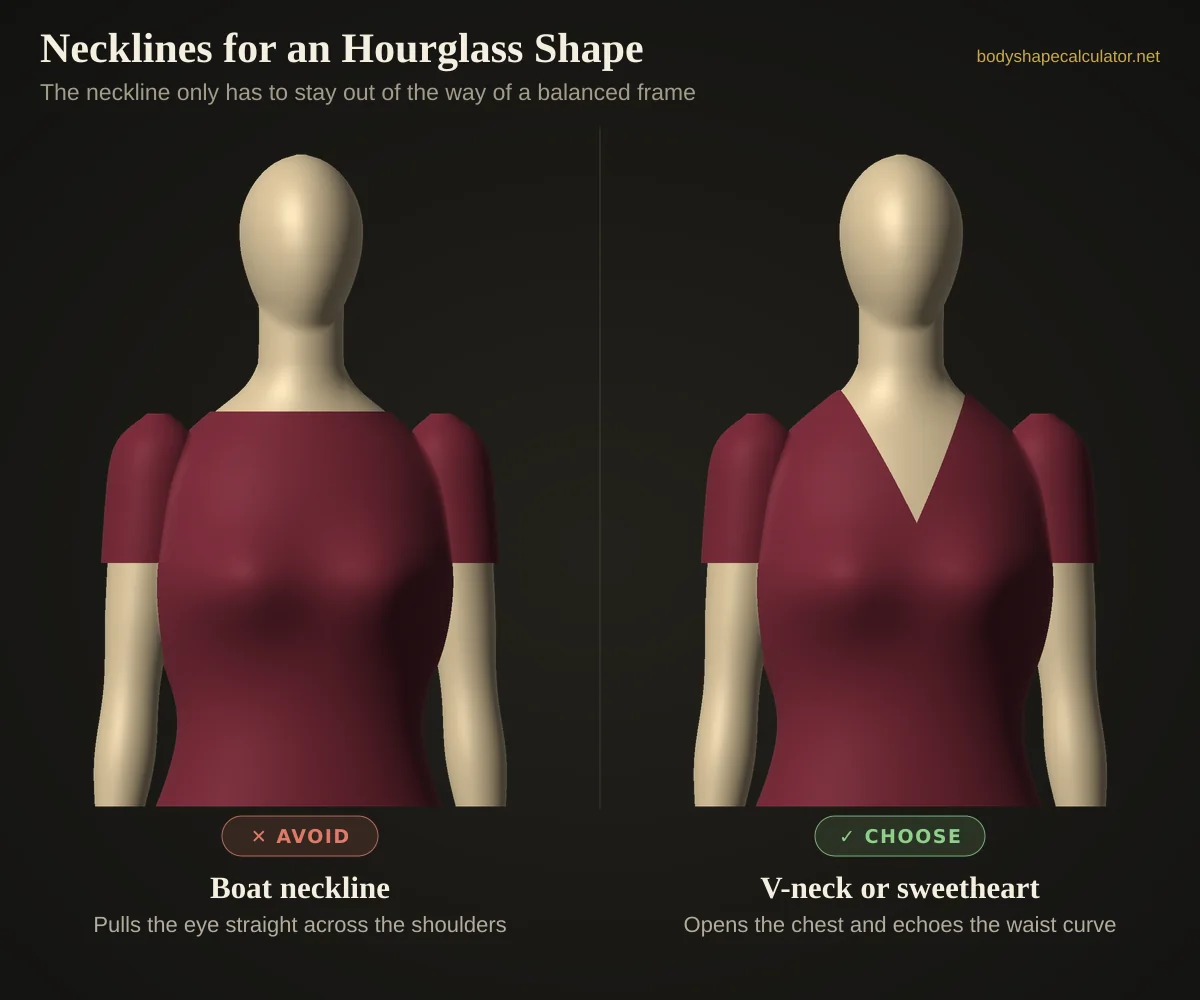
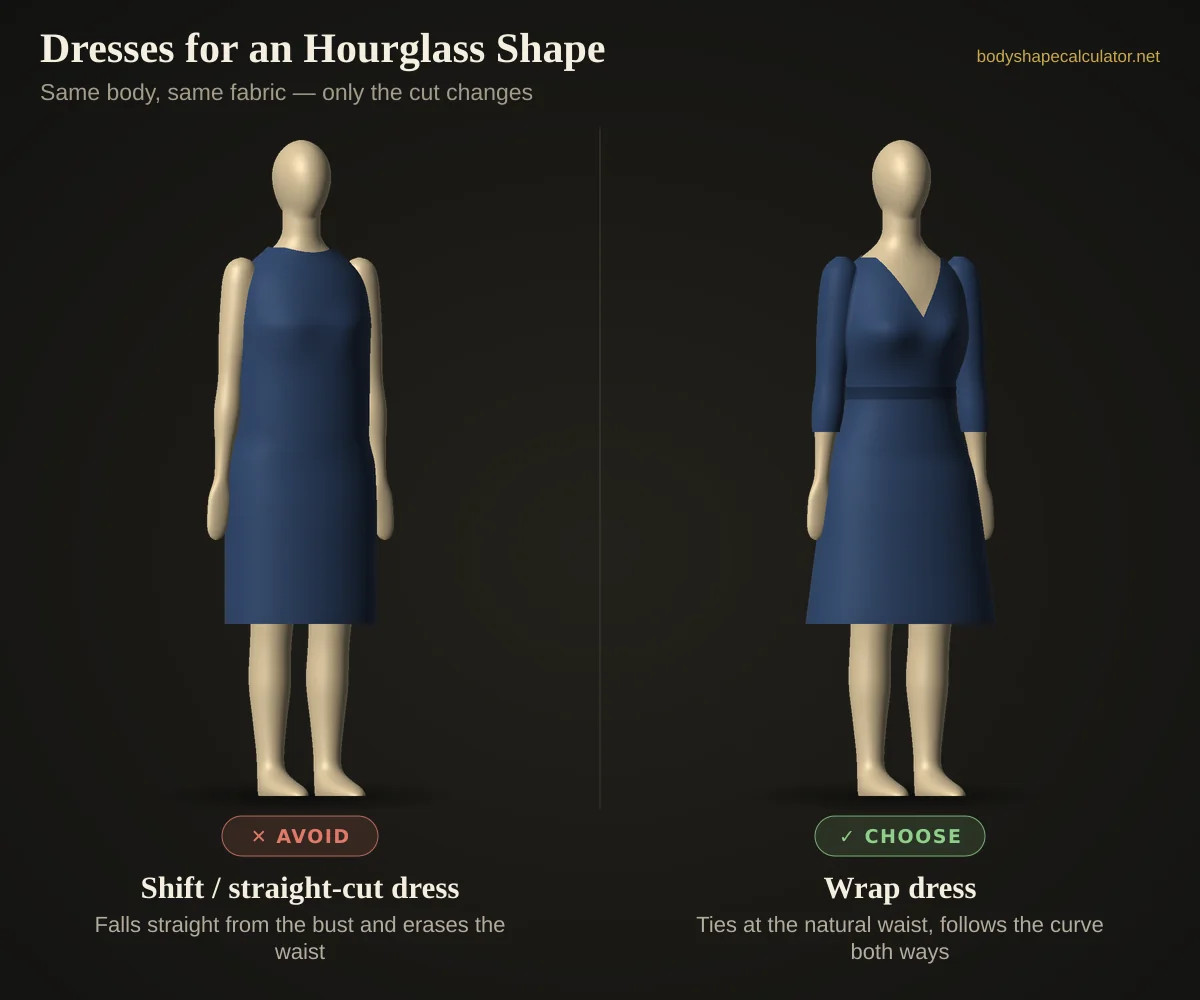
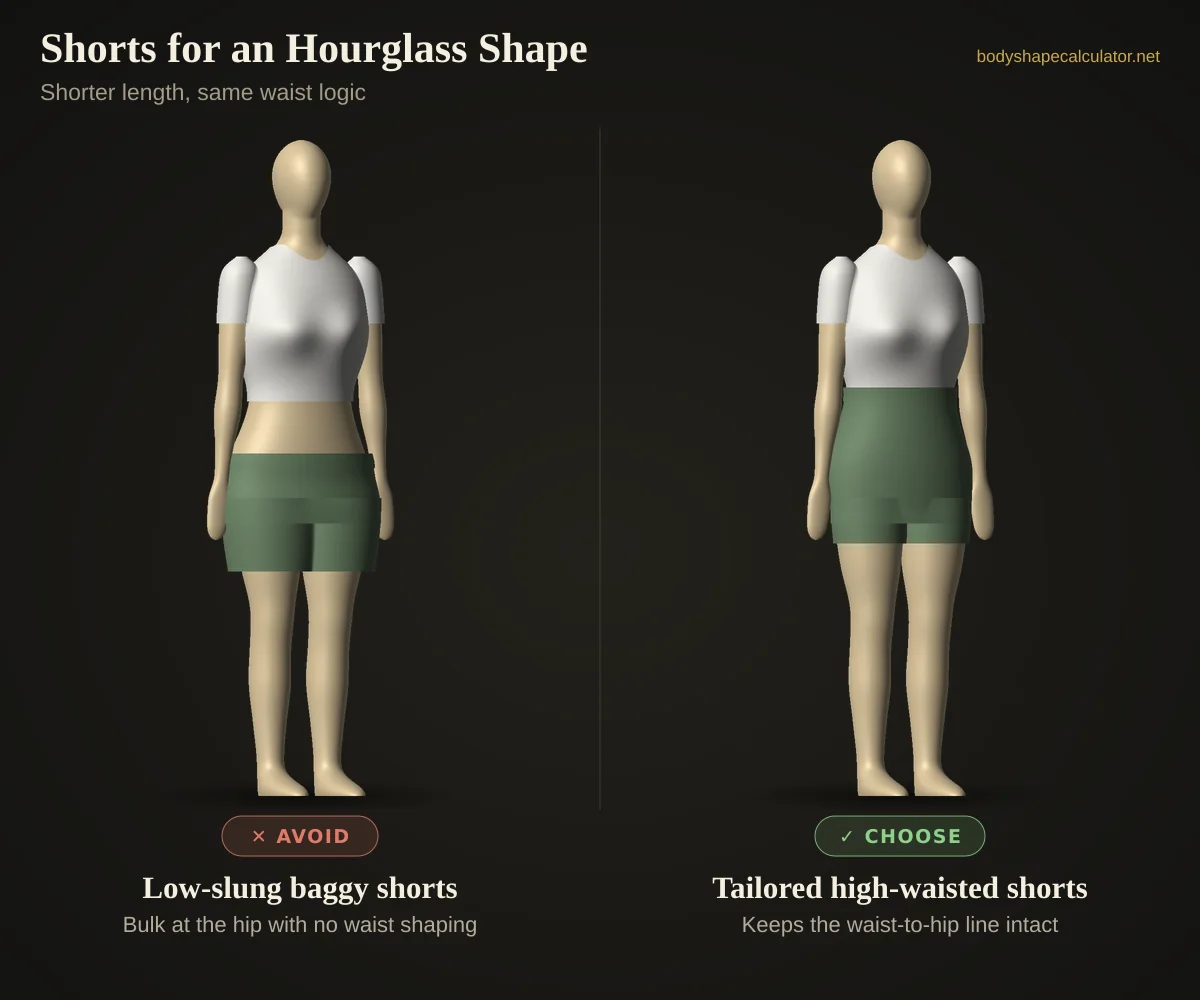
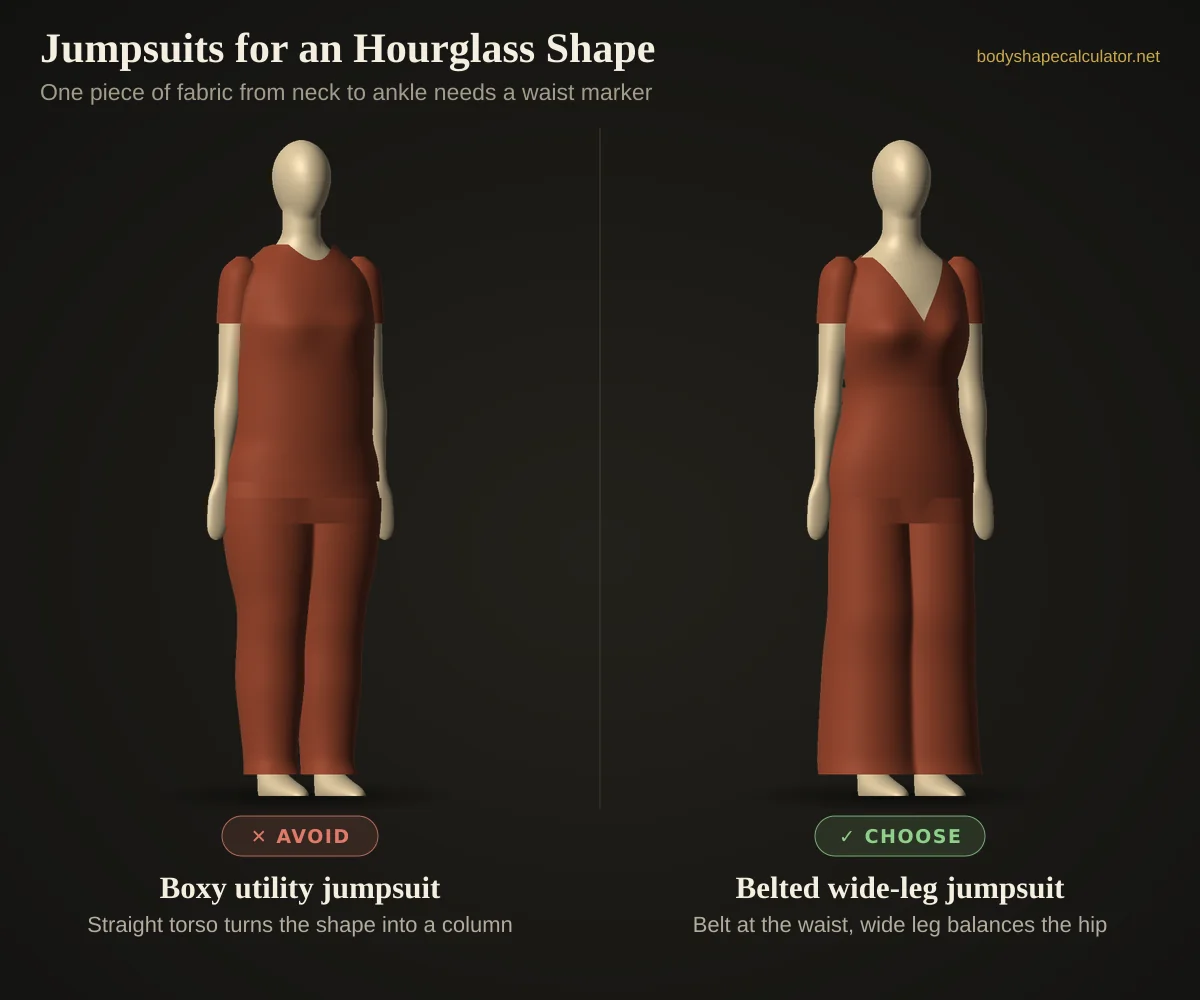
The core rule for this shape is simple and easy to forget: your proportions are already balanced, so clothing that hides the waist is working against you, not for you. The sections below work through each category piece by piece — what to look for and what tends to work against you — each one shown as a 3D “avoid vs choose” pair on the same hourglass figure (38–28–39 in), so the only thing that changes between the two is the cut.
Necklines
Your shoulders and hips are already balanced, so the only job a neckline has here is to not get in the way. Scoop and V-necklines follow the body’s natural line without adding width anywhere it isn’t already there — both are safe, flattering defaults. A sweetheart neckline works the same way while also echoing the curve of your waist, which is why it turns up so often in fitted dresses. What to leave alone: wide boat necklines and structured high necklines, which broaden the shoulder line for no reason when your proportions don’t need the help.
Sleeves
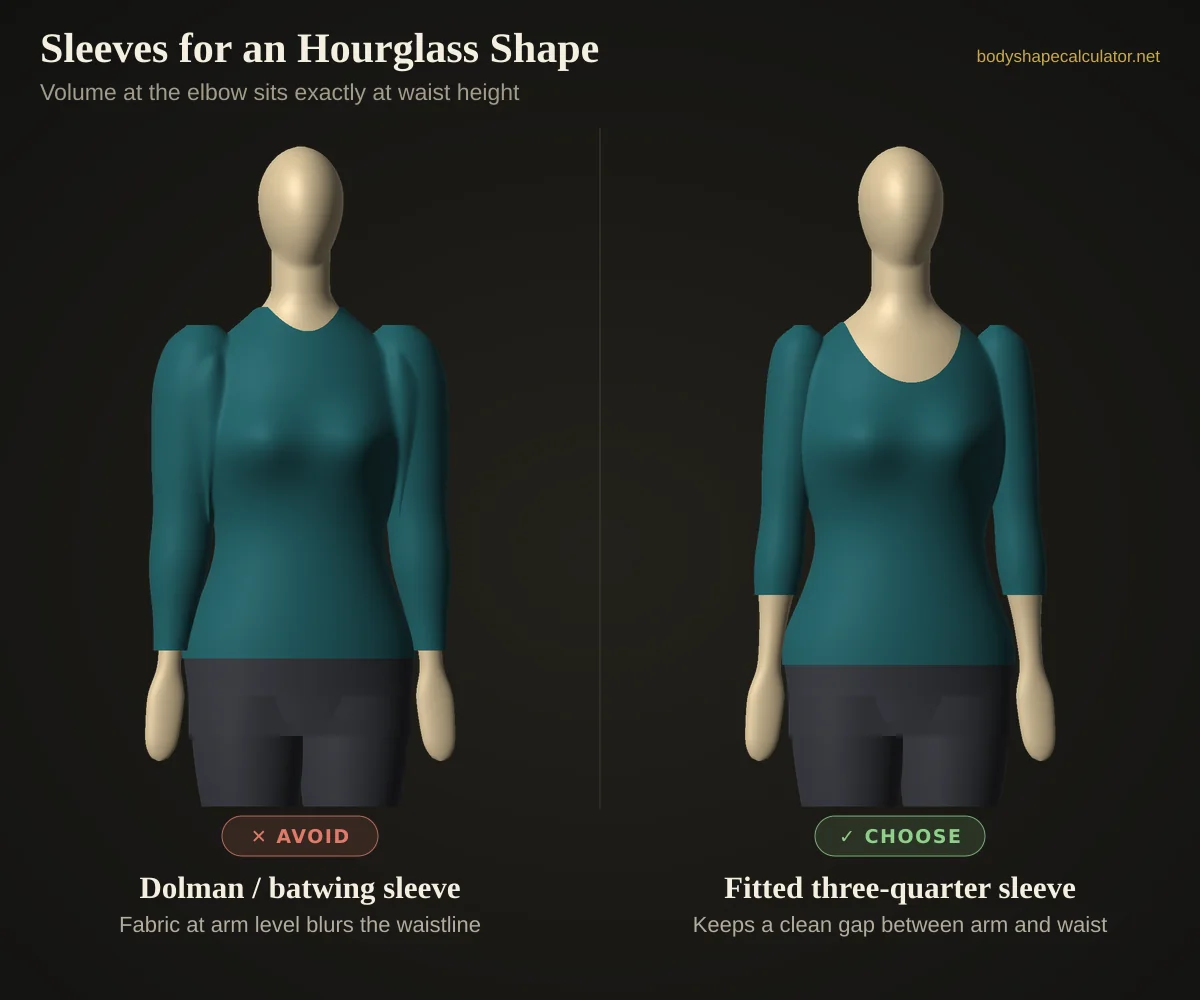
The best sleeve for an hourglass shape is simply one that doesn’t compete with the waist for attention. Fitted and tailored sleeves follow the natural line of the arm and let the eye travel straight down to where your shape actually narrows. A three-quarter sleeve does the same job while showing a little more skin at the wrist. Avoid embellishment or volume at the elbow and cuff specifically — wide, dolman-style sleeves add bulk right at torso height, which visually competes with your waist instead of framing it.
Shirts, T-Shirts & Tops
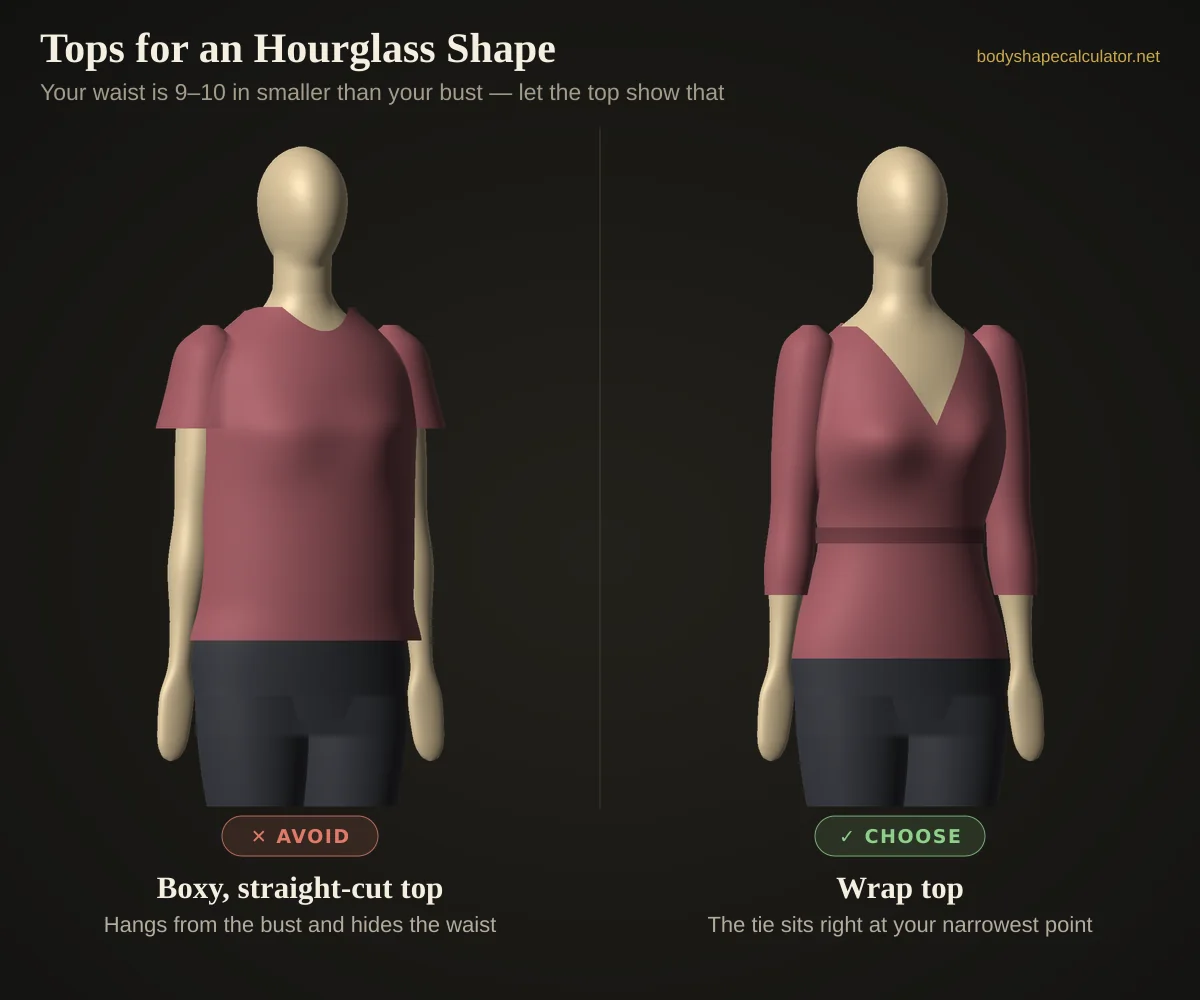
Tops for this shape should follow the natural silhouette rather than fight it. A fitted or semi-fitted cut that skims the ribcage and nips in at the waist is doing exactly what it should — it doesn’t need to be tight, just shaped. A wrap top is a reliable go-to because the tie does the waist-defining work for you, no fitting required. Where this goes wrong is volume: boxy, straight-cut, or heavily oversized tops remove the waistline from the picture entirely, which is the one thing this shape doesn’t need to lose.
Knitwear
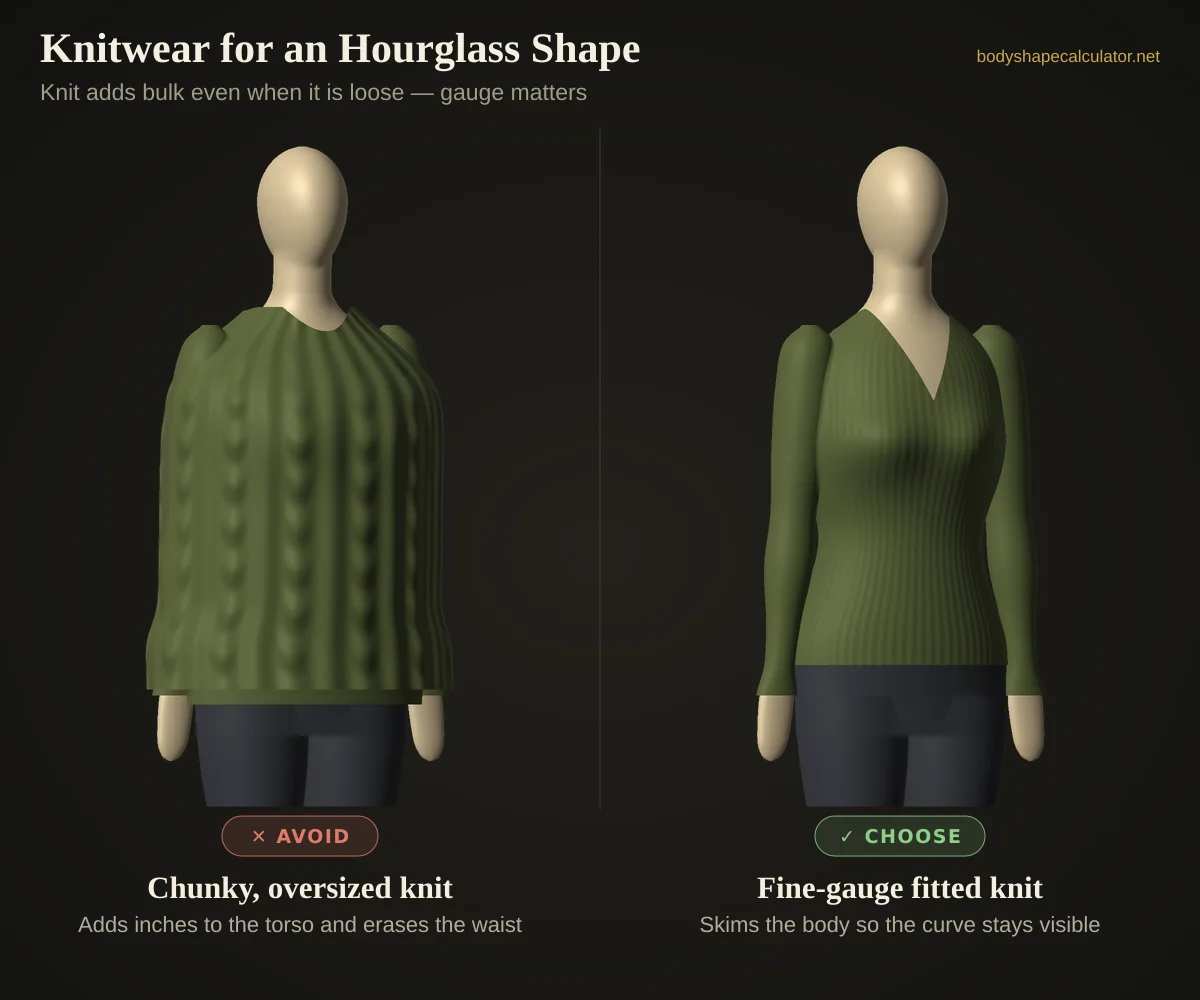
Knitwear is where an hourglass shape most often gets accidentally hidden, because knit fabric adds visual bulk even when it isn’t tight. Lightweight, fine-gauge sweaters that follow the body — rather than standing away from it — keep the waist visible under the layer. A fitted, ribbed knit or a wrap cardigan belted at the waist both do this well. Chunky, cable-knit, or heavily oversized sweaters are the ones to be careful with: they can add several visual inches to the torso and erase the waist definition that’s otherwise your strongest asset.
Jackets & Blazers
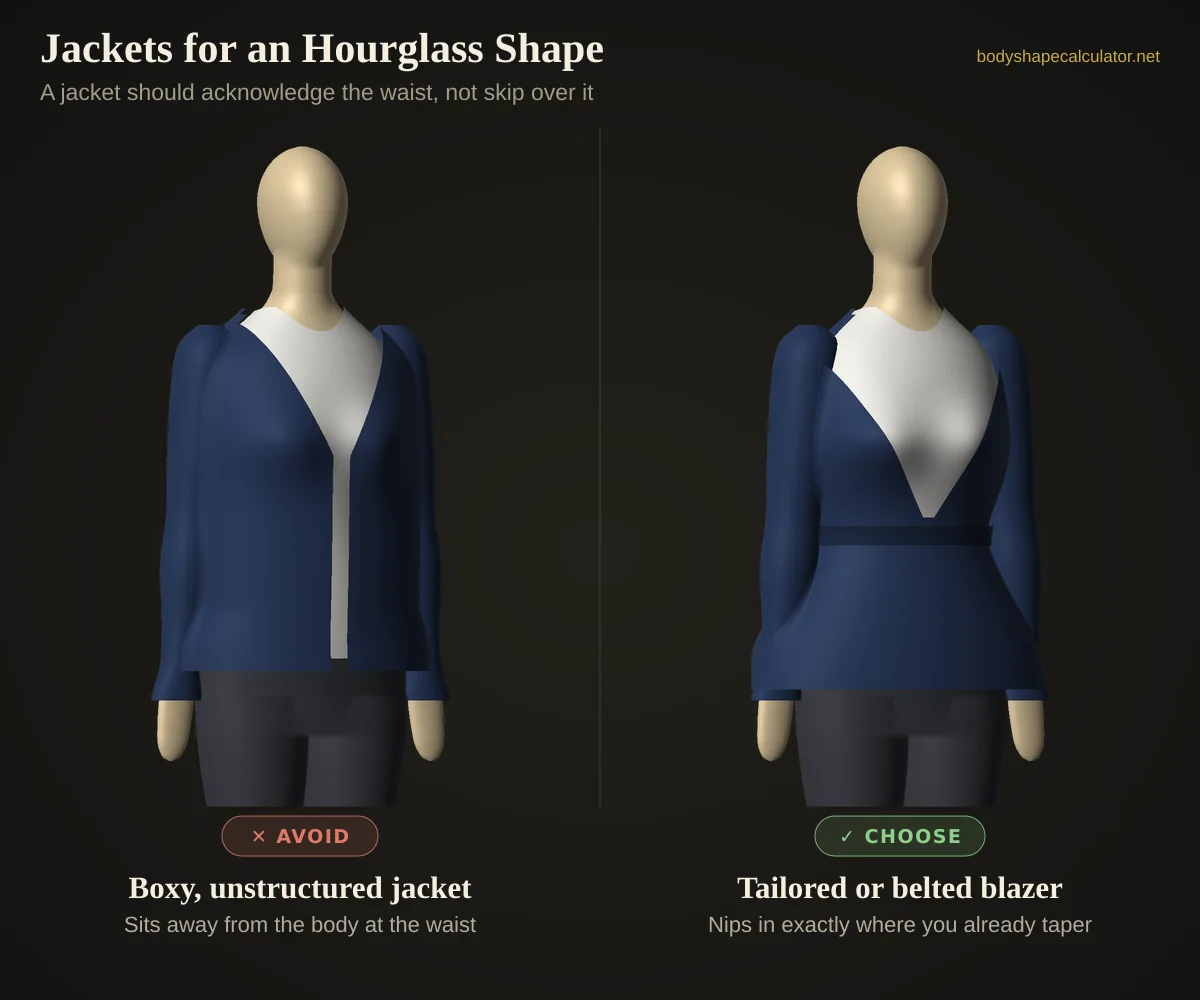
A jacket only flatters this shape if it acknowledges the waist rather than skipping over it. Structured, single-breasted blazers that are tailored or belted at the waist mirror your own proportions and tend to look intentional rather than borrowed. A wrap coat with a tie belt works the same way for outerwear. Boxy, straight-cut, or oversized jackets are the main thing to watch — they sit away from the body and hide the waistline you’d otherwise be showing off, which is usually the opposite of what you want from a jacket in the first place.
Coats
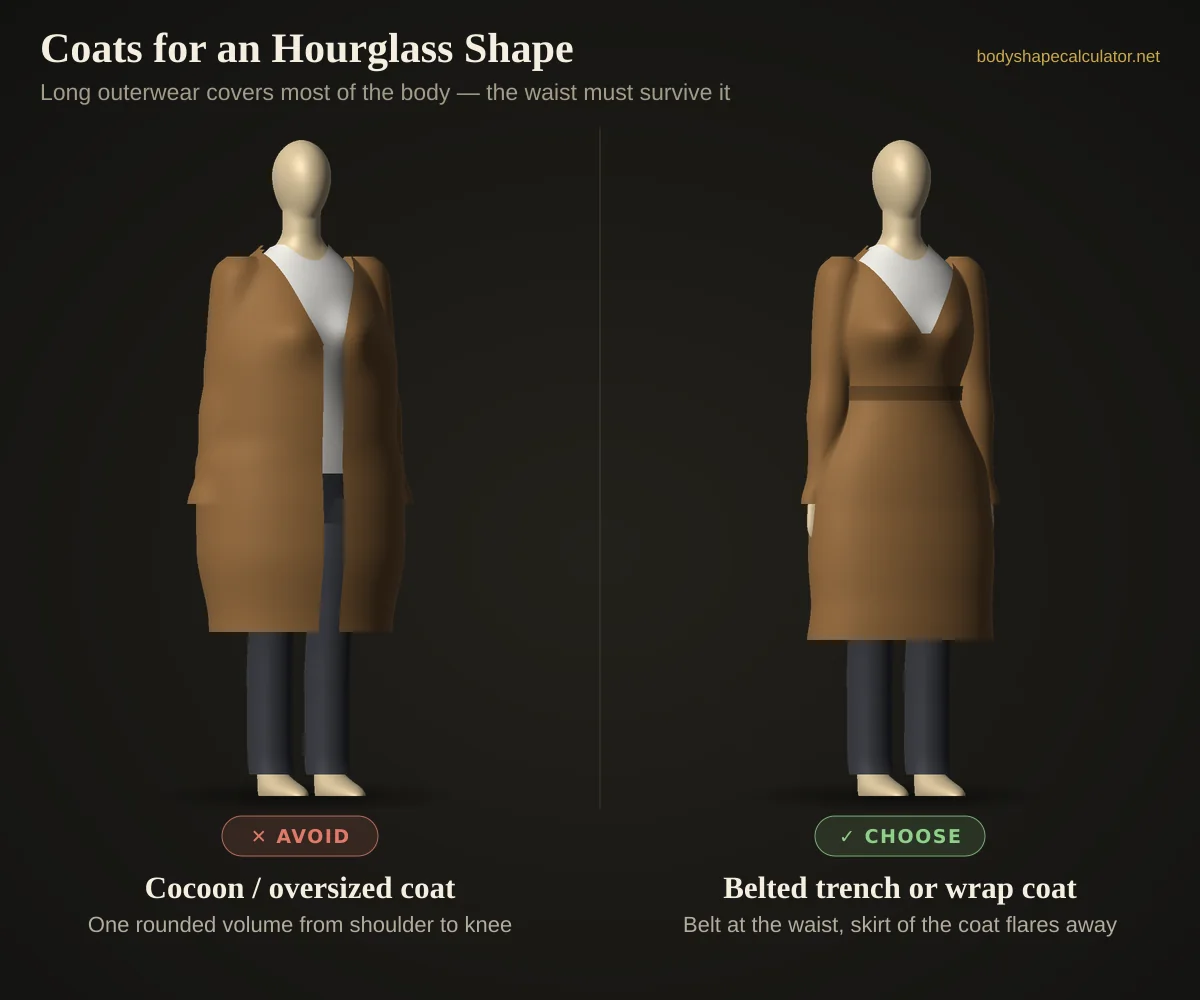
Long outerwear is where an hourglass most often disappears, because a coat covers the waist and the hip at the same time. A belted trench or wrap coat solves that in one move: the belt lands at your narrowest point and the skirt of the coat flares away over the hip, so the outline underneath still reads through a heavy fabric. A single-breasted coat with shaped side seams does the same job without a belt. The one to be careful with is the cocoon or oversized straight coat — a single rounded volume from shoulder to knee that makes a 10-inch waist gap invisible, however relaxed it looks on the hanger.
Trousers
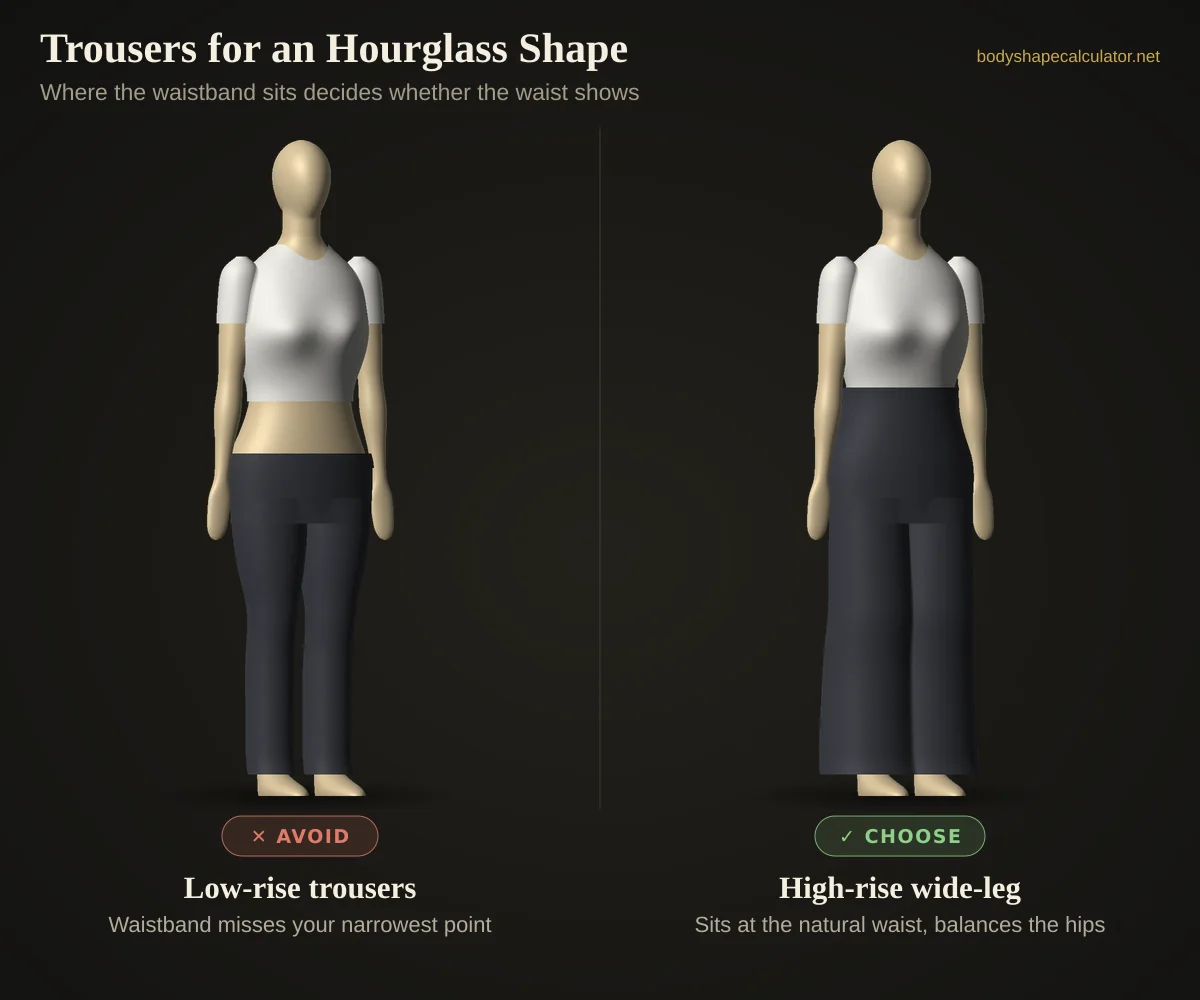
Because your waist is genuinely narrower than your bust and hips, high-rise trousers and jeans are worth prioritising — the waistband sits exactly where your body already narrows, so it reads as tailored rather than tight. Straight-leg and slightly bootcut styles keep the line clean from hip to hem without adding competing volume. Low-rise cuts are the one to be cautious with: they sit below your natural waistline, which means the waistband misses your narrowest point entirely and the trouser reads flatter and less shaped than it would an inch or two higher.
Jeans
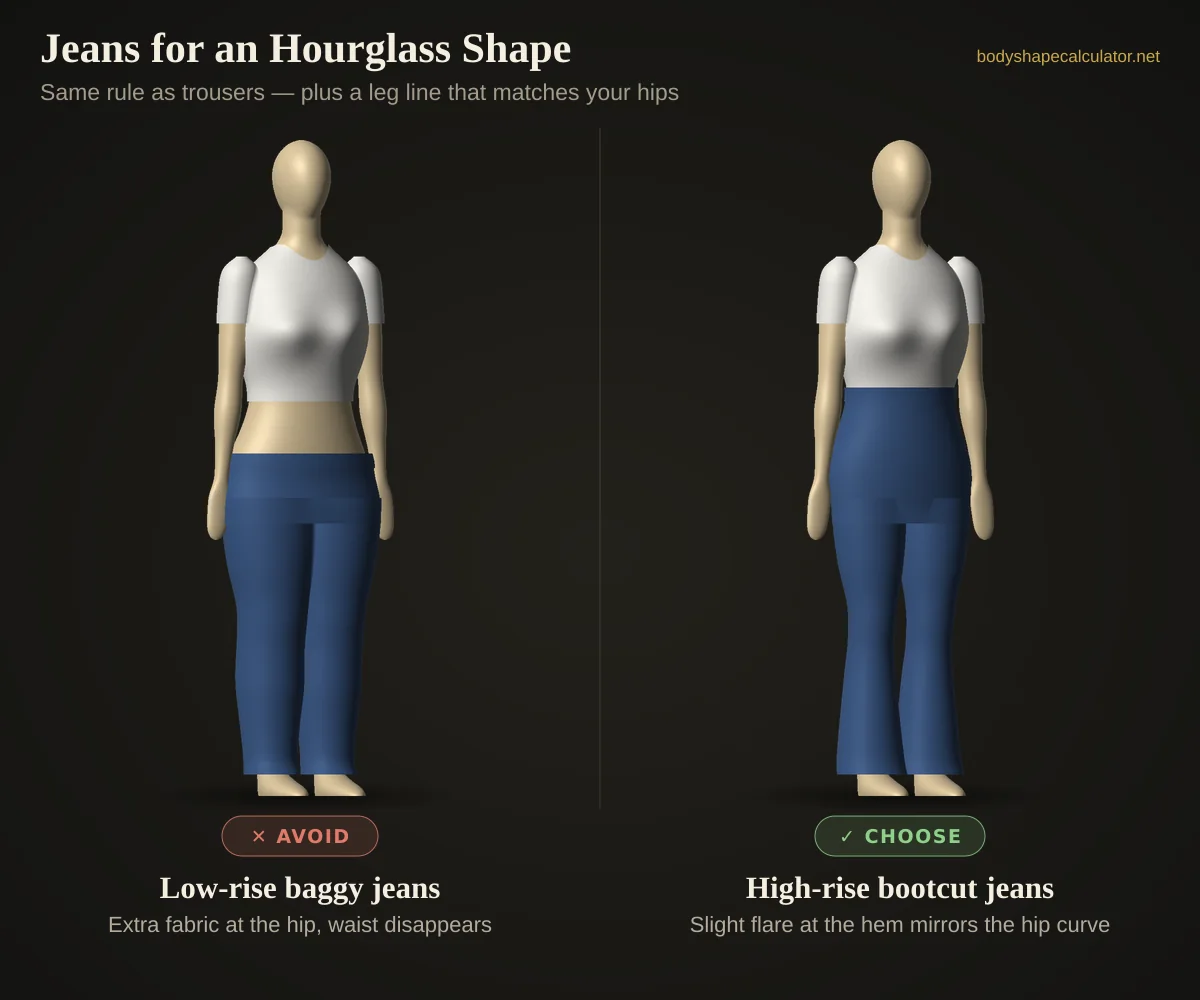
Denim follows the same rise rule as trousers, with one extra lever: the hem. High-rise bootcut or straight jeans sit at the waist and open very slightly below the knee, echoing the hip curve instead of tapering away from it. Because your waist is so much smaller than your hips, a gap at the back waistband is the most common fit problem — a contoured waistband or 1–2% stretch in the denim keeps it flat. Low-rise, baggy and boyfriend cuts are the ones to skip: they add fabric at the hip and drop the waistband below the point that defines your shape.
Skirts
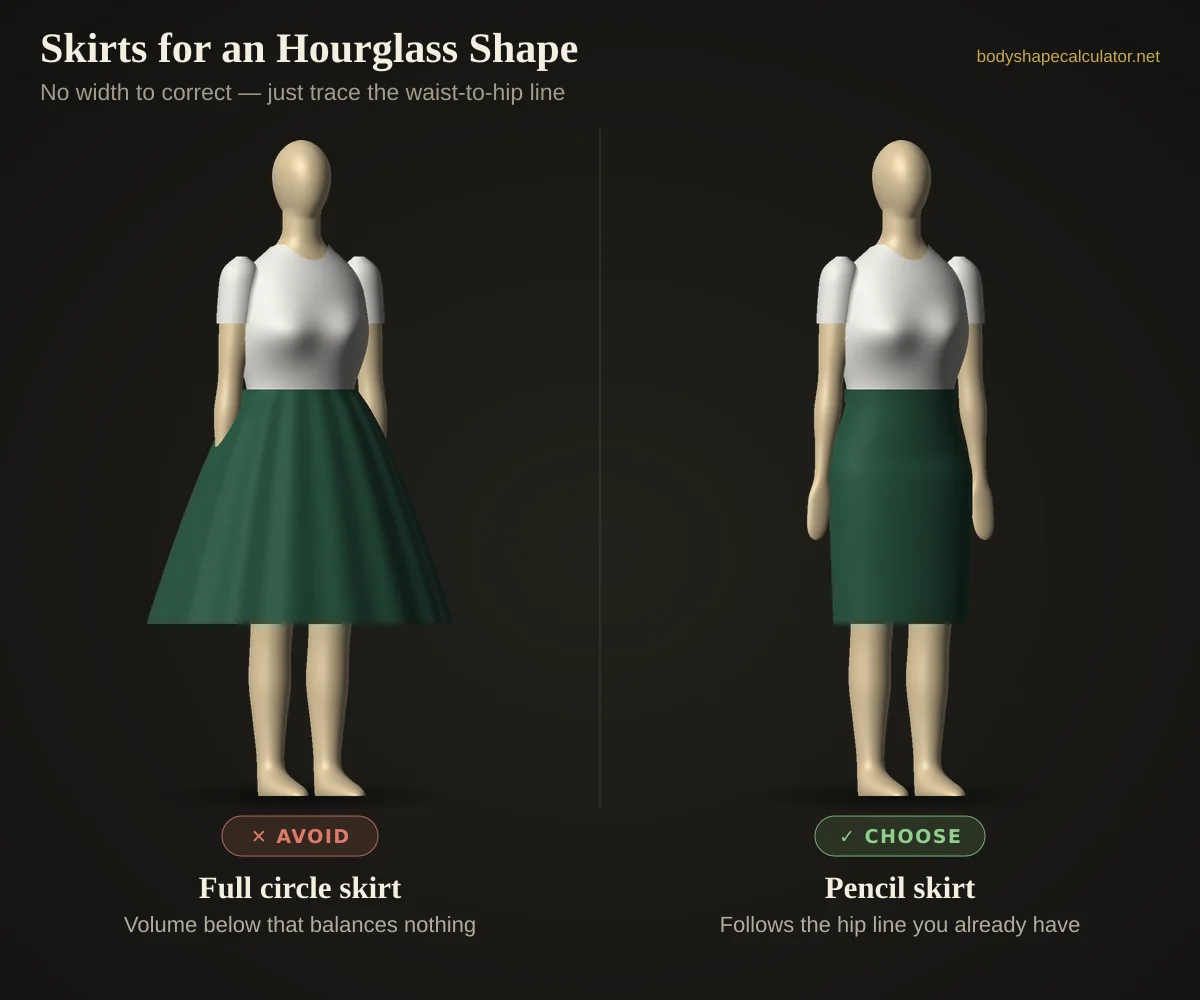
A skirt that follows your actual hip line will always look more deliberate on this shape than one that adds volume you don’t need to balance. A pencil skirt, cut close through the hip and nipped at the waist, is the clearest way to show the proportions you already have. A fitted A-line does the same job with slightly more ease through the thigh. Where this can go wrong is with a lot of extra volume — a full or circle skirt isn’t balancing anything on an hourglass frame, since there’s no width imbalance to correct, so it mostly just hides the waist-hip line underneath it.
Dresses
A dress is the single easiest place to see why this shape earns its name — and the easiest place to lose it entirely with the wrong cut. A wrap dress is close to foolproof: the tie sits at your natural waist and the fabric follows your line on both sides of it. A fitted sheath does the same job with a more structured finish. The one silhouette worth avoiding is the shift or straight-cut dress — it runs in a single unbroken line from shoulder to hem, which on this shape means removing the waist definition that every other silhouette here is designed to show off.
Shorts
The same logic that applies to trousers applies here: a waistband that sits at your natural waist will always look more shaped than one that sits below it. Tailored, high-waisted shorts with a fitted waist and a clean leg line keep the hourglass proportions visible even in a much shorter length. A slightly wider leg is fine as long as the waist itself stays defined. Loose, low-slung, or heavily pocketed cargo shorts are the ones to skip — the extra fabric at the hip and thigh adds bulk without any waist shaping to balance it, so the whole silhouette reads boxier than it needs to.
Jumpsuits & Playsuits
A jumpsuit is one continuous piece of fabric from neckline to ankle, so without a waist marker it turns an hourglass into a column. Look for a belt, tie or seam at the natural waist, then let a wide or straight leg balance the hip below it. A wrap-front bodice gives you the V-neck and the waist definition in a single garment. Playsuits follow the same rule in a shorter length. The one to leave on the rail is the boxy utility jumpsuit worn without a belt — easy to wear, but it removes the one feature this shape is named after.
Hourglass Styling Cheat Sheet
Everything above in one table — useful to screenshot before a shopping trip. The left column is what to reach for first; the right is what tends to hide the waist.
| Category | Reach for | Leave on the rail |
|---|---|---|
| Necklines | V-neck, sweetheart, scoop | Boat, high structured necks |
| Sleeves | Fitted, three-quarter, set-in | Dolman, batwing, heavy cuffs |
| Tops | Wrap, fitted, tucked-in | Boxy, straight-cut, oversized |
| Knitwear | Fine-gauge, ribbed, belted cardigan | Chunky cable, cocoon sweaters |
| Jackets | Tailored, belted, single-breasted | Boxy, unstructured, double-breasted |
| Coats | Belted trench, wrap coat | Cocoon, oversized straight |
| Trousers | High-rise wide-leg or straight | Low-rise, pleated at the hip |
| Jeans | High-rise bootcut, straight | Low-rise baggy, boyfriend |
| Skirts | Pencil, fitted A-line | Full circle, dropped waist |
| Dresses | Wrap, sheath, fit-and-flare | Shift, tent, drop-waist |
| Shorts | Tailored, high-waisted | Low-slung, cargo |
| Jumpsuits | Belted, wrap-front, wide-leg | Boxy utility, unbelted |
Common Hourglass Measurements by Size
The formula holds at every size — it's about the relationship between your numbers, not the numbers themselves. Here's what a true hourglass looks like across a petite, average, and plus-size frame:
| Frame | Bust | Waist | Hips |
|---|---|---|---|
| Petite | 34 in | 25 in | 35 in |
| Average | 38 in | 28 in | 39 in |
| Plus-size | 46 in | 36 in | 47 in |
Notice the pattern in each row: bust and hips sit within an inch of each other, and the waist is a full 9–10 inches smaller than both. That gap is what a stylist means by "defined waist" — it's a specific, measurable thing, not a vague impression.
Try the average row in the Body Visualizer: switch to inches, enter a 38 in bust, 28 in waist and 39 in hips, and the live analysis confirms the shape while you rotate the model.
Frequently Asked Questions
What is the exact ratio for an hourglass body shape?
There's no single "hourglass ratio" number, because the shape is defined by differences in inches rather than a percentage. The two conditions are: bust no more than 1 inch bigger than hips (hips can be up to 3.6 inches bigger than bust), and the waist at least 9 inches smaller than the bust (or 10 inches smaller than the hips). Translated to WHR, that usually works out to roughly 0.65–0.75.
Is the hourglass body shape actually rare?
Yes, by the most widely cited figures — a 2006 NC State analysis puts it around 8% of women, the least common of the seven shapes in that data, well behind rectangle (46%), pear (20%) and apple (14%). It's talked about as though it's the default "curvy" shape, but the strict measurement definition is genuinely uncommon. Worth knowing: those exact percentages come from a press release rather than a peer-reviewed table, and other re-analyses have found different splits — the general pattern (hourglass is rare, rectangle is common) holds up better than any single precise number.
What's the difference between hourglass and bottom hourglass?
Both have a clearly defined waist. In a true hourglass, bust is no more than 1 inch bigger than hips (hips can run up to 3.6 inches bigger than bust). In a bottom hourglass, the hips are 3.6 to 10 inches larger than the bust — still a defined waist, just with the fullness sitting lower. Four-shape systems usually lump bottom hourglass in with "pear," but pear shapes don't have the same sharp waist definition.
Can exercise change your body into an hourglass shape?
Not fully — bust and hip width are largely set by your skeletal frame and breast tissue, which training doesn't change. What resistance training can do is build the muscles around your shoulders, back and glutes, which shifts the visual proportion of an existing shape and can nudge a rectangle or triangle frame toward reading as more balanced. It won't convert your skeleton into a different category, but it does change what you see in the mirror.
What is a "soft" hourglass?
"Soft hourglass" is a styling-world term (not part of the seven-shape measurement system) for someone who is close to hourglass proportions but with slightly less dramatic waist definition, or a bit more overall softness to the frame. If your numbers land just outside the strict 9-inch threshold, you're likely in this territory — most of the same styling advice still applies.
Does the hourglass shape change with age or pregnancy?
Yes. Pregnancy changes waist and hip measurements temporarily and sometimes permanently; menopause-related hormonal shifts often move fat storage toward the abdomen, which can soften a previously sharp waist definition over time. It's worth re-measuring every six months or after a major life change rather than treating one result as fixed for life.
Most of the confusion around this shape comes from treating "hourglass" as a general compliment rather than a specific measurement outcome — once you've got your actual bust, waist and hip numbers next to the formula above, it stops being a matter of opinion.
This guide is for educational and styling purposes only. It does not diagnose any medical condition and isn't a substitute for advice from a qualified healthcare professional.