Quick answer: the average wrist size is 6.9 inches (17.6 cm) for men and 6.1 inches (15.5 cm) for women. Most men measure 6.4–7.5 in and most women 5.6–6.6 in.
Average Wrist Size for Men and Women
The average wrist is 6.9 inches (17.6 cm) for men and 6.1 inches (15.5 cm) for women, measured at the wrist bone in the U.S. Army ANSUR II survey of more than 6,000 adults. Men’s wrists are on average about 0.8 inch (2 cm) larger.
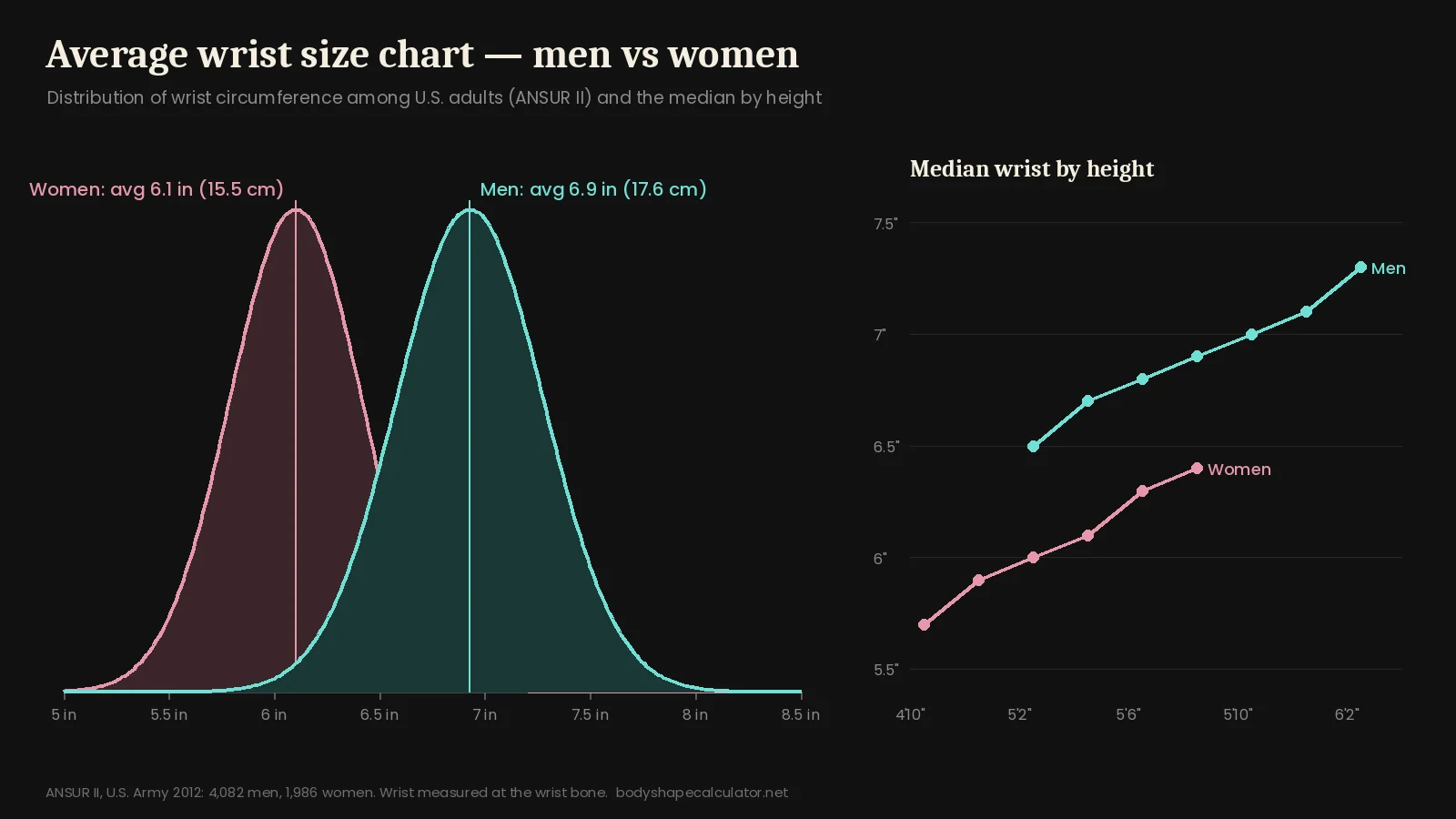
| 5th | 25th | 50th | 75th | 95th | |
|---|---|---|---|---|---|
| Men | 6.4 in (16.2) | 6.7 in (17.0) | 6.9 in (17.6) | 7.2 in (18.2) | 7.5 in (19.0) |
| Women | 5.6 in (14.2) | 5.9 in (15.0) | 6.1 in (15.5) | 6.3 in (16.0) | 6.6 in (16.8) |
Wrist size varies far less than other body measurements: 90% of men fall within about 1.1 inches of each other. That is because the wrist is mostly bone, tendon and skin, with very little fat or muscle.
Is Your Wrist Small, Average or Large?
| Wrist | Men | Women |
|---|---|---|
| 5.5 in (14.0 cm) | 1st | 3rd |
| 6.0 in (15.2 cm) | 1st | 37th |
| 6.5 in (16.5 cm) | 11th | 90th |
| 7.0 in (17.8 cm) | 58th | 99th |
| 7.5 in (19.1 cm) | 95th | 99th |
| 8.0 in (20.3 cm) | 99th | 99th |
A 7 inch wrist is just above average for a man; 7.5 inches is in the top 5%, and fewer than 1 in 100 men measure 8 inches or more.
Average Wrist Size by Height
Taller people have larger wrists: the median rises by roughly a tenth of an inch for every inch of height. Use these medians to judge your wrist against people your own size.
| Height | Men | Women |
|---|---|---|
| 5 ft 2–3 in | 6.5 in | 6.0 in |
| 5 ft 4–5 in | 6.7 in | 6.1 in |
| 5 ft 6–7 in | 6.8 in | 6.3 in |
| 5 ft 8–9 in | 6.9 in | 6.4 in |
| 5 ft 10–11 in | 7.0 in | — |
| 6 ft 0–1 in | 7.1 in | — |
| 6 ft 2–3 in | 7.3 in | — |
What Your Wrist Says About Frame Size
Because the wrist carries so little fat, doctors and dietitians use it to estimate skeletal frame size. The most common method divides height by wrist circumference:
| Small frame | Medium frame | Large frame | |
|---|---|---|---|
| Men | above 10.4 | 9.6–10.4 | below 9.6 |
| Women | above 11.0 | 10.1–11.0 | below 10.1 |
Frame size helps explain why two people of the same height can have very different healthy weights. Get a full result, with BMI context, from the body frame size calculator.
How to Measure Your Wrist
- Find the wrist bone. Rest your forearm on a table, palm up. Find the small bony bump on the little-finger side of the wrist.
- Wrap the tape. Wrap a soft tape measure around the wrist just above that bone, on the hand side, where a watch would sit. Keep the wrist straight and relaxed.
- Keep it snug. The tape should lie flat on the skin without pressing in. If you use a strip of paper or string, mark where it overlaps and measure it against a ruler.
- Read and record. Read the measurement to the nearest eighth of an inch or 0.5 cm. Measure both wrists; a difference of a few millimeters is normal.
No tape? Wrap a strip of paper or a phone charger cable around the wrist, mark it and lay it against a ruler. Our body measurements guide covers the other tape positions.
Wrist Size for Watches and Bracelets
For watches, the case should sit within the width of the wrist, with the lugs not hanging over the edge. A rough guide by wrist circumference:
- Under 6 in: 28–36 mm cases.
- 6–6.5 in: 34–38 mm.
- 6.5–7 in: 36–40 mm.
- 7–7.5 in: 38–42 mm.
- Over 7.5 in: 40–46 mm.
For bracelets, add about 0.5 in (1.3 cm) for a snug fit, 0.75 in for comfort and 1 in (2.5 cm) for a loose drape. Thicker bracelets need a little more room than thin chains.
Can You Change Your Wrist Size?
Adult wrist bones do not grow, so wrist circumference changes very little. Forearm work (wrist curls, farmer’s carries, grip training) builds the forearm just above the wrist, and gaining or losing weight shifts the measurement by a few millimeters. Large wrists are often linked to a bigger frame, which can support more muscle; see where you stand with the average bicep size and average shoulder width pages.
Wrist Size FAQ
What is the average wrist size for a man?
The average wrist size for a man is about 6.9 inches (17.6 cm), from the U.S. Army ANSUR II survey of 4,082 men. The middle half of men measure 6.7 to 7.2 inches (17.0 to 18.2 cm).
What is the average wrist size for a woman?
The average wrist size for a woman is about 6.1 inches (15.5 cm), from the ANSUR II survey of 1,986 women. The middle half measure 5.9 to 6.3 inches (15.0 to 16.0 cm).
Is a 7 inch wrist big for a man?
A 7 inch wrist is slightly above average for a man, larger than about 58% of men. For a man around 6 feet tall it is right on the median.
Is a 6 inch wrist small for a man?
Yes. A 6 inch wrist is smaller than about 99% of men, which puts it in the small range. For a woman, 6 inches is close to average.
What wrist size means a large frame?
Divide your height by your wrist circumference. For men, a ratio below 9.6 means a large frame and above 10.4 a small frame; for women, below 10.1 is large and above 11.0 small. For example, a 6 ft man with a 7.5 inch wrist has a ratio of 9.6, the edge of a large frame.
Can you make your wrists bigger?
Only a little. Wrist size is mostly bone and tendon, which do not grow in adults. Forearm training builds the muscles just above the wrist, and gaining body fat adds a small amount, but the wrist bone itself stays the same.
What size watch fits my wrist?
As a rough guide, wrists under 6.5 inches suit cases of about 34–38 mm, 6.5–7.5 inches suit 36–42 mm, and over 7.5 inches suit 40–46 mm. The lugs should not overhang the edges of your wrist.
What bracelet size do I need?
Add about half an inch (1.3 cm) to your wrist measurement for a snug bracelet, three-quarters of an inch for a comfortable fit, and about an inch (2.5 cm) for a loose fit.
Sources
- Gordon CC, et al. 2012 Anthropometric Survey of U.S. Army Personnel: Methods and Summary Statistics (ANSUR II). NATICK/TR-15/007, 2014.
- MedlinePlus (U.S. National Library of Medicine). Frame size.
- Grant JP. Nutritional assessment by body compartment analysis. In: Handbook of Total Parenteral Nutrition. 1980 (height-to-wrist frame index).
Percentiles assume a normal distribution fitted to the ANSUR II percentiles; height percentiles use the published medians and middle-half ranges. Watch and bracelet sizes are general styling guidance.