Quick answer: the five zones are 50–60%, 60–70%, 70–80%, 80–90% and 90–100% of your heart rate range. With the Karvonen method, zone heart rate = resting HR + (max HR − resting HR) × intensity. Zone 2 is 60–70%.
The Five Heart Rate Zones
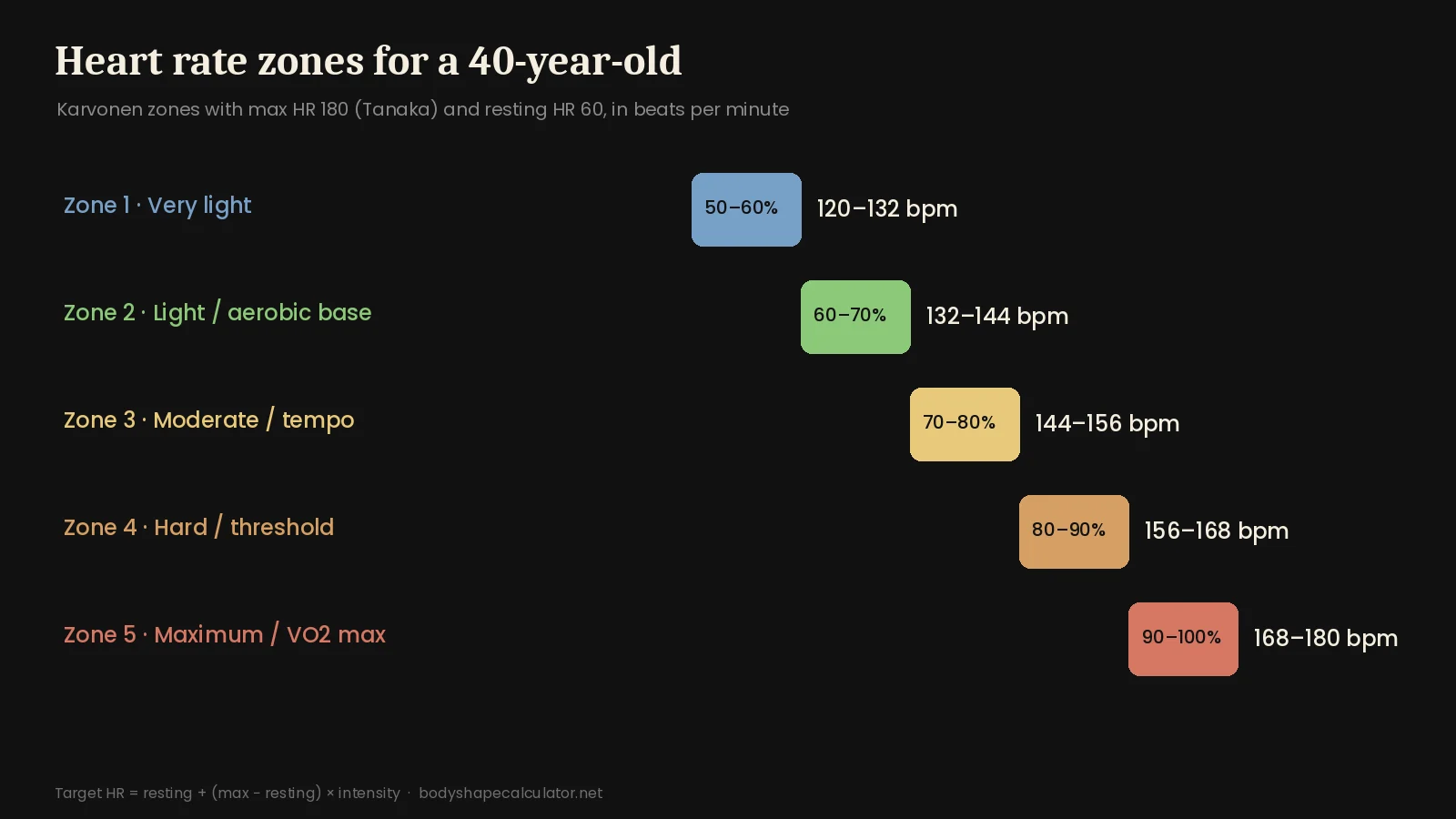
| Zone | Intensity | What it trains |
|---|---|---|
| 1 · Very light | 50–60% | Recovery, warm-up |
| 2 · Light | 60–70% | Aerobic base, fat oxidation, endurance |
| 3 · Moderate | 70–80% | Aerobic capacity, tempo |
| 4 · Hard | 80–90% | Lactate threshold |
| 5 · Maximum | 90–100% | VO2 max, speed, short intervals |
The Karvonen Formula
Target HR = resting HR + (max HR − resting HR) × intensity
Example: max 185, resting 60, zone 2 at 60–70%: 60 + 125 × 0.6 = 135 to 60 + 125 × 0.7 = 148 bpm. Because it accounts for your resting heart rate, Karvonen zones fit fit people better than plain percentages of maximum.
Zone 2 Training
Zone 2 is easy enough to hold a conversation and to sustain for an hour or more. Most endurance coaches put around three quarters of weekly training here, because it builds the heart’s stroke volume, capillaries and mitochondria with little fatigue. If you cannot speak in full sentences, slow down. Track your aerobic fitness over time with the VO2 max calculator.
How to Train With Heart Rate Zones
A simple week for general fitness: three or four sessions mostly in zones 2–3, plus one session with short intervals in zones 4–5. Wrist heart rate monitors lag and can misread during intervals; chest straps are more accurate. Heat, caffeine, stress and poor sleep all raise heart rate, so judge by feel on those days. For running speeds that match your zones, see the running pace calculator.
Heart Rate Zone FAQ
What are my heart rate zones?
Enter your age and resting heart rate above. For a 35-year-old with a resting heart rate of 62, zone 2 is about 138–150 bpm by the Karvonen method.
What heart rate is zone 2?
Zone 2 is 60–70% of your heart rate range (Karvonen) or of maximum heart rate. For most adults it is roughly 115–150 bpm, depending on age and fitness.
Which is better, Karvonen or percent of max?
Karvonen usually fits better because it uses your resting heart rate, which reflects fitness. Percent of max is simpler and fine for beginners.
What is a good resting heart rate?
For adults, 60–100 bpm is normal; well-trained people often have 40–60 bpm. A resting rate that rises by 5–10 bpm can be a sign of fatigue or illness.
What zone burns the most fat?
Zone 2 burns the highest share of calories from fat, but harder zones burn more total calories per minute. For fat loss, total weekly activity and diet matter more than the zone.
Sources
- Karvonen MJ, Kentala E, Mustala O. The effects of training on heart rate; a longitudinal study. Annales Medicinae Experimentalis et Biologiae Fenniae. 1957;35(3):307–315.
- Tanaka H, Monahan KD, Seals DR. Age-predicted maximal heart rate revisited. JACC. 2001;37(1):153–156.
- Seiler S. What is best practice for training intensity and duration distribution in endurance athletes? International Journal of Sports Physiology and Performance. 2010;5(3):276–291.
For general information for healthy adults. It is not medical advice; talk to a doctor before starting a new exercise or diet plan if you have a health condition.