Quick answer: the simplest estimate is 220 − age, but the more accurate Tanaka formula is 208 − 0.7 × age. At 40, that is about 180 bpm. Individual maximums vary by about ±10 bpm.
Max Heart Rate Formulas
| Formula | Equation | Notes |
|---|---|---|
| Tanaka (2001) | 208 − 0.7 × age | Most accurate general formula; based on 18,712 people |
| Fox / Haskell | 220 − age | Simple; overestimates in young and underestimates in older adults |
| Gellish (2007) | 207 − 0.7 × age | Very close to Tanaka |
| Nes (2013, HUNT) | 211 − 0.64 × age | Large Norwegian study |
| Gulati (2010) | 206 − 0.88 × age | Women; lower values at older ages |
Max Heart Rate by Age Chart
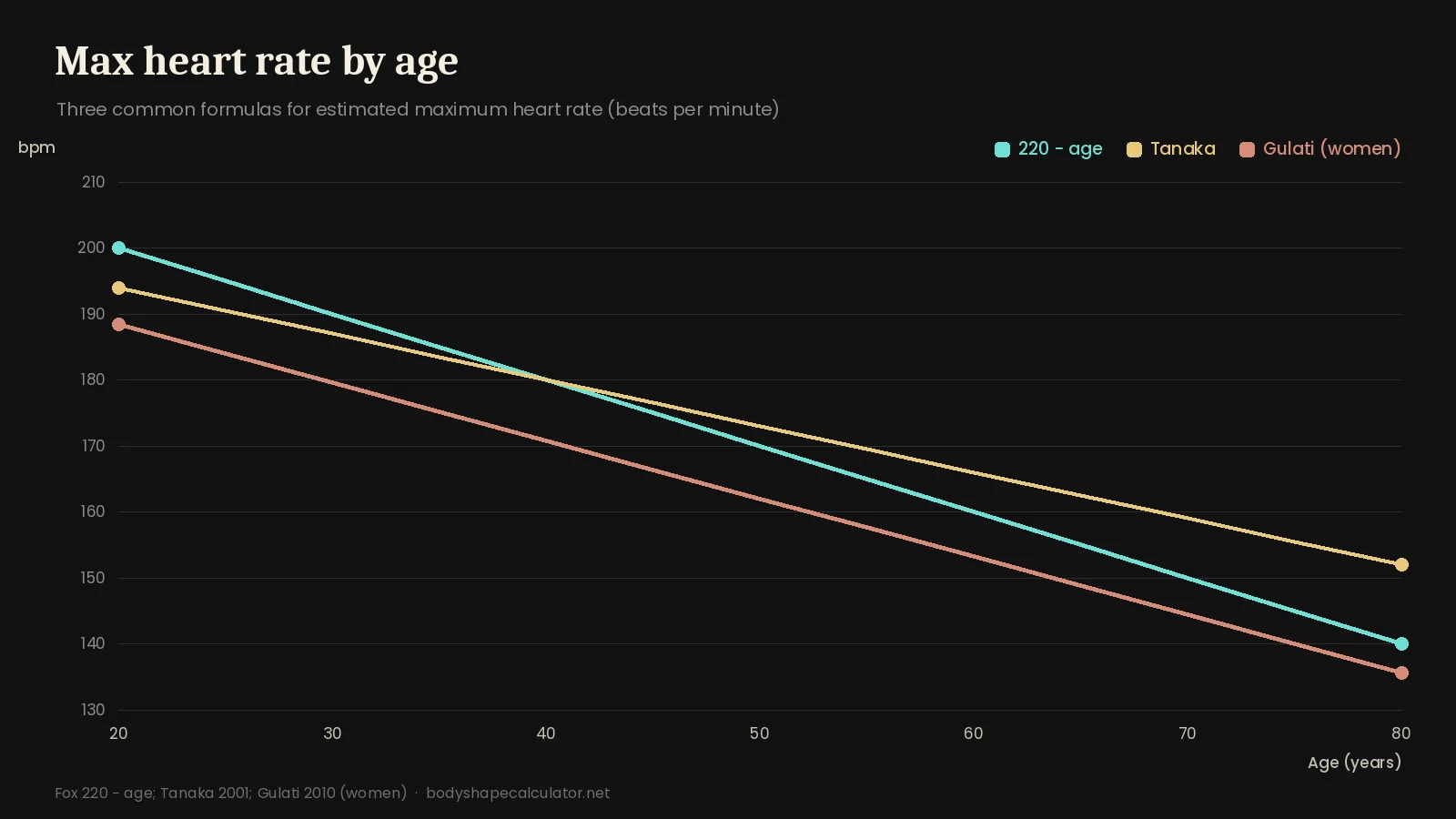
| Age | 220 − age | Tanaka | Women (Gulati) |
|---|---|---|---|
| 20 | 200 | 194 | 188 |
| 25 | 195 | 190 | 184 |
| 30 | 190 | 187 | 180 |
| 35 | 185 | 184 | 175 |
| 40 | 180 | 180 | 171 |
| 45 | 175 | 176 | 166 |
| 50 | 170 | 173 | 162 |
| 55 | 165 | 170 | 158 |
| 60 | 160 | 166 | 153 |
| 65 | 155 | 162 | 149 |
| 70 | 150 | 159 | 144 |
| 75 | 145 | 156 | 140 |
| 80 | 140 | 152 | 136 |
How to Use Your Max Heart Rate
Your maximum heart rate sets the top of your training zones. Easy aerobic work (zone 2) is about 60–70% of it, threshold work 80–90%. For zones that also account for your resting heart rate, use the heart rate zone calculator. Max heart rate itself is not a fitness measure: it falls with age whatever your fitness. Fitness shows up in your VO2 max and resting heart rate.
How to Measure Your True Max Heart Rate
The most accurate way is a supervised maximal exercise test. A field test for healthy, already-active people: after a thorough warm-up, run or cycle hard uphill for 2–3 minutes, then push all-out for the final 30–60 seconds while wearing a chest strap. Do not attempt this if you have heart disease, symptoms or are new to exercise; check with a doctor first.
Max Heart Rate FAQ
What is my max heart rate?
A good estimate is 208 − 0.7 × your age (the Tanaka formula). At 30 that is 187 bpm, at 50 it is 173 bpm. The older 220 − age formula gives similar results in middle age.
Is 220 minus age accurate?
Only roughly. It has an error of about ±10–12 bpm and tends to overestimate max heart rate in young adults and underestimate it in older adults. The Tanaka formula fits large datasets better.
Does max heart rate change with fitness?
Very little. Max heart rate falls with age and is mostly set by genetics. Training lowers your resting heart rate and raises how much work you can do at a given heart rate.
Is it dangerous to reach max heart rate?
For healthy people, brief efforts near max are safe and common in hard intervals. People with heart conditions or symptoms such as chest pain or dizziness should get medical advice before high-intensity exercise.
What is a normal max heart rate for a 60 year old?
Formulas give about 160 to 166 bpm for a 60-year-old, but individuals can be 10 to 15 bpm higher or lower.
Sources
- Tanaka H, Monahan KD, Seals DR. Age-predicted maximal heart rate revisited. Journal of the American College of Cardiology. 2001;37(1):153–156.
- Gulati M, et al. Heart rate response to exercise stress testing in asymptomatic women. Circulation. 2010;122(2):130–137.
- Nes BM, et al. Age-predicted maximal heart rate in healthy subjects: the HUNT Fitness Study. Scandinavian Journal of Medicine & Science in Sports. 2013;23(6):697–704.
- Gellish RL, et al. Longitudinal modeling of the relationship between age and maximal heart rate. Medicine & Science in Sports & Exercise. 2007;39(5):822–829.
For general information for healthy adults. It is not medical advice; talk to a doctor before starting a new exercise or diet plan if you have a health condition.