What Are Body Proportions?
Body proportions are the size relationships between parts of your body — waist to hips, waist to height, shoulders to waist, leg length to total height. A body proportions calculator turns your measurements into these ratios so you can see how your body is balanced, whatever your overall size, and compare each ratio with a reference range.
Two people can be the same height and weight and have very different proportions, which is why proportions, not size, decide body shape. A 30-inch waist means one thing on a 5′2″ frame and another on a 6′0″ frame; dividing by height or hips removes size from the picture and leaves the relationship. That is the idea behind the ratios on this page.
People search for body proportions for three main reasons: to check health-related body ratios such as waist-to-hip and waist-to-height, to understand their body shape, physique and build, and to learn human body proportions for drawing and design. This page covers all three, with a free calculator at the top, a body proportions chart below it, and a one-tap link to see your numbers as a 3D body model.
- Eight ratios — WHR, WHtR, bust or chest-to-waist, bust or chest-to-hip, shoulder-to-waist, leg length, arm span and heads tall.
- Male and female reference points — the right WHO threshold and the right labels for your sex.
- Body shape included — seven female and five male shapes, named with the same rules as our body type calculators.
- See it in 3D — your measurements open in the body visualizer as a rotatable model.
- Private — everything runs in your browser; nothing is uploaded.
How to Use the Body Proportions Calculator (Step by Step)
You need only three numbers for a first result: height, waist and hips. Everything else is optional and simply adds more ratios.
Choose Female or Male and your units
Pick Female or Male, then in or cm. The model sets the right label (bust or chest) and the right waist-to-hip reference point for your sex.
Enter your height, waist and hips
These three core measurements unlock your waist-to-hip ratio and waist-to-height ratio. Results update as you type — there is no calculate button.
Add optional measurements for more ratios
Add bust or chest for bust-to-waist, bust-to-hip and your body shape; shoulder circumference for the shoulder-to-waist ratio; inseam for leg length; arm span for the arm span-to-height ratio; and head height to see how many heads tall you are.
Read each ratio card
Every card shows your value, a plain-language tag, a gauge with the reference range and the arithmetic behind it. Reference ranges come from the WHO, NICE-style guidance and common anthropometry; they describe, they do not grade.
Check your body shape
With bust or chest, waist and hips entered, the calculator names your shape — seven female shapes or five male shapes — with the same rules as our body type calculators, and links to the matching guide.
See your proportions in 3D
Tap See it in 3D to open the body visualizer with your measurements already filled in, then rotate the model and compare it with a second body.
Save or share your numbers
Use Copy link to recreate your exact inputs later, Load example to see a sample result, or Clear to start over. Your numbers stay in your browser.
How to Take Measurements for Accurate Body Ratios
Ratios amplify small errors: a half-inch slip on the waist moves your waist-to-hip ratio by about 0.01 and can push a result across a threshold. Use a soft, flexible tape, keep it snug but not tight, stand relaxed, and measure twice. Use the in / cm switch to match your tape.
| Measurement | Where to measure | Tip |
|---|---|---|
| Height | Standing straight against a wall, barefoot, heels together. | Look straight ahead; mark the wall with a flat book on your head. |
| Waist | Around the narrowest part of the torso, usually just above the navel. | Exhale naturally; don’t pull your stomach in. |
| Hips | Around the fullest part of the hips and buttocks, feet together. | Keep the tape parallel to the floor. |
| Bust (women) | Around the fullest part of the bust, tape level across your back. | Wear a thin, non-padded bra. |
| Chest (men) | Around the fullest part of the chest, just under the arms. | Breathe normally; don’t puff out your chest. |
| Shoulder circumference | Around the widest point of the shoulders, over the deltoids, arms relaxed. | Ask someone to help so the tape stays level. |
| Inseam | From the crotch to the floor along the inside of the leg. | Stand barefoot; a trouser inseam is a different number. |
| Arm span | Fingertip to fingertip with arms stretched straight out to the sides. | Stand with your back against a wall for a straight line. |
| Head height | From the chin to the top of the head. | Use a mirror and a ruler held level against the crown. |
Our full guide to how to measure your body correctly covers each landmark in more detail, including the common mistakes and an inches-to-centimeters reference.
Body Proportions Chart: The Key Ratios and Reference Points
This chart lists every ratio the calculator computes, how it is calculated and the reference point used. Health references come from the World Health Organization and widely used waist-to-height guidance; the rest are descriptive and carry no health meaning.
| Ratio | Formula | Reference point | What it tells you |
|---|---|---|---|
| Waist-to-hip ratio (WHR) | Waist ÷ hips | WHO: above 0.85 (women) or 0.90 (men) = abdominal obesity | Where you carry weight; a health indicator |
| Waist-to-height ratio (WHtR) | Waist ÷ height | Below 0.50; healthy band 0.40–0.49; 0.50–0.59 increased; 0.60+ high | Central fat relative to your size; a health indicator |
| Bust or chest-to-waist | Bust or chest ÷ waist | No health reference; larger = bigger step in to the waist | How defined the waist is (hourglass vs rectangle) |
| Bust or chest-to-hip | Bust or chest ÷ hips | Within 5% of 1.00 = balanced | Upper- vs lower-body balance |
| Shoulder-to-waist (Adonis index) | Shoulder circumference ÷ waist | Popular benchmark: 1.618 (golden ratio); no health meaning | The “V-taper” of the torso |
| Leg length | Inseam ÷ height | Commonly about 45% of height (roughly 43–48%) | Leg vs upper-body proportion |
| Arm span-to-height | Arm span ÷ height | Close to 1.00 (Vitruvian Man) | Limb proportion |
| Heads tall | Height ÷ head height | About 7–7.5 for many adults; 8 in the classical art canon | Overall figure proportion, used in drawing |
Worked example: a woman who is 5′6″ (66 in) with a 29 in waist and 38 in hips has a waist-to-hip ratio of 29 ÷ 38 = 0.76 and a waist-to-height ratio of 29 ÷ 66 = 0.44. Both sit on the lower-risk side of their reference points. Tap Load example in the calculator to see the full set.
Waist-to-Hip and Waist-to-Height Ratio: The Health Proportions
Waist-to-hip ratio (WHR) compares your waist with your hips. The World Health Organization defines abdominal obesity as a WHR above 0.85 for women and above 0.90 for men, a pattern linked to higher cardiovascular and type 2 diabetes risk. For sourcing, measurement protocols and the research behind it, see our waist-to-hip ratio calculator.
Waist-to-height ratio (WHtR) compares your waist with your height and needs no separate male and female thresholds. The rule of thumb is to keep your waist under half your height (below 0.50), with the commonly used bands running from a 0.40–0.49 healthy range to 0.60 or more for high risk. Our waist-to-height ratio calculator explains the chart and its military use.
Both ratios are indicators, not diagnoses, and each has limits: athletes with large hips or heavy muscle, older adults and some ethnic groups can fall on either side of a reference point without the health implication the number suggests. Use them with other information, and ask a health professional if a result worries you.
Human Body Proportions for Drawing: The Eight-Head Figure
Artists measure the body in head units: the distance from chin to crown becomes the ruler. Vitruvius described the head as one eighth of total height, and the classical canon used in figure-drawing instruction divides the body figure into eight equal heads. Real adults are usually closer to 7 to 7.5 heads tall, so many artists draw realistic figures at 7.5 heads and idealized or heroic figures at 8.
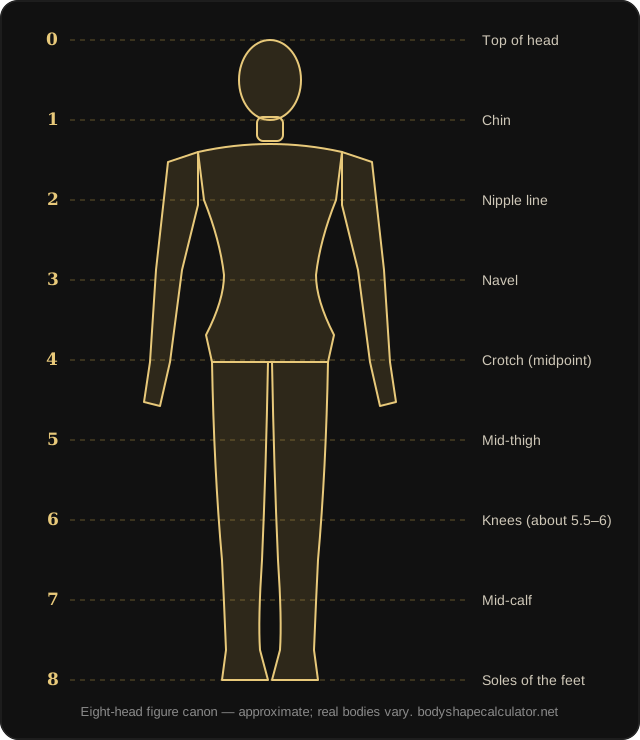
| Landmark | Heads from the top | Typical position |
|---|---|---|
| Top of the head | 0 | Start of the figure |
| Chin | 1 | Bottom of the first head |
| Nipple line | 2 | Chest |
| Navel | 3 | Just above the waist |
| Crotch | 4 | The midpoint of the body |
| Mid-thigh | 5 | Halfway down the thigh |
| Knees | about 5.5–6 | Just above the sixth line |
| Mid-calf | 7 | Below the knee |
| Soles of the feet | 8 | End of the figure |
Other landmarks artists rely on: arm span roughly equals height; the wrists fall near crotch level when the arms hang; the elbows sit near the waist; and the shoulders are about two head widths across in a front view. Enter your head height in the calculator to see how many heads tall you are.
Male and Female Body Proportions: What Differs
Male body proportions and female body proportions overlap heavily, but on average they differ in a few consistent ways. These are population averages, not rules for any one person:
| Proportion (on average) | Women | Men |
|---|---|---|
| Waist-to-hip ratio | Lower — the waist is smaller relative to the hips | Higher — the waist is closer to hip size |
| Shoulders vs hips | Narrower shoulders relative to the hips | Broader shoulders relative to the hips |
| Where fat tends to sit | Hips, thighs and buttocks | Abdomen |
| Height and limbs | Shorter on average, with shorter limbs in absolute terms | Taller on average, with longer limbs |
| Chest | Narrower rib cage, plus breast tissue | Wider rib cage and more chest muscle |
| Neck | Slimmer | Thicker |
These differences are why the calculator uses a different WHR reference point for men and women, and why the shape names differ: women’s shapes (hourglass, pear, apple, inverted triangle, rectangle) are read from bust, waist and hips, while men’s shapes (trapezoid, inverted triangle, triangle, oval, rectangle) are read from chest, waist and hips. Our body type calculator for men covers the male shapes in depth, and the body type calculator covers the female ones.
Ideal Body Proportions: What the Research Actually Says
There is no single ideal set of body proportions, but three ideas come up constantly:
- The golden ratio and the Adonis index. In fitness circles a shoulder-to-waist ratio of 1.618 is called the “Adonis index”. It is an aesthetic benchmark with no proven health significance.
- A waist-to-hip ratio near 0.7. Devendra Singh’s 1993 studies reported that many raters preferred a female WHR near 0.7. Later work shows preferences vary across cultures and eras, so it describes taste, not health.
- The Vitruvian Man. Leonardo’s drawing after Vitruvius set arm span equal to height and the head at one eighth of it. It is a geometric ideal, not a measurement of typical people.
For health, research points to a different set of numbers: a waist that is not large relative to the hips or height. That is why the calculator marks WHO and waist-to-height reference points as health guidance and shows the aesthetic ratios purely as references.
Can You Change Your Body Proportions?
Some proportions are fixed and some are not. In adults, bone structure, height and limb lengths do not change, so your underlying body build and ratios such as leg length, arm span and heads tall stay put. Girth-based ratios can move: fat distribution follows genetics, hormones, age and pregnancy; overall weight change usually shifts waist and hip measurements together; and resistance training can increase shoulder, back and glute size. Research does not support “spot reducing” fat from a single area.
To preview a change before you commit to it, use the visualizer’s Compare mode: set your current numbers as body A, adjust body B, and overlay one on the other.
See Your Body Proportions in 3D
Numbers are abstract; a figure is not. After you enter your measurements, tap See it in 3D in the calculator and the Body Visualizer opens with your height, waist, hips and any other measurements already filled in, as a rotatable female or male body model. From there you can view the front, side and back, compare it with a second body, and see your BMI and shape update live. It works like a body proportion simulator: change a measurement and watch the figure and the ratios respond together.
Body Proportions vs. Body Shape vs. BMI
| Measure | What it uses | What it answers | Where to calculate it |
|---|---|---|---|
| Body proportions | Ratios between measurements | How is my body balanced? | This calculator |
| Body shape | Bust or chest, waist and hips | Which pattern do my proportions form? | Body type calculator · for men |
| BMI | Height and weight | How does my weight compare with my height? | Body visualizer · frame size |
| Body frame size | Wrist circumference and height | Is my frame small, medium or large? | Frame size calculator |
They are complementary: BMI describes size, proportions describe balance, and shape names the pattern. Using all three gives a fuller picture than any one number.
Body Proportions FAQ
What are body proportions?
Body proportions are the size relationships between parts of your body, such as waist to hips, waist to height, shoulders to waist and leg length to total height. They describe how your body is balanced regardless of overall size, and they decide your body shape more than weight does.
How do I calculate my body proportions?
Divide one measurement by another. Waist-to-hip ratio is waist ÷ hips, waist-to-height ratio is waist ÷ height, leg-length ratio is inseam ÷ height, and heads tall is height ÷ head height. Enter your numbers in the calculator above and it does the division and adds a reference range for each ratio.
What is a good waist-to-hip ratio?
The World Health Organization treats a waist-to-hip ratio above 0.85 for women and above 0.90 for men as abdominal obesity. Below those lines is generally considered lower risk, but the ratio is one indicator among several, not a diagnosis.
What is a good waist-to-height ratio?
Keeping your waist under half your height, a ratio below 0.50, is the common rule of thumb. The commonly used bands are 0.40 to 0.49 for the healthy range, 0.50 to 0.59 for increased risk and 0.60 or more for high risk.
What are ideal body proportions?
There is no single ideal. Ratios such as the golden ratio, a waist-to-hip ratio near 0.7 or the proportions of the Vitruvian Man reflect cultural preferences rather than health. This calculator shows health reference points where they exist and treats aesthetic ratios as references, never as goals.
What is the Adonis index or golden ratio for the body?
The Adonis index is the ratio of shoulder circumference to waist circumference, with 1.618, the golden ratio, as the popular benchmark. It is a fitness and aesthetics idea with no proven health significance, so use it as a curiosity or a training reference only.
How many heads tall am I?
Divide your height by your head height, measured from chin to crown. Many adults land between about 7 and 7.5 heads; artists often draw realistic figures at 7.5 heads and idealized figures at 8. Enter your height and head height in the optional fields to see your number.
What are typical male and female body proportions?
On average, women have a lower waist-to-hip ratio and narrower shoulders relative to their hips, while men have broader shoulders relative to their hips and are taller with longer limbs. Individual bodies vary a lot, so treat these as averages, not rules.
What is the difference between body proportions and body shape?
Body proportions are the individual ratios between measurements. Body shape is the pattern they form together, such as hourglass, pear, apple or rectangle for women and trapezoid, oval or triangle for men. This calculator shows both, and links to guides for each shape.
Can my body proportions change?
Bone structure, height and limb lengths are fixed in adults, but ratios that involve girth can change with fat distribution, muscle size, posture, age, pregnancy and hormones. Overall weight change usually shifts your waist and hip measurements, and training can change shoulder and back size.
Can I see my proportions in 3D?
Yes. Tap See it in 3D and the body visualizer opens with your height, waist, hips and other measurements filled in, as a rotatable female or male model. You can then compare it with a second body or overlay a goal.
Is the body proportions calculator free and private?
It is free, needs no signup, and runs entirely in your browser. Your measurements are never uploaded or stored, and the Copy link button keeps your numbers after the # symbol in the address, which browsers do not send to a server.
Sources and References
- World Health Organization. Waist Circumference and Waist–Hip Ratio: Report of a WHO Expert Consultation, Geneva, 8–11 December 2008 (published 2011).
- Ashwell M, Hsieh SD. “Six reasons why the waist-to-height ratio is a rapid and effective global indicator for health risks of obesity.” International Journal of Food Sciences and Nutrition, 2005;56(5):303–307.
- Singh D. “Adaptive significance of female physical attractiveness: role of waist-to-hip ratio.” Journal of Personality and Social Psychology, 1993;65(2):293–307.
- Vitruvius. De architectura, Book III (proportions of the human body); Leonardo da Vinci, Vitruvian Man, c. 1490.
- Loomis A. Figure Drawing for All It’s Worth, 1943 — the eight-head figure canon used in art instruction.
- Centers for Disease Control and Prevention, National Center for Health Statistics. FastStats: Body Measurements.