Quick answer: divide shoulder circumference by hip circumference. The average is about 1.18 for men and 1.03 for women. For women, above 1.05 suggests an inverted triangle and below 0.96 a pear shape.
What Is the Shoulder-to-Hip Ratio?
The shoulder-to-hip ratio (SHR) compares the circumference of your shoulders with the circumference of your hips. It is one of the clearest differences between male and female body shape: men’s shoulders are usually well wider than their hips, while women’s are about the same size.
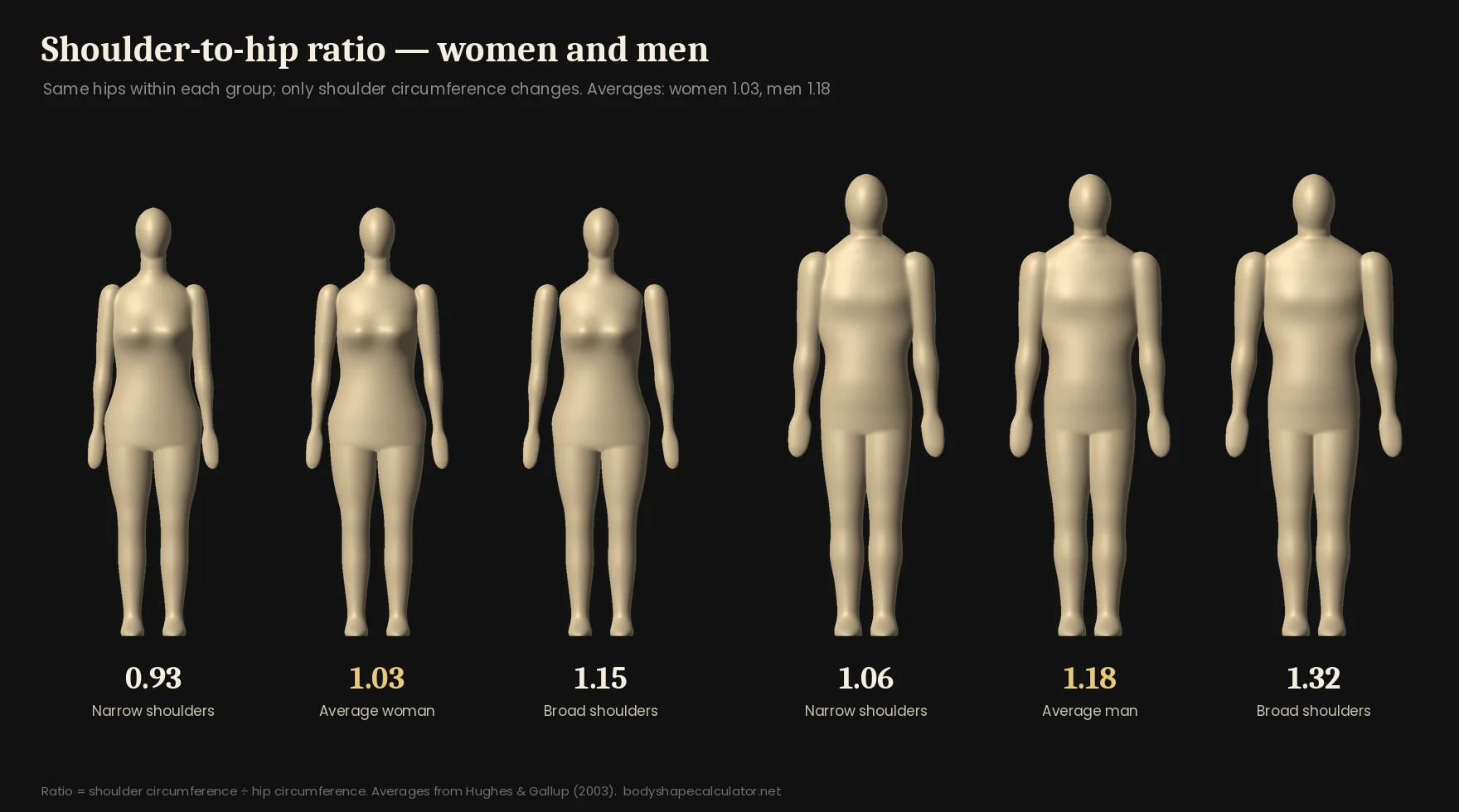
Average Shoulder-to-Hip Ratio for Men and Women
| 5th | 25th | 50th | 75th | 95th | |
|---|---|---|---|---|---|
| Women | 0.92 | 0.99 | 1.03 | 1.07 | 1.14 |
| Men | 1.06 | 1.13 | 1.18 | 1.23 | 1.30 |
The figures come from Hughes and Gallup (2003), who measured 116 young adults with a tape over the shoulders and around the hips. Because the sample was college students, treat them as a guide rather than national norms. For context, larger U.S. Army data put average shoulder circumference at about 46 in for men and 40.5 in for women.
Shoulder-to-Hip Ratio and Body Shape
For women, SHR is one of the simplest ways to separate the main body shapes:
- Above about 1.05: shoulders wider than hips, typical of the inverted triangle.
- About 0.96 to 1.05: balanced, typical of the hourglass (defined waist) and rectangle (straight waist).
- Below about 0.96: hips wider than shoulders, typical of the pear.
The body shape calculator uses bust, waist and hips to give a full result. For men, a high SHR and a narrow waist make the trapezoid and inverted triangle builds; check yours with the male body type calculator.
Shoulder-to-Hip Ratio and Attractiveness
Studies in evolutionary psychology have linked a higher SHR in men with being rated as more attractive and stronger, much as a lower waist-to-hip ratio is linked with attractiveness ratings for women. These are averages across raters, not rules, and they say nothing about health.
How to Measure Shoulder-to-Hip Ratio
- Measure your shoulders. Stand straight with your arms relaxed at your sides. Wrap a tape around the widest part of the shoulders, over the deltoids and shoulder blades, keeping it level.
- Measure your hips. Stand with feet together and wrap the tape around the widest part of the hips and buttocks, level with the floor.
- Divide. Divide the shoulder measurement by the hip measurement, using the same unit for both.
You can also compare widths instead of circumferences: shoulder width across the back (see average shoulder width) against hip width at the widest point. Width ratios are larger numbers but tell the same story.
Can You Change It?
Shoulder and pelvis bones stop growing in early adulthood, so the frame underneath is fixed. What you can change is the soft tissue: building the deltoids and upper back raises shoulder circumference, and losing fat from the hips and buttocks lowers hip circumference. Try different combinations in the 3D body visualizer, or compare your shoulders with your waist in the shoulder-to-waist ratio calculator.
Shoulder-to-Hip Ratio FAQ
What is the average shoulder-to-hip ratio?
In a study of young U.S. adults by Hughes and Gallup, the average shoulder-to-hip ratio (shoulder circumference divided by hip circumference) was 1.18 for men and 1.03 for women. Most men fell between about 1.10 and 1.27 and most women between 0.95 and 1.11.
How do you calculate shoulder-to-hip ratio?
Measure around the widest part of your shoulders and around the widest part of your hips, in the same unit, then divide the shoulder number by the hip number. For example, 44 ÷ 40 = 1.10.
What is a good shoulder-to-hip ratio for a man?
There is no medical target, but ratios above about 1.25 read as broad-shouldered and athletic, and research suggests a higher ratio is generally seen as more attractive in men. The average is about 1.18.
What is a good shoulder-to-hip ratio for a woman?
A ratio close to 1.0, with shoulders and hips about the same size, is typical for women and is part of the balanced look of hourglass and rectangle shapes. There is no healthy or unhealthy value; the ratio describes shape, not health.
Is shoulder-to-hip ratio related to body shape?
Yes. For women, a ratio well above 1.05 usually means shoulders wider than the hips (inverted triangle), and a ratio below about 0.96 usually means hips wider than the shoulders (pear). For men, a high ratio is part of the trapezoid and inverted triangle builds.
Can you change your shoulder-to-hip ratio?
Partly. Building the shoulders and upper back raises the ratio, and losing fat from the hips raises it slightly too. The bone widths of the shoulders and pelvis do not change in adults.
Is shoulder-to-hip ratio the same as waist-to-hip ratio?
No. Waist-to-hip ratio compares the waist with the hips and is used as a health marker for belly fat. Shoulder-to-hip ratio compares the shoulders with the hips and describes frame and shape.
Sources
- Hughes SM, Gallup GG. Sex differences in morphological predictors of sexual behavior: Shoulder to hip and waist to hip ratios. Evolution and Human Behavior. 2003;24(3):173–178.
- Gordon CC, et al. 2012 Anthropometric Survey of U.S. Army Personnel (ANSUR II). NATICK/TR-15/007, 2014.
- Sell A, Lukaszewski AW, Townsley M. Cues of upper body strength account for most of the variance in men’s bodily attractiveness. Proceedings of the Royal Society B. 2017;284:20171819.
Percentiles assume a normal distribution around the averages published by Hughes and Gallup (2003). The ratio describes shape, not health.