Body Shape Guide
Inverted Triangle Body Shape
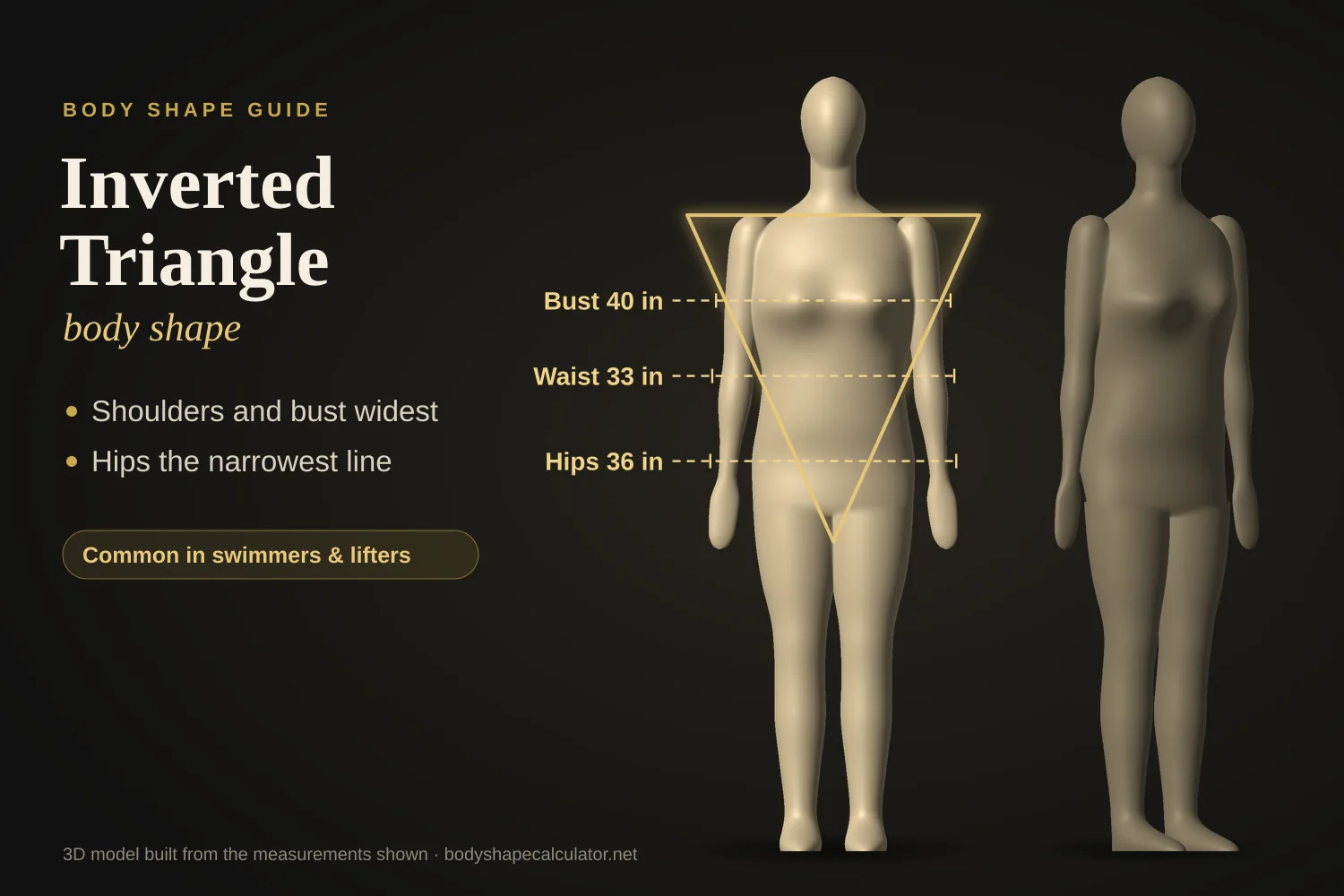
Bust and shoulders noticeably broader than the hips, with a waist that's present but not sharply carved. Common among swimmers and naturally broad-shouldered frames. Here's the exact formula, a health-metric quirk worth knowing, and how to dress for it.
What Is an Inverted Triangle Body Shape?
An inverted triangle body shape has a bust that's clearly wider than the hips, without the sharp waist taper you'd see in a top hourglass. It's the shape behind a strong, athletic-looking upper body with a narrower, straighter lower half. If you haven't measured yet, our full body type calculator will tell you exactly where you land across all seven shapes.
The formula: bust has to be at least 3.6 inches wider than the hips, and the gap between bust and waist has to stay under 9 inches. That second condition is what most people miss — an inverted triangle isn't waistless, it just doesn't have the dramatic 9-plus-inch taper that would push it into top hourglass territory instead.
Quick check: bust at least 3.6 inches wider than the hips, waist within 9 inches of the bust measurement. If your waist is more than 9 inches smaller than your bust, you're actually a top hourglass, not an inverted triangle — the styling shifts to favour showing off that waist instead of softening the shoulder line.
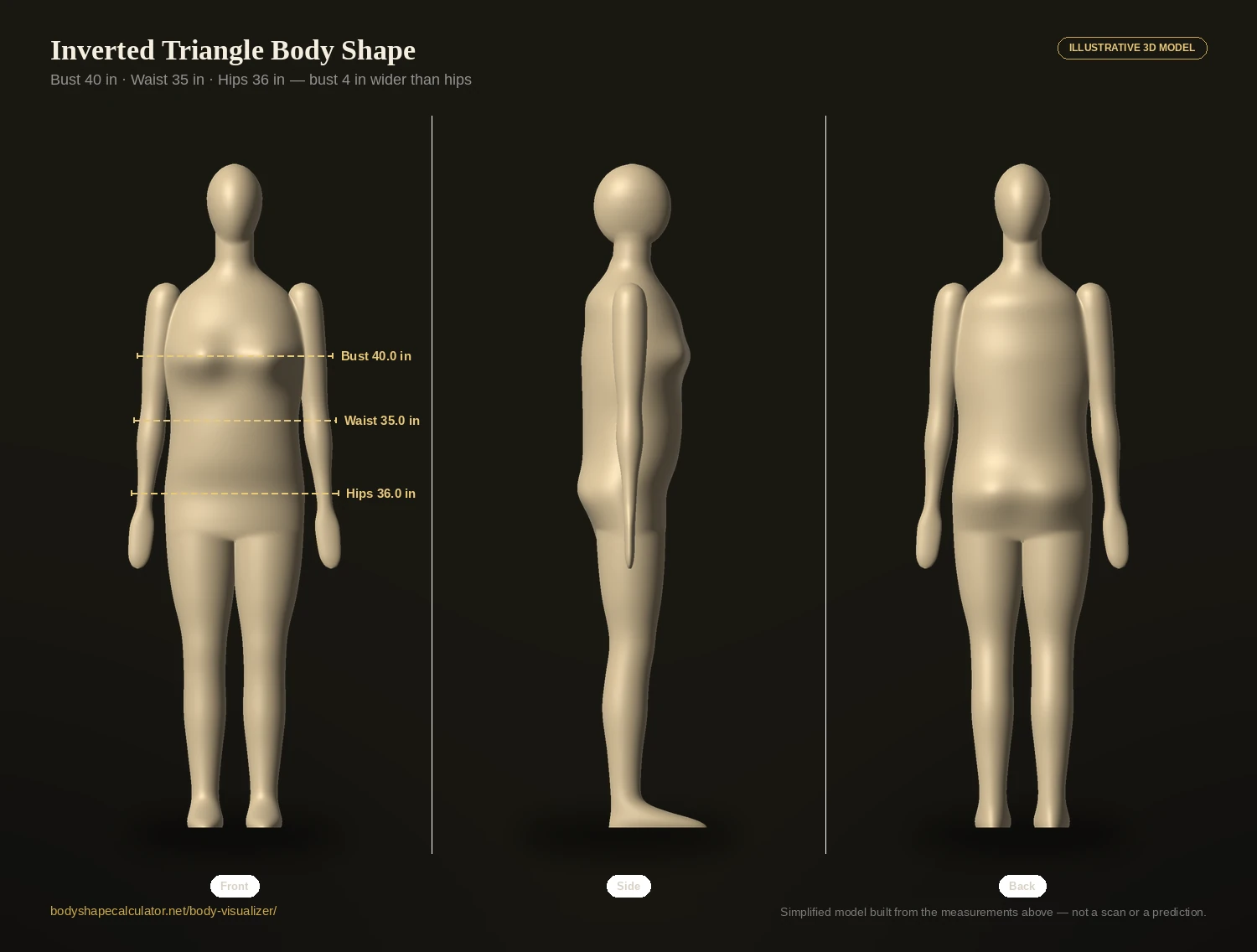
You can preview this silhouette interactively in our body simulator: choose the female model, tap Inverted triangle under Try a shape and rotate the figure. Switch to the male model to see the same broad-shoulder pattern on a man.
Who Tends to Have This Shape?
It's especially common among competitive swimmers, and among anyone who trains the shoulders, lats and upper back heavily without matching lower-body volume — the upper-body width in this shape often comes from muscle as much as frame. It also occurs naturally in women with broader shoulders or a fuller bust and comparatively narrow hip bones, independent of training. Both routes land in the same measurement category.
Inverted Triangle vs Top Hourglass — What's the Real Difference?
Both shapes have a bust wider than the hips, which is why they're constantly confused. The waist is what splits them.
| Trait | Inverted Triangle | Top Hourglass |
|---|---|---|
| Bust vs. hips | 3.6 in or more wider | 1–10 in wider |
| Waist definition | Under 9 in smaller than bust (soft) | 9 in or more smaller than bust (sharp) |
| Visual read | Broad, straight line from shoulder to hip | Broad on top, but visibly nipped at the waist |
| Styling focus | Add volume below, soften the shoulder line | Show the waist, balance is secondary |
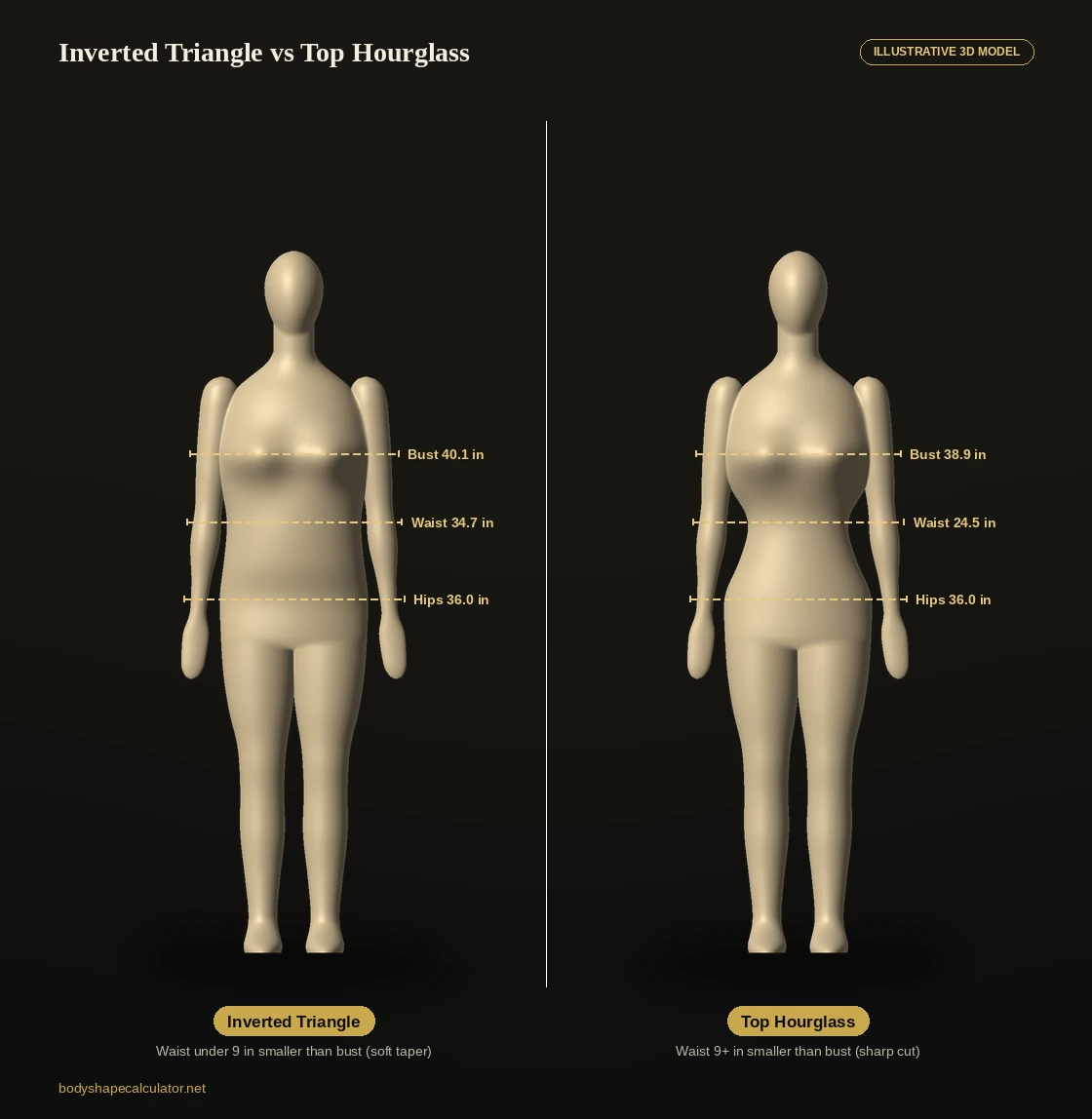
If generic "broad shoulders" styling advice has felt slightly off, it's usually because it was written for a top hourglass — someone with the same shoulder width as you, but a much more defined waist to work with. Our full body type calculator tells you which of the two you actually are.
Styling an Inverted Triangle at a Glance
The whole strategy is a transfer of visual weight: take some away from the shoulders, add some to the hips and legs. Here is how that plays out category by category — the full reasoning, with 3D comparisons, is further down.
| Category | Adds balance below — choose | Adds width on top — skip |
|---|---|---|
| Necklines | Deep V, scoop, halter | Boat, off-shoulder, wide square |
| Sleeves | Raglan, fitted, sleeveless | Puff, dropped shoulder, epaulettes |
| Tops & knits | Soft drape, fine-gauge V-neck | Boxy, chunky, shoulder-padded |
| Outerwear | Soft longline, raglan A-line coat | Strong-shoulder blazer, caped coat |
| Trousers & jeans | Wide-leg, flared, bootcut | Skinny, tapered |
| Skirts & dresses | Full, A-line, fit-and-flare | Pencil, straight shift |
| Shorts & jumpsuits | Culotte shorts, halter wide-leg | Slim shorts, puff-sleeve skinny |
The Waist-to-Hip Ratio Quirk for This Shape
Waist-to-hip ratio (WHR) can be misleading for an inverted triangle, and it's worth understanding why. Because hips are the smaller of your two key measurements in this shape, WHR — waist divided by hip — often comes out higher than it would for a pear or hourglass shape with the same waist size, sometimes landing at 0.85 or above simply because the hip number in the denominator is small.
WHR was designed around variable fat distribution, not variable hip-bone width. A narrow-hipped, broad-shouldered frame can post a WHR that looks elevated on paper without carrying the same abdominal-fat pattern that actually drives risk in an apple shape. If your WHR reads high here, waist-to-height ratio (WHtR) is the more reliable second check, since it only uses your waist and height — no hip measurement involved at all.
Run both on our waist to hip ratio calculator and waist to height ratio calculator to see how the two compare for your own numbers. For the shoulder-to-waist ratio and other proportions specific to this build, use the body proportions calculator.
How to Dress for an Inverted Triangle Body Shape
The core rule for this shape is the mirror image of a pear’s: softening the shoulder line rather than reinforcing it, and adding volume through the lower body to balance it. The sections below work through each category piece by piece — rendered as 3D side-by-sides on an inverted-triangle figure (40–33–36 in) with broad shoulders, so you can see how each cut shifts the balance between top and bottom.
Necklines
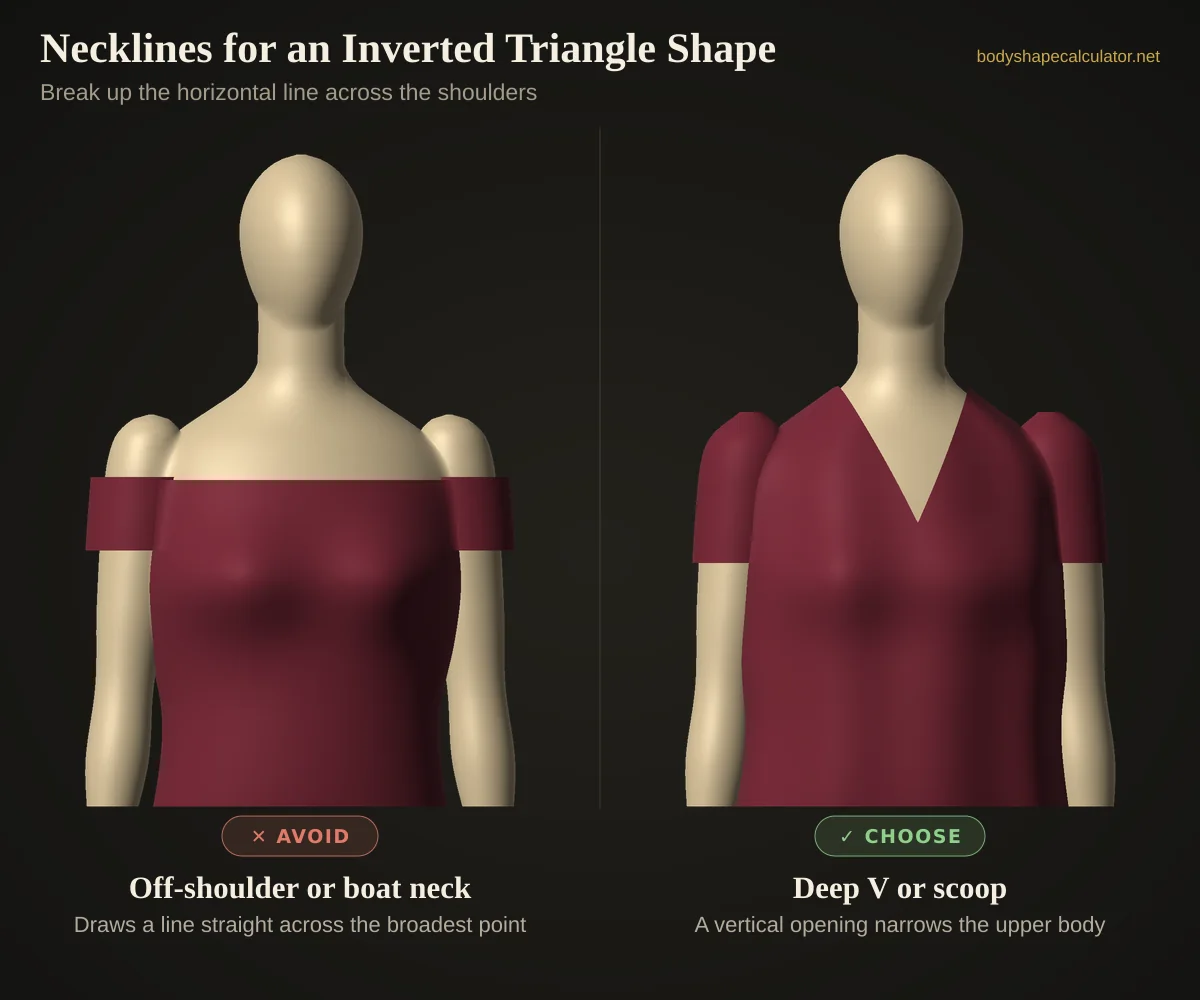
A neckline that opens up vertically rather than horizontally is the single most useful adjustment available here, because it draws a line down the centre of the body instead of adding emphasis along the shoulder seam. A V-neckline, especially a deeper one, does this most clearly. A plain scoop neck does a softer version of the same thing. Boat necklines and off-the-shoulder styles are the ones to be selective with — both run in a wide horizontal line right along the shoulder, which is exactly the measurement you’re usually trying to soften rather than emphasise further.
Sleeves
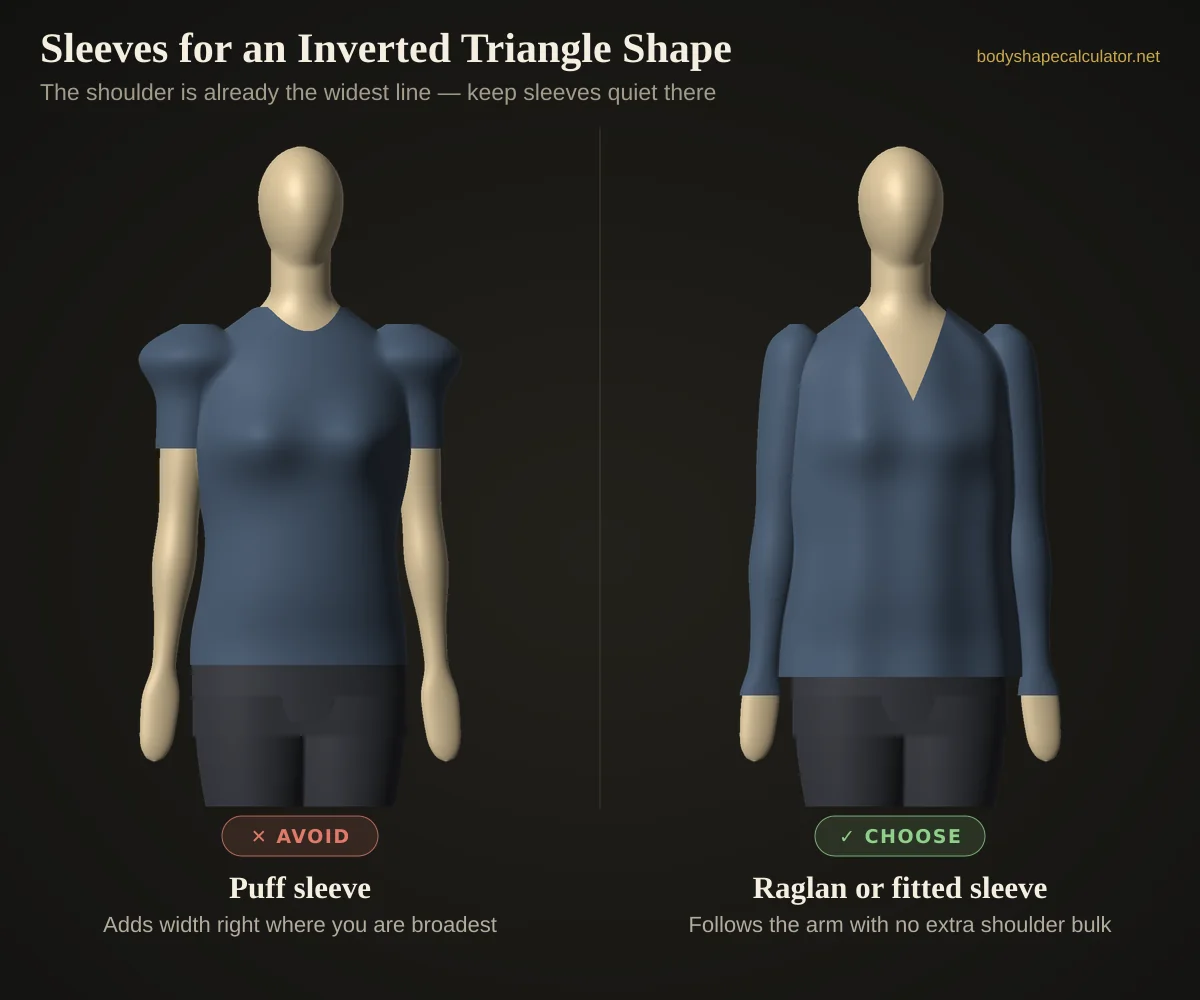
Sleeve construction changes where the shoulder seam actually sits, which matters more here than almost any other detail. A raglan sleeve, which runs in a diagonal line from the collar to the underarm instead of a horizontal seam at the shoulder tip, softens the shoulder point noticeably. A simple fitted sleeve with no shoulder padding or structure does the same job. Puff sleeves, dropped shoulders, and anything with shoulder padding are the ones to limit — all three add width or emphasis at the exact point that’s already the widest part of the frame.
Shirts, T-Shirts & Tops
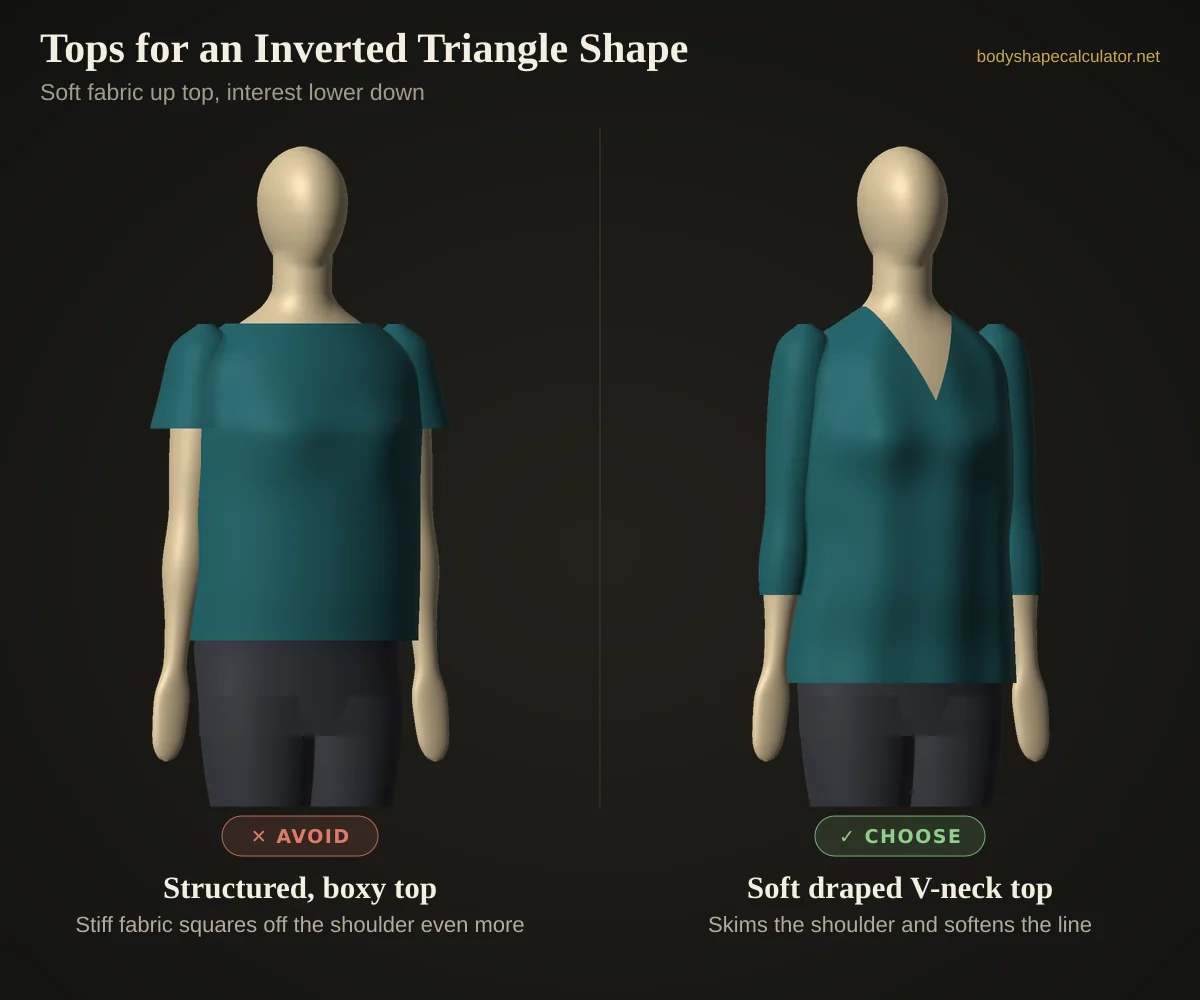
Soft, fluid fabric does more for this shape than structure does. A draped or wrap top in a fabric with some movement — jersey, a soft crepe, a fluid viscose — skims over the shoulder rather than defining it sharply, which takes some of the visual weight out of the upper body. A simple V-neck top in a soft fabric does the same job with less effort. Structured, boxy, or heavily tailored tops are worth being selective with, since crisp fabric and a defined shoulder seam both add sharpness and width to an area that’s usually already the broadest point of the silhouette.
Knitwear
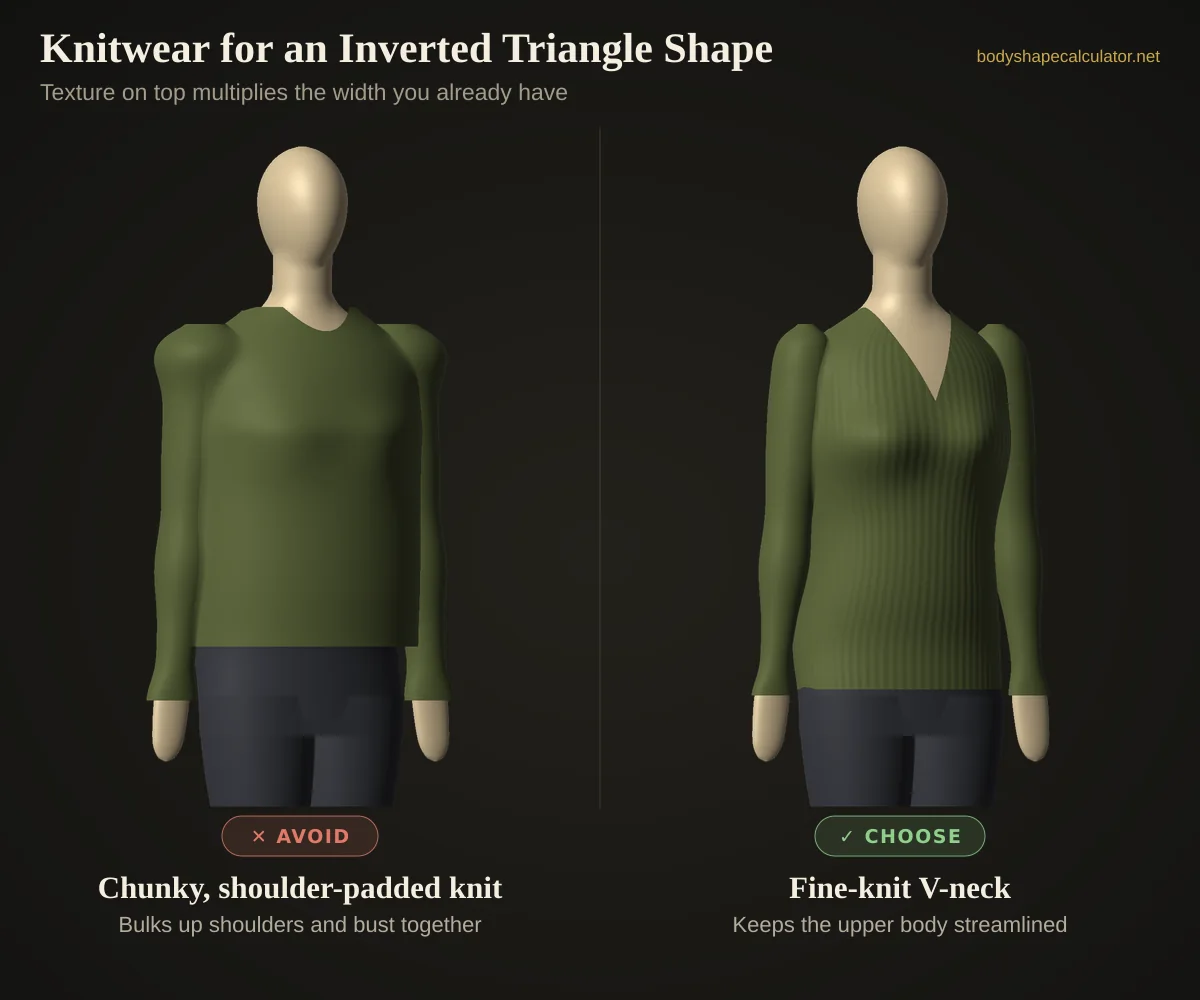
A fitted, fine-gauge sweater in a V-neck or scoop keeps the upper body looking streamlined rather than adding bulk on top of an already broad shoulder line. Lightweight yarn matters here as much as the cut does — a thin, closely fitted knit sits close to the body instead of standing away from it. Chunky, cable-knit, or boxy sweaters are the harder choice: thick yarn adds visible volume at the shoulder and bust, and a boxy cut adds structure on top of that, both compounding a proportion that’s usually already working against you.
Jackets & Blazers
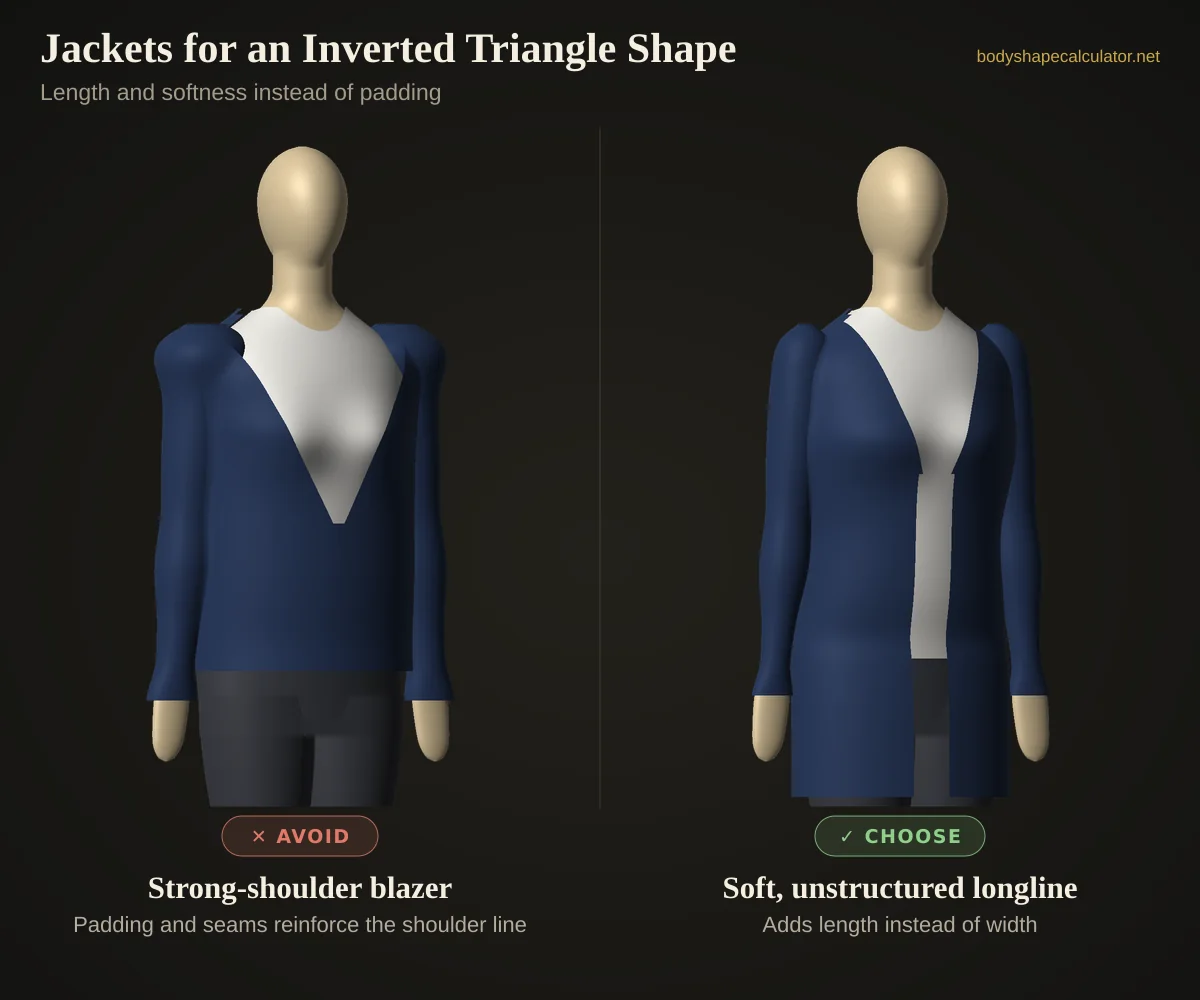
An unstructured, longline cardigan-jacket or a soft duster coat adds length to the silhouette without adding any width at the shoulder — it hangs from the body rather than being built out from it. A wrap coat with a tie belt does something similar while adding a defined waist. Structured blazers with strong shoulders, padding, or a sharp lapel are the ones to be careful with: tailoring in that category is specifically designed to build the shoulder line out and square it off, which is the opposite of what usually helps this shape.
Coats
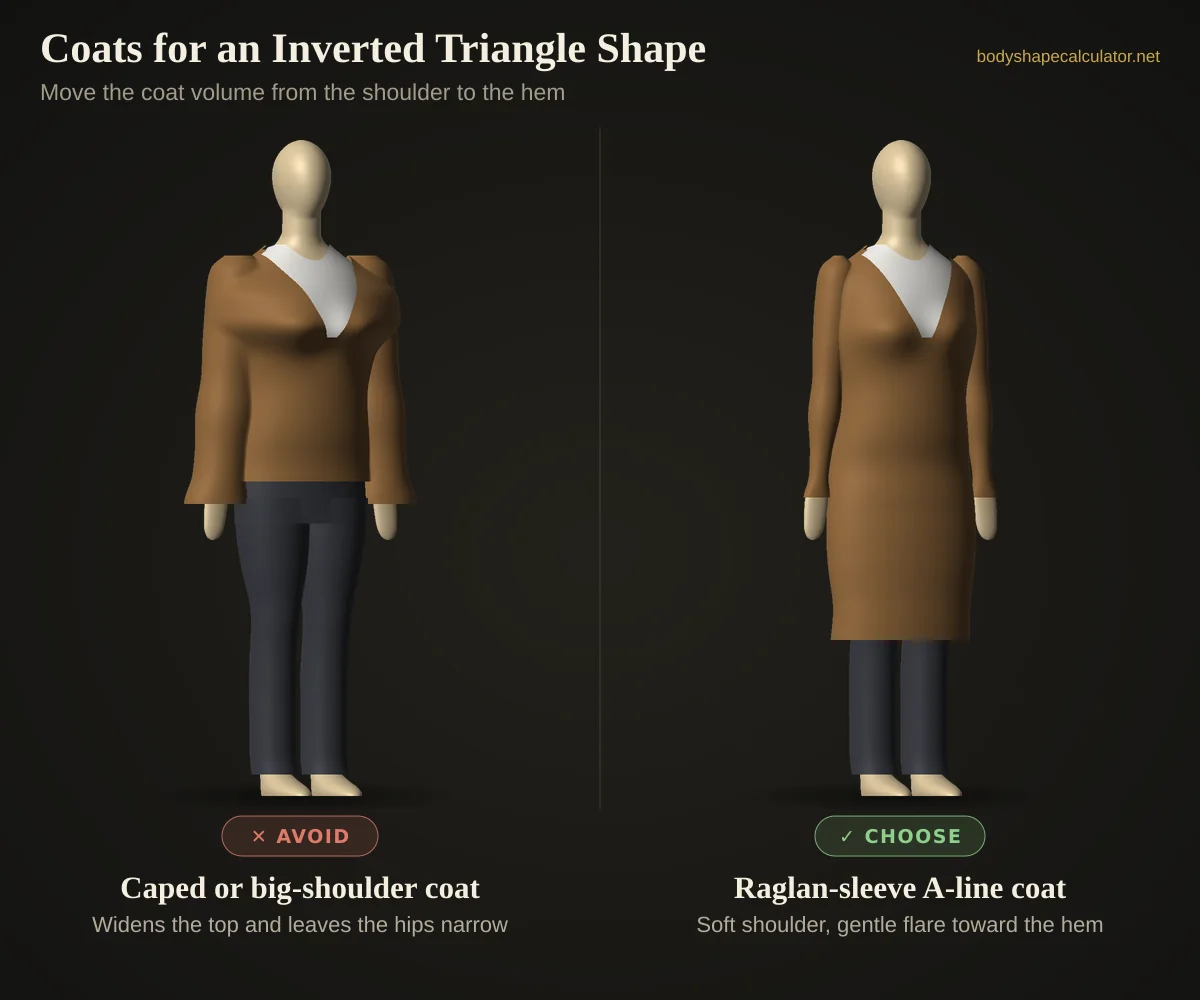
Move the coat's volume from the shoulder to the hem. Capes, strong epaulettes and wide peak lapels stack more width onto the broadest line of your body and leave the hips looking narrower still. A raglan-sleeve coat removes the shoulder seam altogether, and a gentle A-line cut adds a little width below the waist, so the silhouette evens out from top to bottom. Single-breasted and knee-length is the easiest version to wear; a wrap coat with a tie belt is a good alternative if you want a defined waist.
Trousers
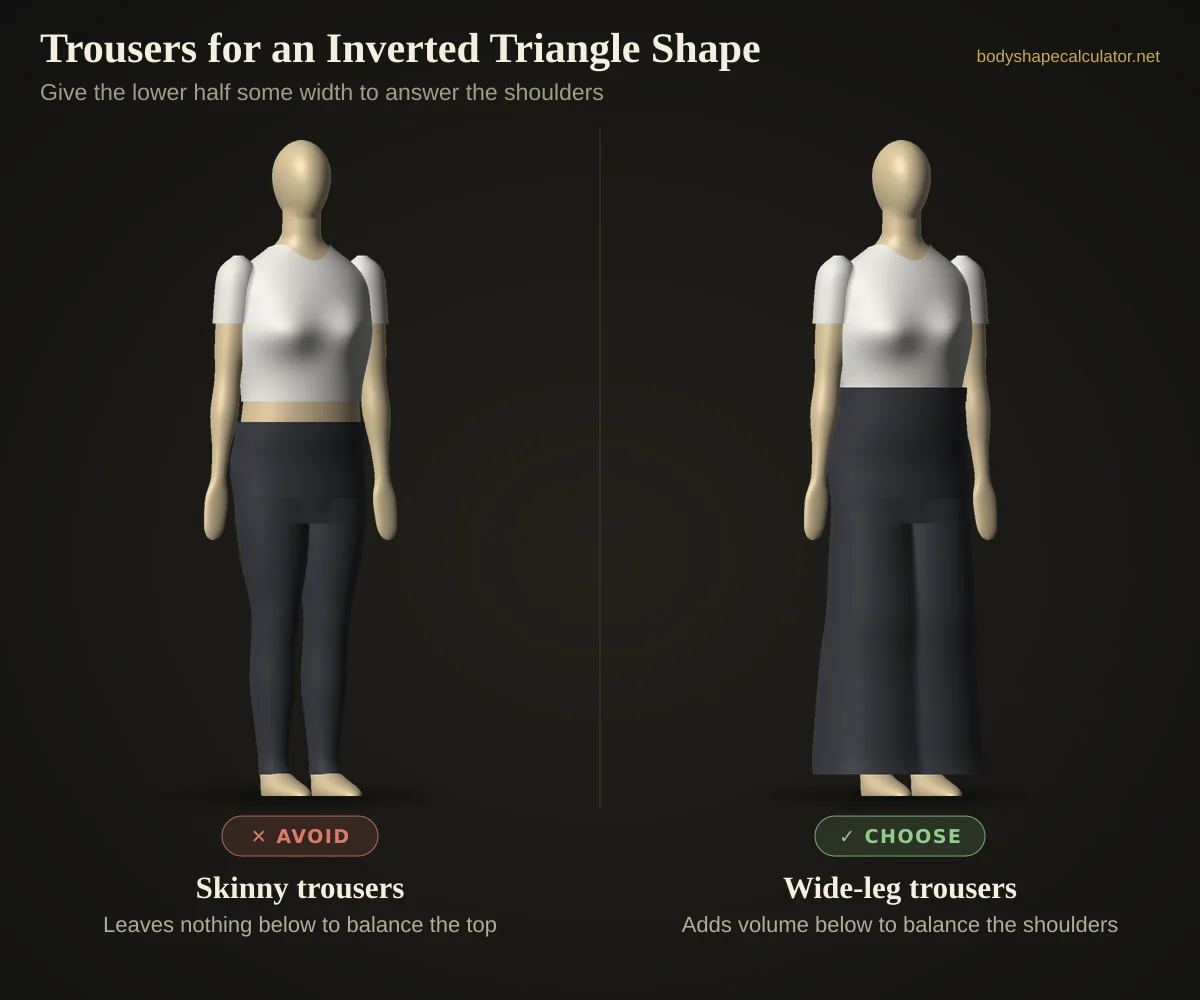
Wide-leg and bootcut trousers add volume at the bottom of the silhouette, which does the balancing work that a narrower leg can’t — the goal is a lower body with enough visual weight to hold its own against broader shoulders above it. A relaxed straight-leg cut is a slightly more streamlined version of the same idea. Skinny or tightly tapered jeans are the more difficult choice here, since a narrow leg leaves the bottom half of the silhouette with very little visual weight, which makes the shoulder-to-hip imbalance more obvious rather than less.
Jeans
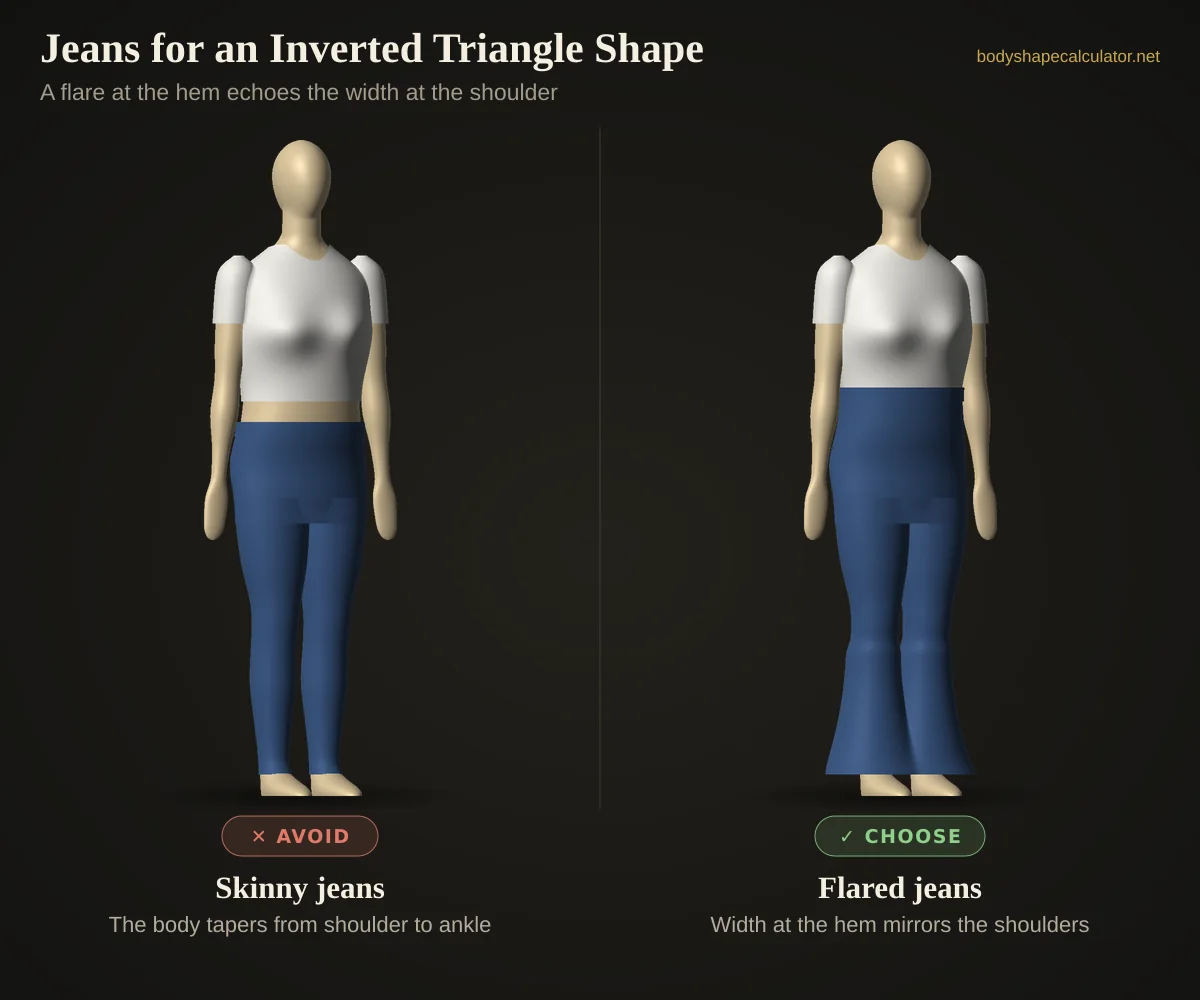
This is the shape that can wear a real flare. Flared or wide-leg jeans add width at the ankle that mirrors the width at the shoulder, turning a V-shaped silhouette into something closer to an X. Details that add interest at the hip — flap back pockets, a lighter wash, contrast stitching — help as well. Skinny jeans leave the body tapering in one direction from shoulder to ankle, which is exactly the pattern that makes the upper body look heavier than it is.
Skirts
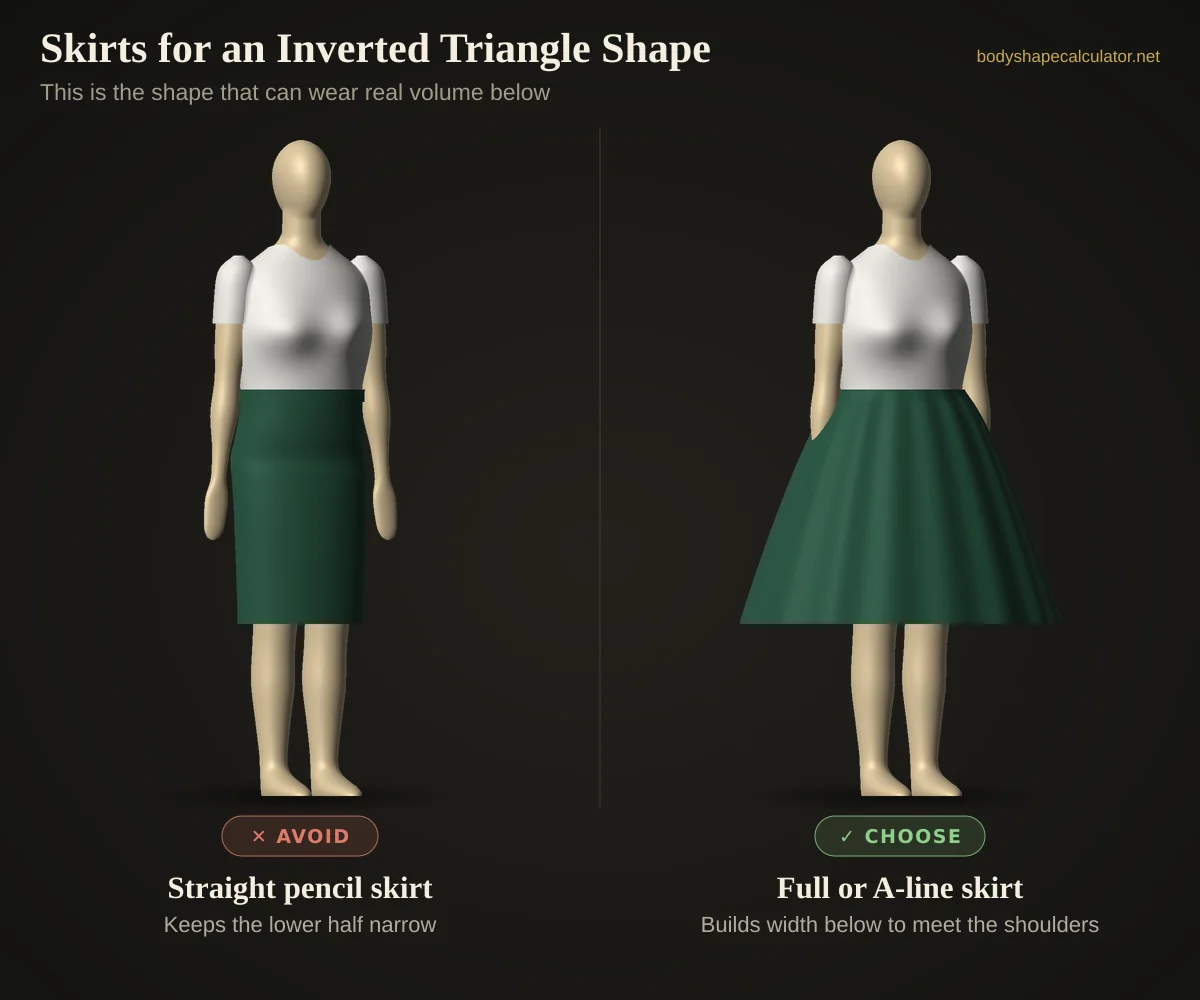
A skirt with some built-in volume — a full skirt, an A-line, or anything with soft pleating — gives the lower half of the silhouette enough visual weight to balance a broader shoulder line above it. A skirt that flares from the waist rather than skimming straight down does this most clearly. A straight or pencil-cut skirt is the harder choice in this category: it keeps the lower body narrow and close to the leg line, which leaves the shoulder-to-hip proportion looking more lopsided than a fuller shape below the waist would.
Dresses
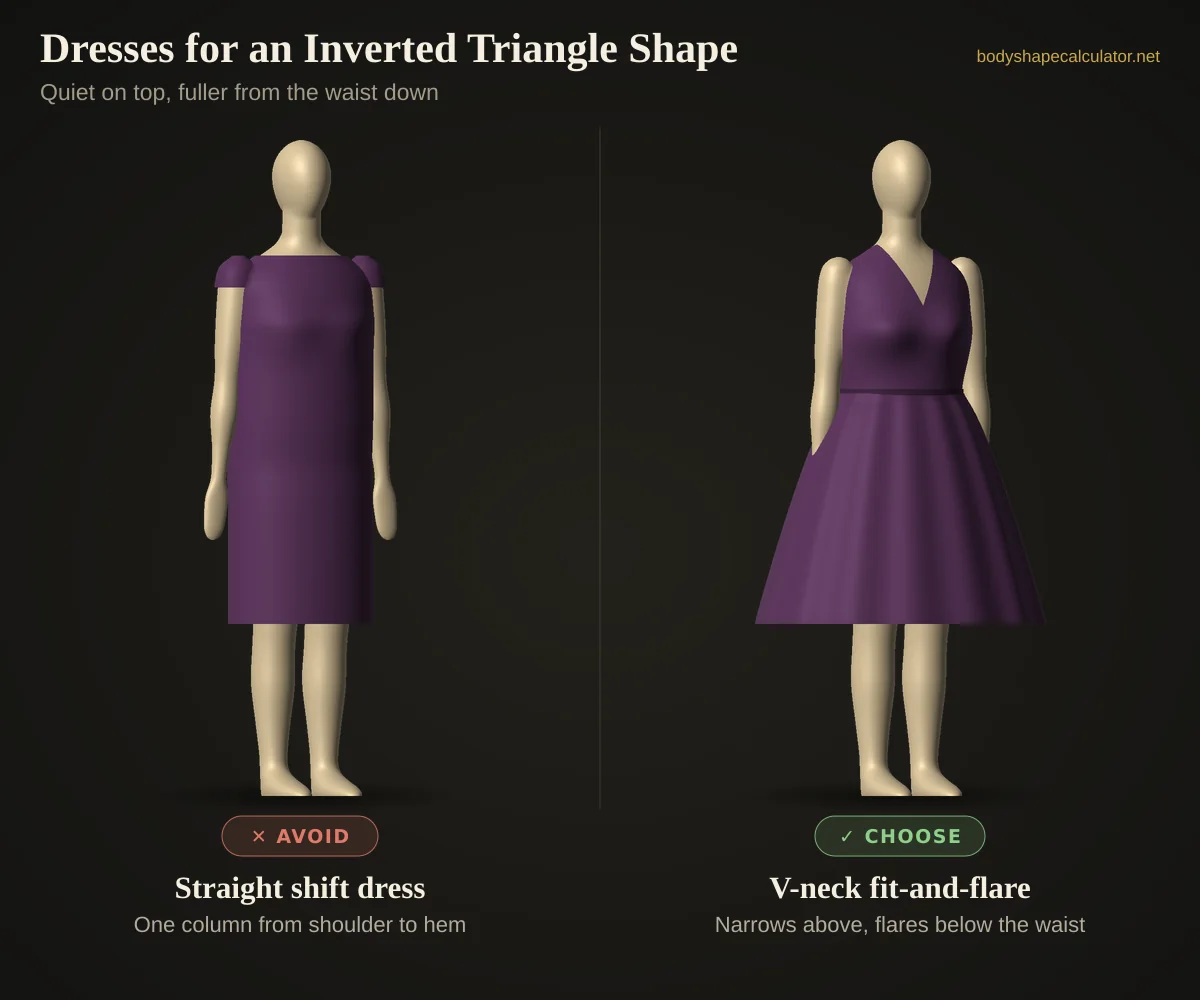
A fit-and-flare dress nips in at the waist and then flares outward, which gives the lower half of the silhouette real volume to work with against a broader shoulder line — the flare is doing the same balancing job that a full skirt or wide-leg trouser does elsewhere in this guide. An A-line dress with some movement in the skirt achieves something similar with a softer transition at the waist. A straight shift dress is the more difficult choice: it runs in one continuous line from shoulder to hem with no added volume below, so the shoulder stays the widest point of the whole silhouette.
Shorts
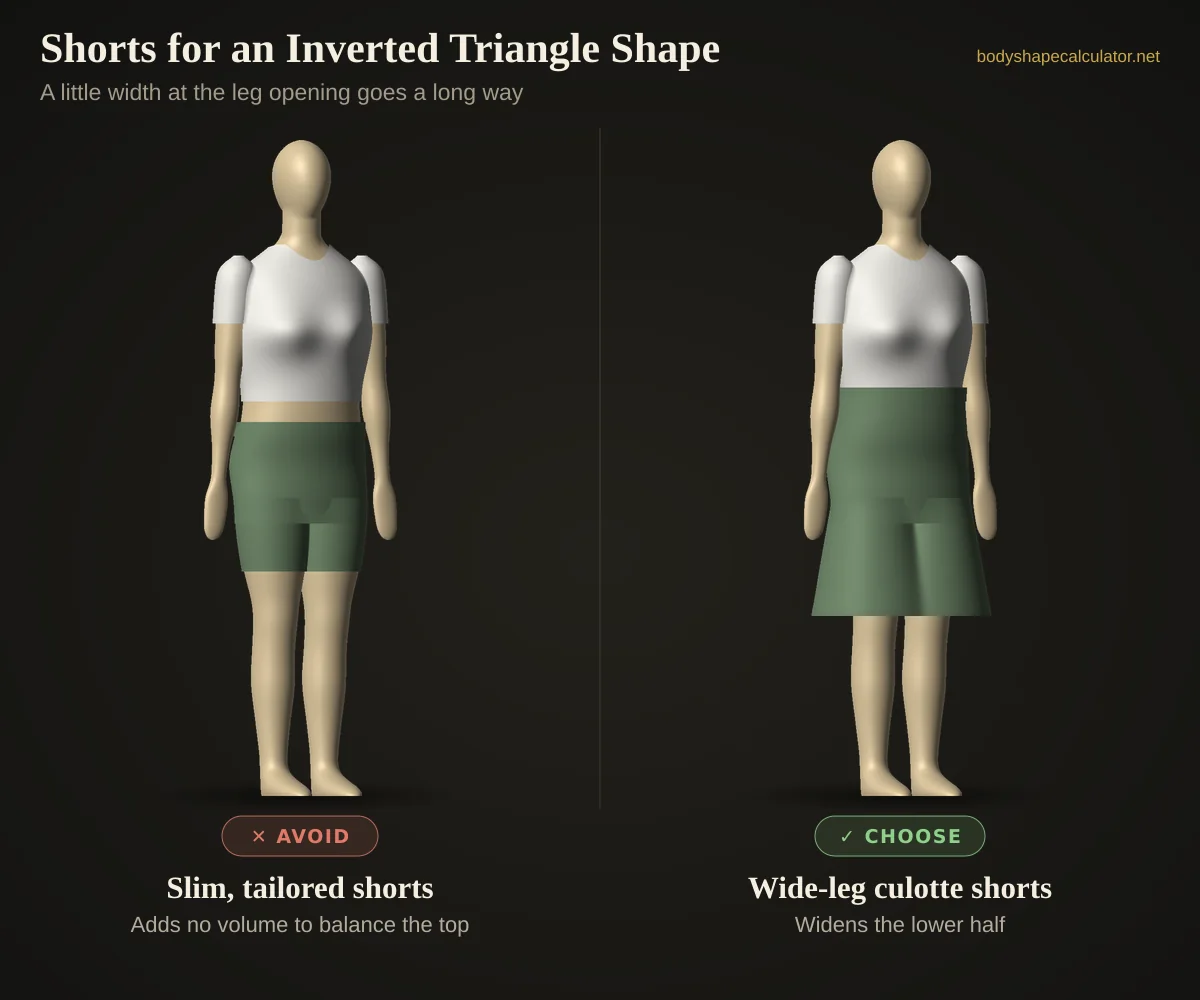
Wide-leg or culotte-style shorts extend the same balancing logic used elsewhere on this page into warm-weather dressing — a bit of flare and movement in the leg gives the lower body some visual weight rather than leaving it narrow underneath broader shoulders. A relaxed, slightly cropped wide leg keeps this practical for everyday wear. Slim, tailored shorts with a narrow leg are the harder choice: they keep the lower body streamlined and close-fitting, which does nothing to offset a shoulder line that’s usually already the widest point of the outfit.
Jumpsuits & Playsuits
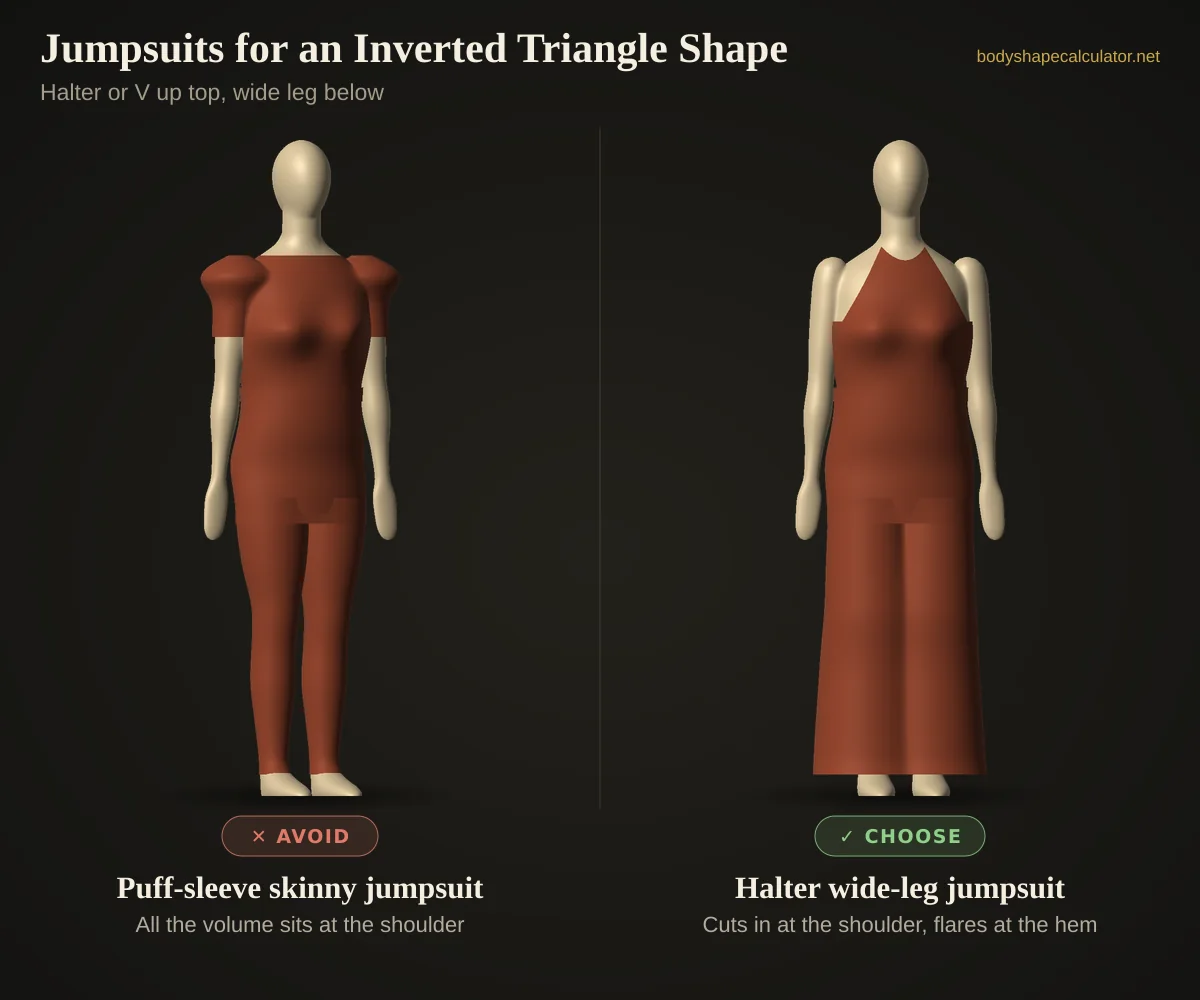
A halter neckline is one of the best tops this shape can wear: the straps cut in toward the neck and leave the shoulder point bare, which visually narrows it. On a jumpsuit, pair that with a wide leg and you get volume exactly where you need it. V-neck and wrap-front styles do the same job with more coverage. The combination to skip is puff sleeves or a boat neck on a skinny-leg jumpsuit — every bit of volume sits at the top.
Common Inverted Triangle Measurements by Size
The formula holds at every size — bust noticeably wider than hips, with a waist that stays fairly close to the bust:
| Frame | Bust | Waist | Hips |
|---|---|---|---|
| Petite | 36 in | 32 in | 32 in |
| Average | 40 in | 35 in | 36 in |
| Plus-size | 48 in | 43 in | 44 in |
In every row, the bust-to-hip gap is around 4 inches — enough to clear the 3.6-inch threshold — while the waist stays within about 5 inches of the bust, well under the 9-inch mark that would push the result into top hourglass instead.
Try the average row in the Body Visualizer: switch to inches, enter a 40 in bust, 35 in waist and 36 in hips, and the live analysis confirms the shape while you rotate the model.
Frequently Asked Questions
What is the exact formula for an inverted triangle body shape?
Bust at least 3.6 inches wider than the hips, with a bust-to-waist gap of under 9 inches. The first condition separates it from rectangle and pear; the second is what separates it from top hourglass, which has the same wider-bust pattern but a much more defined waist.
Inverted triangle vs top hourglass — which one am I?
Check the gap between your bust and your waist. Under 9 inches, you're an inverted triangle. Nine inches or more, you're a top hourglass. Both have a bust wider than the hips — waist definition is the whole difference.
Why does this shape show a high waist-to-hip ratio even with a normal waist?
Because WHR divides your waist by your hip measurement, a naturally narrow hip (which is part of what defines this shape) can push the ratio up even when your waist itself isn't especially large. WHR assumes fat distribution is the main variable; it doesn't account for frame width. Waist-to-height ratio, which skips the hip measurement entirely, is a more reliable second check if this applies to you.
Is inverted triangle common among athletes and swimmers?
Yes, particularly swimmers and anyone who trains the shoulders, lats and upper back heavily. Muscle development in that area widens the bust-to-hip gap without changing the hips at all, which can shift someone from rectangle toward inverted triangle over time. It also occurs naturally in people with broader shoulders or a fuller bust and narrower hip bones, with no training involved.
Does strength training make an inverted triangle shape more pronounced?
Upper-body training — shoulders, back, chest — can widen the visual bust-to-hip gap further. If the goal is more balance rather than more contrast, shifting training emphasis toward glutes and legs, alongside the same upper-body work, tends to even out the proportion over time without requiring less upper-body strength.
What's the most flattering swimsuit for an inverted triangle?
A patterned, ruffled or brighter-coloured bottom paired with a plain, darker scoop-neck or plunge top. The aim is the opposite of pear styling — shift visual weight down and keep the shoulder line as quiet as possible.
Most inverted-triangle styling advice online focuses entirely on "hiding" broad shoulders, which misses the more useful framing: the shoulder line isn't a problem to disguise, it's a fixed proportion to balance — and balance, unlike disguise, actually works with tailoring instead of against it.
This guide is for educational and styling purposes only. It does not diagnose any medical condition and isn't a substitute for advice from a qualified healthcare professional.