Quick answer: the average shoulder width is about 16.4 inches (41.6 cm) for men and 14.4 inches (36.5 cm) for women, measured bone to bone across the back. Measured across the deltoid muscles, the averages are about 20.1 in (51 cm) for men and 17.7 in (45 cm) for women.
Average Shoulder Width Chart
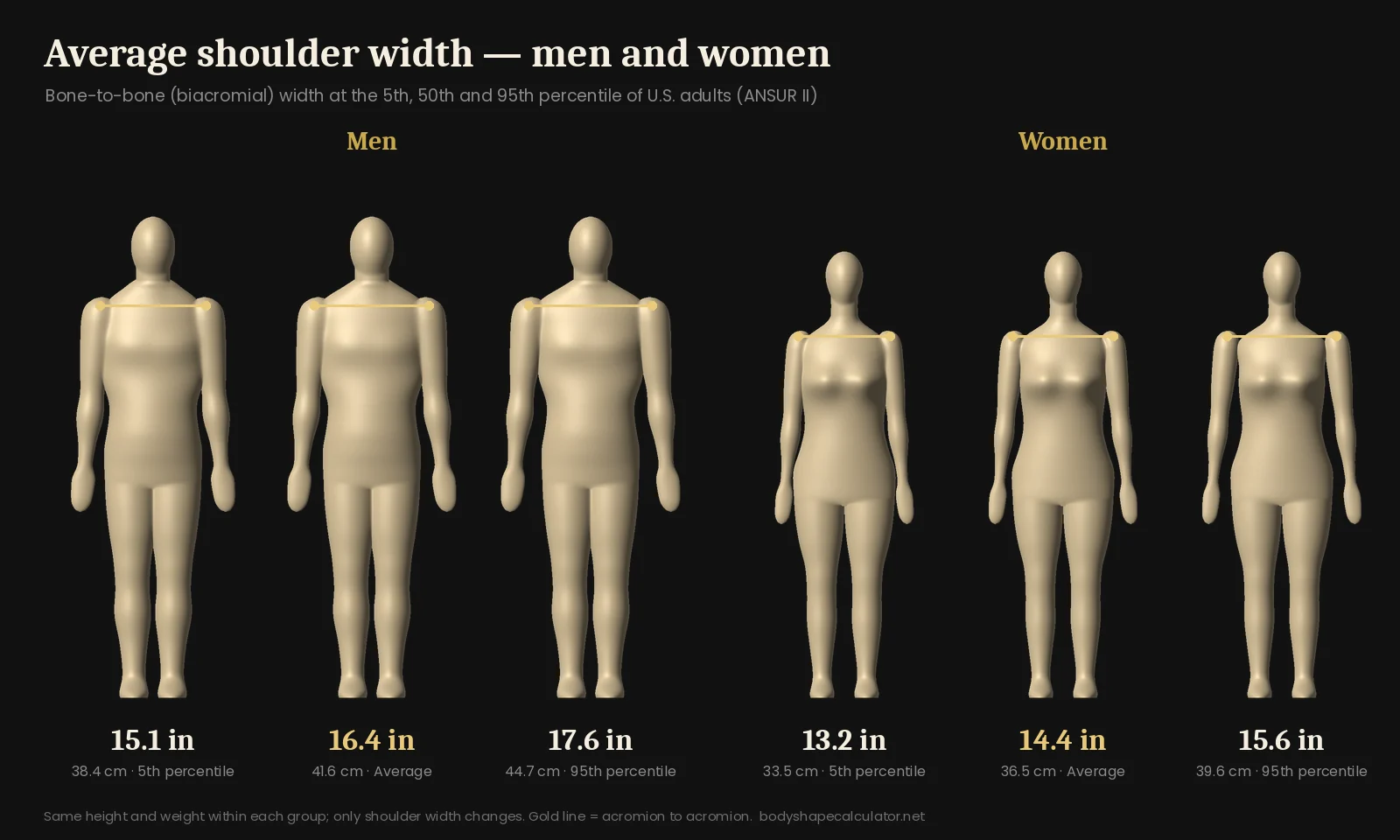
The figures below keep the same height and weight within each group and change only the shoulders, from the 5th percentile (narrower than 95% of people) to the 95th (wider than 95%). The difference between narrow and broad is only about 2.5 inches of bone, but it changes the whole outline of the upper body.
| Survey | Men | Women |
|---|---|---|
| ANSUR II, U.S. Army 2012 · bone to bone | 16.4 in (41.6 cm) | 14.4 in (36.5 cm) |
| ANSUR II, U.S. Army 2012 · across deltoids | 20.1 in (51.0 cm) | 17.7 in (45.0 cm) |
| NHANES III, U.S. adults 20+, 1988–94 · bone to bone | 16.1 in (41.1 cm) | 14.4 in (36.7 cm) |
| U.S. Health Examination Survey, 1960–62 · bone to bone | 15.6 in (39.6 cm) | 13.9 in (35.3 cm) |
The Army survey is the newest large data set and the only recent one that also gives the deltoid width. Soldiers are younger and fitter than average, which matters most for the deltoid number. The bone-to-bone width barely depends on fitness, and the civilian NHANES figures are within half an inch of it.
Average Shoulder Width for Men
The average man’s shoulders measure about 16.4 inches (41.6 cm) from one shoulder tip to the other, and about 20.1 inches (51 cm) across the deltoids. The middle half of men fall between about 15.9 and 16.9 inches bone to bone.
| Percentile | Bone to bone | Across deltoids |
|---|---|---|
| 5th | 15.1 in (38.4 cm) | 18.1 in (45.9 cm) |
| 10th | 15.4 in (39.2 cm) | 18.4 in (46.8 cm) |
| 25th | 15.9 in (40.3 cm) | 19.3 in (48.9 cm) |
| 50th (median) | 16.3 in (41.5 cm) | 20.0 in (50.9 cm) |
| 75th | 16.9 in (42.8 cm) | 20.9 in (53.1 cm) |
| 90th | 17.3 in (44.0 cm) | 21.7 in (55.2 cm) |
| 95th | 17.6 in (44.7 cm) | 22.3 in (56.7 cm) |
Bone-to-bone width is mostly set by the length of your collarbones, so it follows your frame. The deltoid width also depends on muscle and body fat, which is why it spreads out more: the gap between the 5th and 95th percentile is about 4.3 inches across the deltoids but only 2.5 inches bone to bone.
Average Shoulder Width for Women
The average woman’s shoulders measure about 14.4 inches (36.5 cm) bone to bone and about 17.7 inches (45 cm) across the deltoids. The middle half of women fall between about 13.9 and 14.8 inches bone to bone.
| Percentile | Bone to bone | Across deltoids |
|---|---|---|
| 5th | 13.2 in (33.5 cm) | 16.0 in (40.6 cm) |
| 10th | 13.4 in (34.1 cm) | 16.3 in (41.4 cm) |
| 25th | 13.9 in (35.3 cm) | 17.0 in (43.1 cm) |
| 50th (median) | 14.4 in (36.5 cm) | 17.7 in (45.0 cm) |
| 75th | 14.8 in (37.7 cm) | 18.5 in (46.9 cm) |
| 90th | 15.3 in (38.9 cm) | 19.1 in (48.6 cm) |
| 95th | 15.6 in (39.6 cm) | 19.6 in (49.9 cm) |
Women’s shoulders are on average about 2 inches narrower than men’s bone to bone, while hip widths differ far less. That is why shoulders wider than the hips are typical for men but stand out on women. Broad shoulders over narrower hips are the defining feature of the inverted triangle body shape; shoulders and hips of similar width with a defined waist point to an hourglass.
Average Shoulder Width by Height
Taller people tend to have wider shoulders, but height explains only part of the difference. The tables show the typical (average) shoulder width at each height, estimated from the ANSUR II averages, spreads and height correlations. Use them to judge your shoulders against people your own size; the calculator above does this for any height.
| Height | Bone to bone | Deltoids |
|---|---|---|
| 5 ft 2 in (157 cm) | 15.3 in | 19.0 in |
| 5 ft 4 in (163 cm) | 15.6 in | 19.3 in |
| 5 ft 6 in (168 cm) | 15.9 in | 19.6 in |
| 5 ft 8 in (173 cm) | 16.2 in | 19.9 in |
| 5 ft 10 in (178 cm) | 16.5 in | 20.2 in |
| 6 ft 0 in (183 cm) | 16.8 in | 20.5 in |
| 6 ft 2 in (188 cm) | 17.1 in | 20.8 in |
| 6 ft 4 in (193 cm) | 17.4 in | 21.1 in |
| Height | Bone to bone | Deltoids |
|---|---|---|
| 4 ft 10 in (147 cm) | 13.4 in | 16.9 in |
| 5 ft 0 in (152 cm) | 13.7 in | 17.1 in |
| 5 ft 2 in (157 cm) | 14.0 in | 17.4 in |
| 5 ft 4 in (163 cm) | 14.3 in | 17.7 in |
| 5 ft 6 in (168 cm) | 14.7 in | 18.0 in |
| 5 ft 8 in (173 cm) | 15.0 in | 18.2 in |
| 5 ft 10 in (178 cm) | 15.3 in | 18.5 in |
| 6 ft 0 in (183 cm) | 15.6 in | 18.8 in |
Estimates are averages, not limits. At any height, about half of people measure more than the number shown and half less. The women’s table uses the men’s height correlation because the survey summary does not publish it for women.
Biacromial vs. Bideltoid: Two Kinds of Shoulder Width
Biacromial width (bone to bone) is the straight distance between the two acromions, the bony points at the outer tip of each shoulder. It reflects your skeleton and hardly changes with weight or training. Doctors, researchers and most “average shoulder width” figures use this measurement.
Bideltoid width (shoulder breadth) is the widest distance across the deltoid muscles, with your arms relaxed at your sides. It is what you see in the mirror and what decides whether a shirt or a car seat feels tight. It is about 23% larger than the bone-to-bone width, roughly 3.7 inches more for men and 3.3 inches more for women, and it rises with muscle and body fat.
Tailors use a third number: the jacket shoulder, measured from one shoulder seam to the other across the back. It usually falls between the two. Because these numbers differ so much, always check which one a chart or size guide means before comparing.
How to Measure Shoulder Width
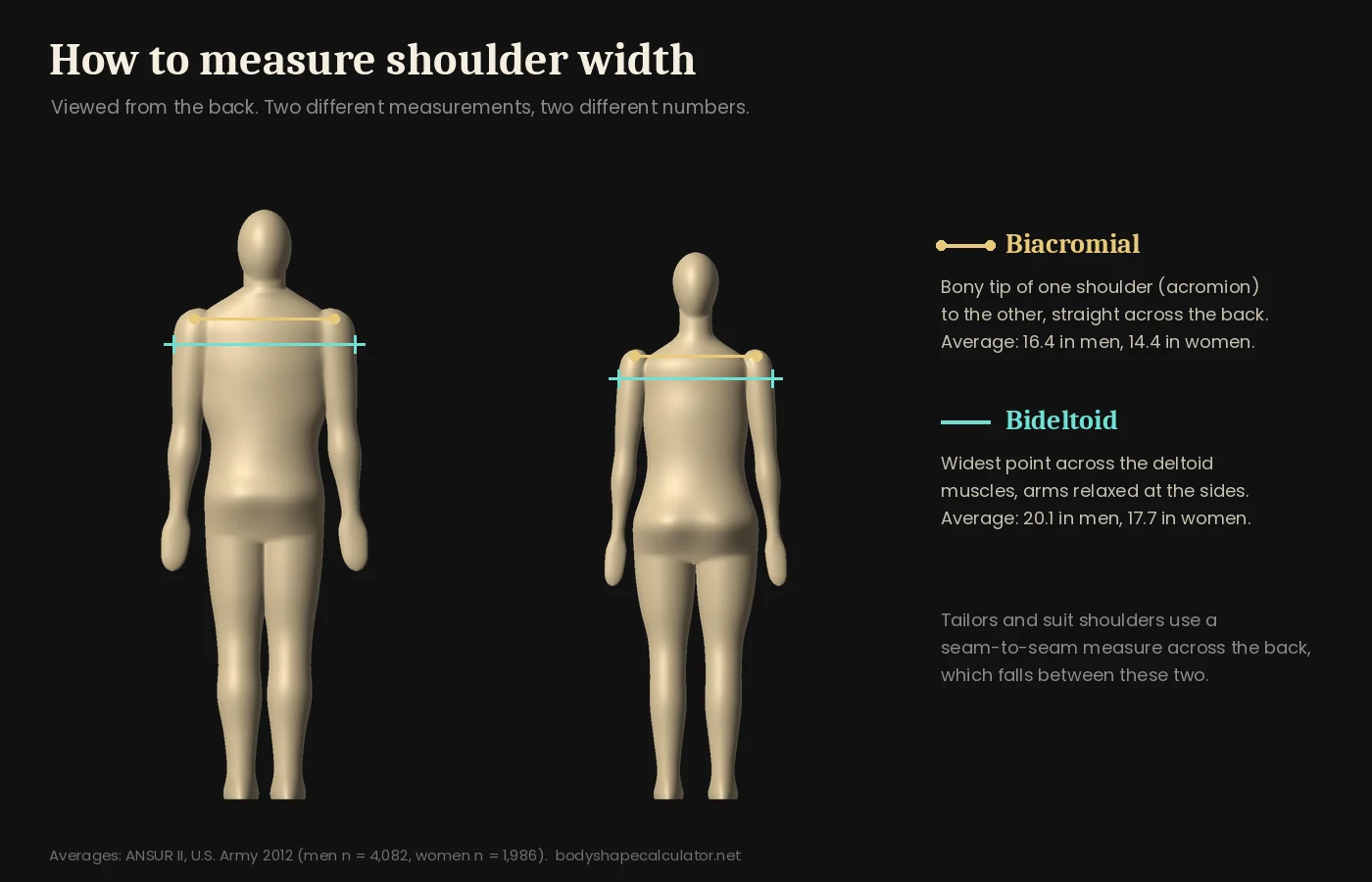
- Find the shoulder tips. Stand straight with arms relaxed. Feel along the top of each shoulder for the bony point at the outer end (the acromion). That is where the measurement starts and ends.
- Measure straight across the back. Have a helper run a tape measure from one shoulder tip to the other across your upper back, keeping it straight, not following the curve of the neck. This is your bone-to-bone (biacromial) width.
- Measuring alone? Use a wall. Stand with your back to a wall, mark the wall just above each shoulder tip with a pencil, step away and measure between the two marks.
- Measure across the deltoids (optional). For the bideltoid width, measure across the widest part of the shoulder muscles, about 2 inches below the shoulder tips, with arms hanging at your sides.
- Enter the number in the calculator. Choose the measurement type you took, add your height, and the calculator shows your percentile overall and for your height.
Wear a thin T-shirt or nothing on top, stand relaxed rather than pulling your shoulders back, and measure twice. For a full set of measurements, see our body measurements guide.
Are Your Shoulders Broad? Common Sizes Explained
“Broad” only means something compared with other people, and the answer depends on which width you measured. Here is where common measurements fall for U.S. adults.
| Measurement | Men | Women |
|---|---|---|
| 14 in bone to bone | Below the 1st percentile | 31st percentile · average |
| 15 in bone to bone | 3rd percentile · narrow | 81st percentile · broad |
| 16 in bone to bone | 31st percentile · average | 99th percentile · very broad |
| 17 in bone to bone | 80th percentile · broad | Above the 99th percentile |
| 17 in across deltoids | 1st percentile · narrow | 26th percentile · average |
| 18 in across deltoids | 5th percentile · narrow | 60th percentile · average |
| 19 in across deltoids | 20th percentile · slightly narrow | 88th percentile · broad |
| 20 in across deltoids | 48th percentile · average | 98th percentile · very broad |
| 22 in across deltoids | 93rd percentile · very broad | Above the 99th percentile |
How wide shoulders look also depends on the waist below them. A man with average shoulders and a slim waist often looks broader than a man with wide shoulders and a thick waist. Our body proportions calculator compares your shoulders, chest, waist and hips, and the male body type calculator tells you whether your build reads as a trapezoid, inverted triangle or rectangle.
What Decides Shoulder Width, and Can You Make It Wider?
Bones set the base. The length of your collarbones decides the bone-to-bone width. It is largely inherited, and in boys it is pushed up by testosterone during puberty. The inner end of the collarbone is one of the last growth plates in the body to close, usually in the early to mid 20s. After that, the bone-to-bone width stays the same.
Muscle adds the rest. The deltoids sit on the outside of the shoulder joint, so building them, especially the side (lateral) deltoids, adds directly to the across-deltoid width. Lateral raises, overhead presses and upright rows work the side delts; pull-ups and rows build the upper back that frames them.
A smaller waist makes shoulders look wider. Lowering body fat around the middle sharpens the V shape even if your shoulders do not change. See where you stand on the body fat percentage chart, or try different shoulder and waist sizes in the 3D body visualizer.
Shoulder Width and Frame Size
Wide shoulders often go with a larger skeletal frame, but not always. Frame size is usually judged from the wrist or elbow, which are bony and carry little fat or muscle. If you want to know whether you have a small, medium or large frame, use the body frame size calculator; shoulder width adds a second, independent check.
Shoulder Width FAQ
What is the average shoulder width for a man?
The average shoulder width for a man is about 16.4 inches (41.6 cm) measured bone to bone (biacromial), based on the U.S. Army ANSUR II survey of 4,082 men. U.S. civilian data from NHANES III gave a similar 16.1 inches (41.1 cm). Measured across the deltoid muscles (bideltoid), the average is about 20.1 inches (51 cm).
What is the average shoulder width for a woman?
The average shoulder width for a woman is about 14.4 inches (36.5 cm) bone to bone, from the ANSUR II survey of 1,986 women; U.S. civilian data gave 14.4 inches (36.7 cm). Across the deltoids, the average is about 17.7 inches (45 cm).
How do you measure shoulder width?
Find the bony point at the outer tip of each shoulder (the acromion), where the collarbone meets the shoulder blade. Have someone measure straight across your back between those two points with a tape measure. That is the biacromial width. For the bideltoid width, measure across the widest part of the shoulder muscles with your arms relaxed at your sides.
Are 18-inch shoulders broad?
It depends on what you measured. Bone to bone, 18 inches is very broad: wider than about 98% of men. Across the deltoids, 18 inches is narrow for a man (about the 5th percentile) and about average for a woman (about the 60th percentile).
Are 20-inch shoulders good for a man?
Measured across the deltoids, 20 inches is almost exactly average for a man (about the 48th percentile). 21 inches is above average (about the 76th percentile) and 22 inches is broad (about the 93rd percentile).
Is 45 cm shoulder width broad?
Bone to bone, 45 cm is very broad for a man, wider than about 96% of men. Across the deltoids, 45 cm is narrow for a man but exactly average for a woman.
Does shoulder width depend on height?
Yes, but only partly. Taller people tend to have wider shoulders, gaining roughly 0.15 cm of bone-to-bone width per centimeter of height (about 0.3 inches per 2 inches of height). Many people of the same height still differ by an inch or more.
Can you make your shoulders wider?
You cannot widen the bone-to-bone width after your collarbones stop growing, usually by the early to mid 20s. You can widen the width across the deltoids by building the side (lateral) deltoids and upper back, and you can make shoulders look wider by lowering body fat around the waist.
Why are men’s shoulders wider than women’s?
Testosterone during puberty lengthens the collarbones and widens the shoulder girdle in boys, while estrogen widens the pelvis in girls. On average, men’s shoulders end up about 2 inches (5 cm) wider bone to bone, while hip widths are much closer.
Sources
- Gordon CC, Blackwell CL, Bradtmiller B, et al. 2012 Anthropometric Survey of U.S. Army Personnel: Methods and Summary Statistics (ANSUR II). U.S. Army Natick Soldier RD&E Center, Technical Report NATICK/TR-15/007, 2014.
- National Center for Health Statistics. Third National Health and Nutrition Examination Survey (NHANES III), 1988–1994: anthropometric reference data for adults.
- National Center for Health Statistics. Skinfolds, body girths, biacromial diameter, and selected anthropometric indices of adults, United States 1960–62. Vital and Health Statistics, Series 11, No. 35, 1970.
- The Ergonomics Center of North Carolina. Anthropometric Summary Data Tables (from ANSUR II), 2017.
Percentiles for the 10th and 90th and all calculator results assume a normal distribution fitted to the published means and spreads. Height tables are statistical estimates. This page is for general information.